Panasonic Tests 10 kW Hydrogen Fuel Cell and Heat Pump Integration at Finland Demonstration Site
The Jyväskylä pilot evaluates whether a combined 10 kW fuel cell and 9 kW heat pump can sustain a building entirely on stored summer solar hydrogen during months of Arctic darkness.
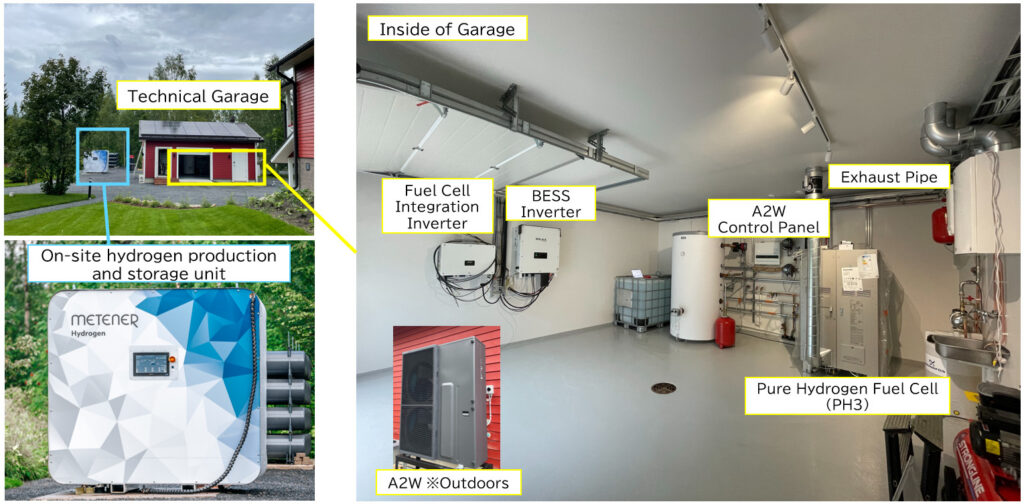
A residential-scale hydrogen energy system combining a 10-kilowatt fuel cell with an air-to-water heat pump is now operational in Jyväskylä, central Finland, as Panasonic pushes to prove that pure hydrogen can reliably power and heat buildings through extreme northern winters where solar generation collapses for months.
The deployment at the Hydrogen House, managed by the Central Finland Mobility Foundation (Cefmof), represents a deliberate stress test. Unlike pilot projects in temperate climates, the Finnish site forces the equipment to handle sub-zero temperatures and prolonged darkness. The region receives fewer than six hours of daylight during peak winter, rendering photovoltaic arrays insufficient as a standalone power source from November through February.
Rather than relying on grid electricity or natural gas during those dark months, the facility uses a closed-loop architecture. A rooftop solar array powers an electrolyzer during summer and shoulder seasons to produce green hydrogen. That hydrogen is compressed into underground storage tanks holding up to 90 kilograms and piped throughout the property. When solar output drops, Panasonic’s Pure Hydrogen Fuel Cell converts the stored gas back into electricity to run the building and feed its Aquarea air-to-water heat pump, which delivers 9 kilowatts of thermal output for space heating and domestic hot water.
This integration addresses a persistent engineering challenge in decarbonized heating. Air-to-water heat pumps are highly efficient but consume significant electricity. In regions without abundant winter solar or wind resources, running them typically requires drawing heavily from carbon-intensive grids. By pairing the heat pump with a fuel cell that recovers waste heat during power generation, the system attempts to maximize total energy yield from every kilogram of stored hydrogen. Panasonic’s H2 Kibou fuel cell platform, introduced in 2021, achieves roughly 56% electrical efficiency on its own, but capturing the thermal byproduct pushes overall system efficiency toward 95%.
The Jyväskylä house routes hydrogen beyond mechanical systems. The gas directly fuels a fireplace, oven, grill, and sauna, demonstrating how a single microgrid can serve both high-demand thermal appliances and precision electrical loads simultaneously.
Europe has lagged behind Asia in deploying stationary hydrogen fuel cells for buildings. Japan’s Ene-Farm program has installed hundreds of thousands of residential fuel cells since 2009, though the vast majority run on reformed natural gas rather than pure hydrogen. Panasonic is attempting to bridge that gap by exporting its pure-hydrogen configurations westward. In 2022, the company commissioned a 495-kilowatt demonstration at its Kusatsu factory in Japan using 99 H2 Kibou units paired with 570 kilowatts of solar and 1.1 megawatt-hours of battery storage. A scaled-down version followed at its microwave oven plant in Cardiff, Wales, utilizing 21 generators alongside 372 kilowatts of solar capacity and 1 megawatt-hour of batteries.
The Welsh deployment proved the hardware could operate under European grid codes and safety standards, but it did not replicate the severe climatic constraints of Scandinavia. The Finnish project isolates weather resilience as the primary variable, providing data on whether polymer electrolyte membrane fuel cells and ambient-air heat pumps can maintain performance when outside temperatures routinely drop below minus 20 degrees Celsius.
Panasonic has steadily adapted its heating hardware for these conditions. The Aquarea line, sold in Europe since 2008, has shifted toward propane (R290) refrigerant models to comply with tightening EU regulations on fluorinated greenhouse gases. The current L series units deliver between 5 and 8 kilowatts of heating capacity, generate water temperatures up to 75 degrees Celsius, and feature smart-grid inverters designed to communicate directly with rooftop solar arrays and battery management systems.
In July 2025, the manufacturer expanded that R290 lineup with the Aquarea DHW Heat Pump, a dedicated domestic hot water unit available in wall-mounted and floor-standing formats, engineered specifically to extract thermal energy from ambient air even in cold climates.