The $600 Billion Resurrection: How Larry Culp Reengineered General Electric
How a 'lean' manufacturing philosophy saved an American icon and created $600 billion in shareholder value.
When Larry Culp assumed leadership of General Electric in 2018, the storied American conglomerate was a shadow of its former self. The industrial giant that once defined American innovation under Jack Welch was suffocating under $150 billion in debt, its market valuation having plummeted 80% from its turn-of-the-century peak. Today, that narrative has been entirely rewritten through a radical three-way split that has created nearly $600 billion in new shareholder value.
The transformation culminated in April 2024 with the final separation of GE Vernova, the energy franchise, and GE Aerospace, the aviation crown jewel where Culp remains CEO. This followed the early 2023 spinoff of GE HealthCare. Collectively, the three entities are now valued at approximately $689 billion, a staggering leap from the $96 billion market cap Culp inherited. Since his arrival, the trio has delivered annualized returns of roughly 30%, doubling the performance of the S&P 500 over the same period.
Culp’s strategy centered on dismantling the very conglomerate model that competitors once emulated. For decades, GE operated as a sprawling, capital-intensive maze where diverse businesses were managed through a centralized bureaucracy. Culp pivoted toward extreme decentralization and a relentless focus on the factory floor, a philosophy he refined decades ago while studying the Toyota Production System in Japan.
At the heart of this cultural reboot was the concept of “kaizen”—a Japanese term for continuous improvement. Culp replaced what he called “success theater”—a corporate culture where managers only reported good news—with a mandate to “embrace red.” In the lean manufacturing lexicon, “red” signifies a bottleneck or a failing metric that requires immediate attention. By breaking the company into smaller, autonomous units, Culp forced executives to confront discrete profit-and-loss statements rather than hiding behind consolidated figures.
The results are most visible at GE Aerospace, which now commands a 55% share of the global commercial jet engine market. The company’s LEAP engine, produced through a long-standing joint venture with Safran of France, is the exclusive power plant for the Boeing 737 Max and a primary option for the Airbus A320neo family. This dominance extends to wide-body aircraft, where the GEnx engine holds a 70% win rate on the Boeing 787 Dreamliner.
GE Aerospace operates on a highly profitable “razor and blade” business model. While new engine sales are vital, the real margins lie in the aftermarket services—overhauls, maintenance, and spare parts—which accounted for 70% of the company’s $45.9 billion revenue in 2025. With an installed base of 50,000 commercial engines and a backlog worth $211 billion, the company is essentially a service business with a massive, multi-year pipeline of guaranteed work.
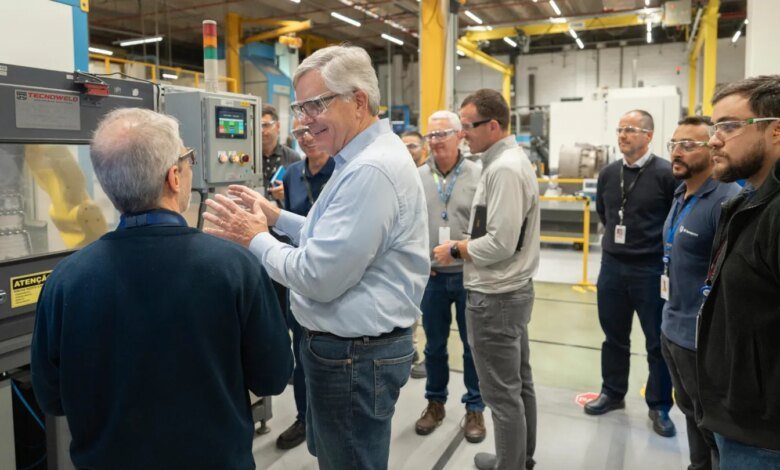
The turnaround was not without significant pain. Culp eliminated roughly three-quarters of GE’s central corporate positions, which once numbered 26,000, and shuttered the iconic Crotonville executive training campus. These moves signaled the end of the era where GE was viewed as a “school for CEOs,” shifting the focus back to industrial execution. This lean approach was tested at facilities like Plant One in Lynn, Massachusetts, where Culp revived a struggling complex that manufactures engines for Black Hawk helicopters and F-16 fighters by implementing rigorous, data-driven workflows.
While GE Aerospace remains the primary engine of growth, the other spinoffs have found their own momentum. GE Vernova has benefited from a global surge in energy demand, particularly from AI-driven data centers, while GE HealthCare continues to leverage its massive installed base of 5 million medical devices.
Looking ahead, Culp is betting on the RISE program, a revolutionary “open fan” engine architecture designed to drastically reduce fuel consumption and carbon emissions. Though the technology may not enter service for another decade, it represents the next chapter in Culp’s effort to ensure GE remains at the forefront of aviation. For a company that once teetered on the edge of Chapter 11 bankruptcy, the focus has shifted from survival to the next generation of flight.