Home Invasions Surge as Crypto ‘Wrench Attacks’ Reach Record Highs, with France at the Epicenter
Physical home invasions and kidnappings target digital asset holders as criminals bypass on-chain security.
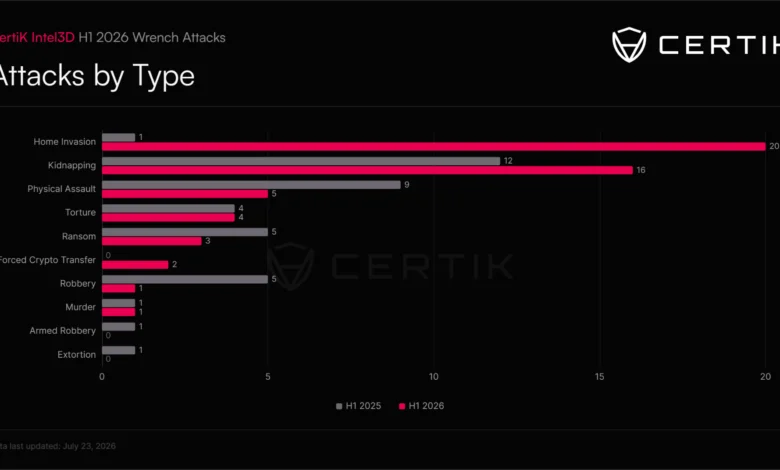
Physical home invasions targeting cryptocurrency holders have emerged as the most prevalent form of physical coercion, skyrocketing to 20 verified incidents in the first half of 2026 from just a single case during the same period last year, according to data from blockchain security firm CertiK.
In a report released on Thursday, the cybersecurity firm documented 52 global “wrench attacks”—a term used to describe physical violence or threats aimed at stealing digital assets—during the first six months of 2026. This represents a 33.3% increase from the 39 incidents verified in the first half of 2025. While kidnappings rose from 12 to 16, traditional physical robberies dropped from five to one.
The financial impact of these physical confrontations has grown exponentially. CertiK tracked approximately $124.1 million in financial exposure tied to these attacks in the first half of 2026, compared to just $10.5 million in the prior year’s corresponding period. This total includes successful thefts, ransom demands, forced transactions, as well as assets that were subsequently frozen or recovered.
The shift toward home invasions indicates that criminals are adapting to robust digital security protocols by targeting the human element, using physical intimidation against investors and their families to bypass cryptographic defenses. This trend poses a fundamental challenge to the traditional crypto ethos of self-custody, which encourages users to hold their own private keys and act as their own banks, often without the physical security infrastructure of traditional financial institutions.
Geographically, Europe was the primary theater for these crimes, accounting for 39 of the 52 verified incidents. France emerged as the global epicenter, with 33 recorded cases—representing nearly two-thirds of the worldwide total. CertiK noted that its figures rely on a conservative methodology that only includes publicly reported incidents that the firm could independently verify.
The severity of the situation in France is underscored by official government statistics. On July 2, French Interior Minister Laurent Nuñez revealed that law enforcement agencies had registered 77 cases of cryptocurrency-related kidnappings, extortions, or attempted extortions in the first half of 2026 alone. This figure significantly surpasses the 45 total cases recorded throughout the entirety of 2025.
According to CertiK, France’s high concentration of attacks may be linked to its highly visible cryptocurrency ecosystem, coupled with historical data breaches that have exposed the physical addresses and identities of wealthy digital asset holders. For context, major security breaches in the past, such as the massive leak of customer data from French hardware wallet manufacturer Ledger, have previously exposed thousands of users’ physical locations, making them potential targets for real-world criminals.
To combat this violent trend, French law enforcement has established a specialized prevention platform alongside an emergency rapid-alert system designed for both individual investors and industry professionals. Minister Nuñez stated that these proactive measures have already led to the arrest of 200 suspects.
The rise of physical violence presents a serious challenge to traditional self-custody practices, which often assume that digital security is sufficient. To mitigate these physical risks, CertiK advises investors to implement advanced security frameworks. These include multi-signature wallets and multi-party computation (MPC) protocols, which distribute signing authority across multiple parties. The firm also recommends establishing withdrawal delays, daily transaction limits, and utilizing geographically dispersed keyholders to ensure that a single individual under physical duress cannot immediately transfer all of their assets.