Trump Administration Pivots from Traditional Foreign Aid to Private Investment Doctrine
At a UN forum in New York, U.S. officials pitch a market-driven 'Trade Over Aid' model to replace taxpayer-funded development programs.
NEW YORK — The Trump administration is executing a sweeping realignment of American foreign policy, seeking to replace decades of traditional, taxpayer-funded assistance with a model centered on private investment, bilateral trade, and commercial partnerships.
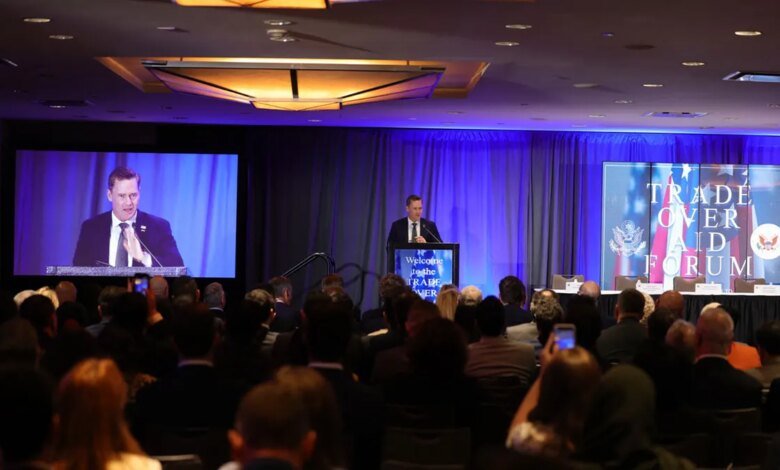
The strategy was on full display at a “Trade Over Aid” forum hosted by the U.S. Mission to the United Nations in New York. The two-day event, held on July 13 and 14, 2026, served as the administration’s clearest blueprint yet for dismantling the post-World War II development paradigm in favor of an “America First” approach to global engagement.
“We are completely reforming how we do aid,” Ambassador Mike Waltz, the U.S. permanent representative to the United Nations, said in an exclusive interview. Waltz argued that traditional development programs have historically yielded poor returns for both American taxpayers and recipient nations. “For too many years, the United States and other countries have poured billions and billions of dollars into these aid programs and got very little in return,” he said. “You go to these forums at the United Nations and at development agencies around the world, and you never find the private sector. You find NGOs and academics and governments, but you don’t find the creators of growth and the creators of jobs.”
Ambassador Mike Waltz speaks at the U.S. Mission to the United Nations’ “Trade Over Aid” forum in New York, where Trump administration officials pitched private investment as a new engine of global development. July 14, 2026. (Donald Conahan/ U.S. mission to the U.N.)
A Structural Overhaul of Foreign Assistance
The “Trade Over Aid” doctrine follows a major institutional shakeup. In 2025, the Trump administration moved to dismantle the U.S. Agency for International Development (USAID), folding its functions directly into the State Department. USAID, which was established in 1961 by President John F. Kennedy to centralize U.S. civilian foreign aid, had long been criticized by conservative policymakers as inefficient and ideologically disconnected from core U.S. strategic interests.
When asked whether the new initiative is a direct replacement for the defunct agency, Waltz emphasized that the restructuring was designed to ensure that foreign assistance directly serves U.S. geopolitical objectives. “What we’re doing, this isn’t about USAID or what replaces it,” Waltz said. “That was an efficient effort to get our aid to serve our foreign policy, not the other way around. But what I think is more important is how do we help American businesses and how do [we] help create jobs around the world and reduce dependency.”
The administrative consolidation reflects a broader effort to reduce open-ended taxpayer commitments while leveraging the scale of Wall Street and multinational corporations. The forum drew representatives from dozens of countries, United Nations agencies, international financial institutions, and corporate giants, including Microsoft, Google, JPMorgan, Goldman Sachs, Boeing, Walmart, Mastercard, and Meta.
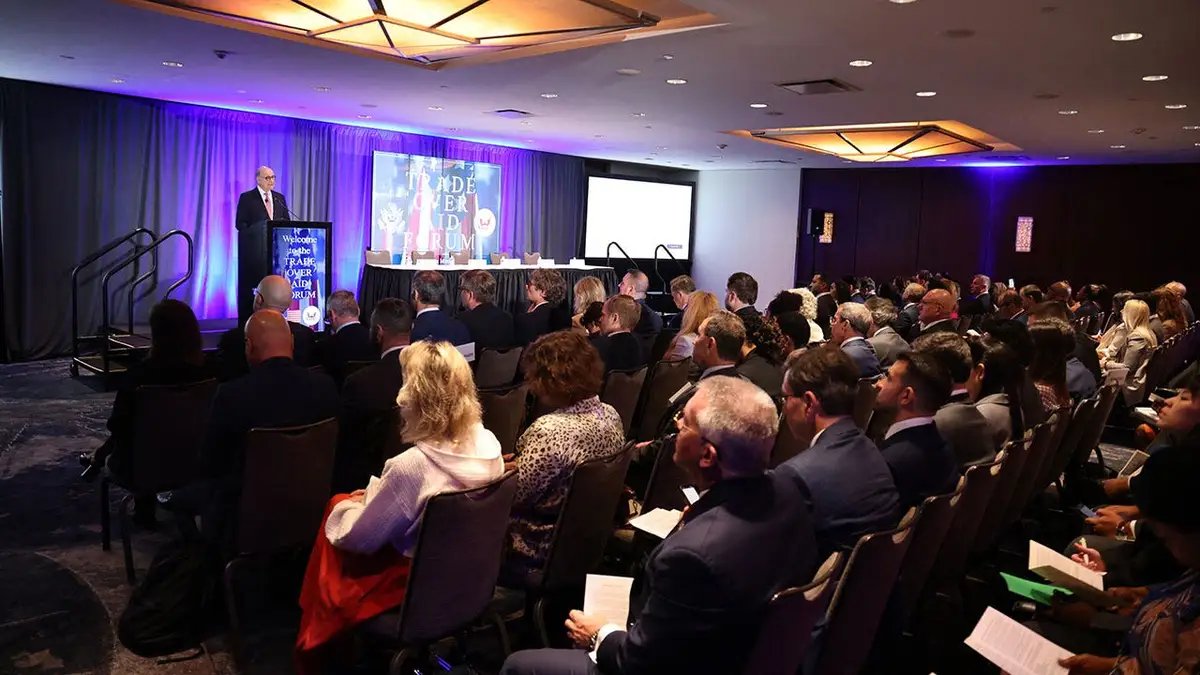
Ambassador Dan Negrea addresses the U.S. Mission to the United Nations’ “Trade Over Aid” forum in New York, July 13, 2026. (Donald Conahan/ U.S. mission to the U.N.)
Navigating Risk in Fragile Markets
A primary challenge of the private-sector-led model is attracting commercial capital to fragile states characterized by weak rule of law, systemic corruption, or ongoing conflict—regions where traditional aid has historically filled the gap.
To address this, Waltz pointed to the role of institutions like the World Bank and the U.S. International Development Finance Corporation (DFC). The DFC, originally created in 2019 to mobilize private capital for development projects, can provide the critical risk insurance and financial guarantees needed to de-risk investments in volatile markets.
“When we talk to organizations like J.P. Morgan, Goldman Sachs and others, they’re saying, we want to invest hundreds of millions into these industries abroad, but they need better laws, they need better arbitration,” Waltz said. “We need to know that we can get our money out for our investors here in the United States.”
This framework is particularly vital for securing supply chains for critical minerals required by the U.S. technology and defense sectors. “It is incredibly risky,” Waltz acknowledged. “Sometimes these capital providers like on Wall Street and in New York are only going to go to the safest place. Sometimes it makes sense, for example, as we’re looking for critical minerals for our tech industry, to go into risky places, but they need a little help.”
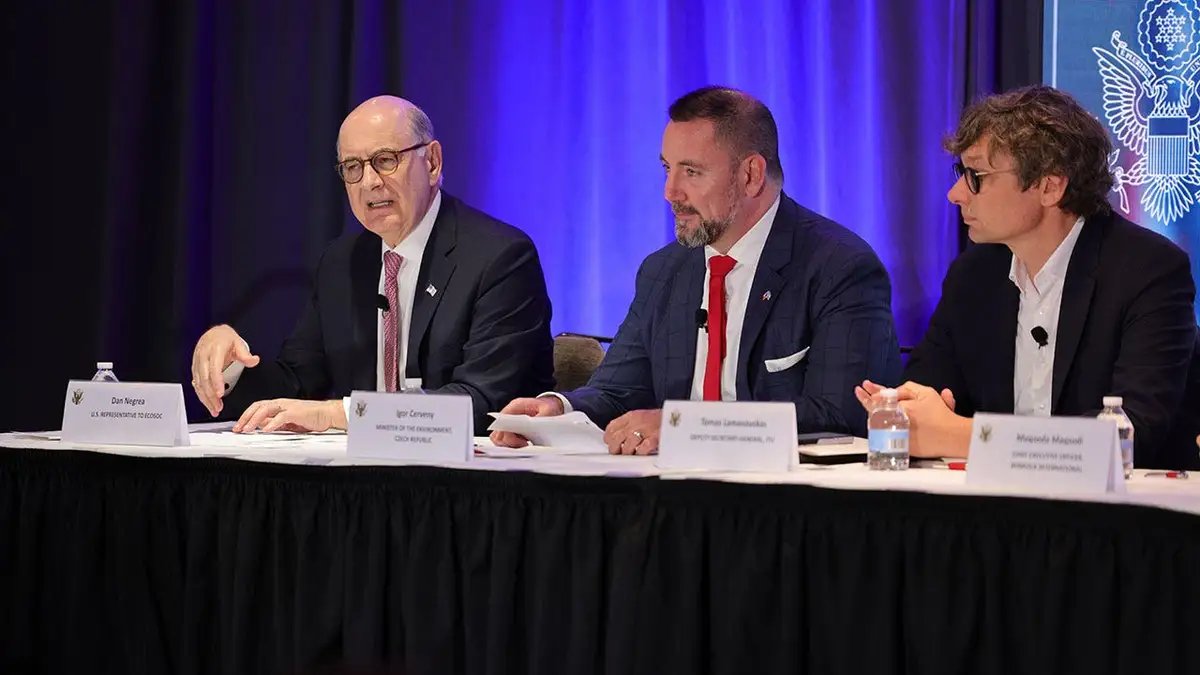
Ambassador Dan Negrea moderates a panel at the U.S. Mission to the United Nations’ “Trade Over Aid” forum in New York, joined by Czech Environment Minister Igor Cerveny and other participants. (Donald Conahan/ U.S. mission to the U.N.)
Divergent Perspectives on the Transition
Ambassador Dan Negrea, who is spearheading the initiative within the U.S. Mission, argued that shrinking aid budgets globally make a market-driven approach inevitable. “We need to think differently about how we help developing countries in an environment in which, in the United States, we are indebted and we cannot continue to spend money on helping other countries the way we used to,” Negrea said. “Development aid is going down not only in the U.S., but in countries around the world.”
According to Negrea, the pushback against this shift has come primarily from traditional donor countries rather than the recipients of foreign assistance. “Interestingly, there is less pushback from countries receiving aid than from some donor countries that like to continue in this attitude of charity, being magnanimous to other countries,” Negrea said. “For years and years and for decades, many developing countries are saying that they want to end this status of recipient of charity and move to a much more dignified relationship of partners and development.”
The initiative has already garnered participation from 46 countries and led to the creation of a digital library featuring 63 capacity-building offers from private companies, non-governmental organizations, academic institutions, and philanthropies. While Negrea acknowledged that the library was only inaugurated last week and is in its early stages, he emphasized that the ultimate goal is to facilitate “actual transactions” that benefit both partner nations and American businesses without costing U.S. taxpayers.
For some participants, the emphasis on self-reliance echoed their own national histories. Czech Environment Minister Igor Cerveny noted that after the fall of communism, his country had to rebuild through industry, innovation, and commerce rather than relying on external assistance.
“If you work on your economy, on your industry, on your society, on nature as well, probably two, three, five years later, [you will] be in a better position,” Cerveny said. “You have your own money. You are not now the slave of [asking]. You are now the master of your destiny.” He added that trade offers nations an “opportunity to cooperate” rather than repeatedly asking donors to “Please give me some money.”
The Limits of Market-Led Development
Despite the enthusiasm, several prominent voices at the forum urged caution, arguing that private capital cannot entirely replace humanitarian aid, particularly during acute crises.
Thérèse Kayikwamba Wagner, the Democratic Republic of Congo’s Minister of State for Foreign Affairs, International Cooperation, and Francophonie, emphasized that aid remains indispensable in emergencies, citing the response to Ebola outbreaks in her country.
“Aid sometimes can transform dramatically a situation,” Kayikwamba Wagner said. “This is not something you can change overnight with trade. But yes, over a long term, trade is the pathway to create greater growth, greater economic prosperity, and therefore also more equal relationships between countries.” She cautioned that the transition must be “adapted to circumstances” and avoid being “too abrupt.”
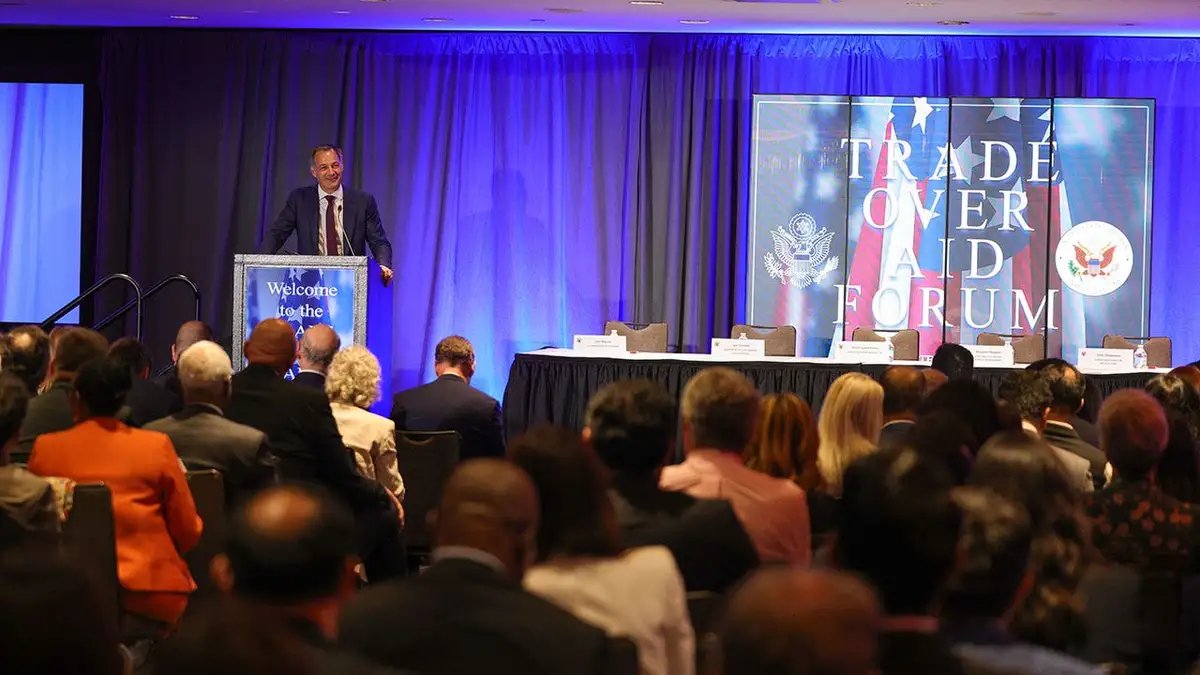
Alexander De Croo, UNDP administrator and former Belgian prime minister, speaks at the U.S. Mission to the United Nations’ “Trade Over Aid” forum in New York, July 13, 2026. (Donald Conahan/ U.S. mission to the U.N.)
This sentiment was echoed by Alexander De Croo, the former Belgian prime minister who now leads the United Nations Development Programme (UNDP). De Croo argued that public development assistance and private trade are complementary rather than mutually exclusive.
“Trade is a destination, but development is how we get to that destination,” De Croo said. “Markets do not build themselves. They have to be built.” He noted that private capital only flows when institutional foundations—such as predictable legal frameworks, trusted public institutions, and a skilled workforce—are already established. “There is no country over the past decades that has successfully developed without a strong private sector and without trade being a big part of that,” he added.
Christopher Sharrock, Microsoft’s vice president for United Nations and international organizations, also highlighted the unique role of traditional aid in addressing systemic global challenges. “Aid does do an essential job and it does a job that possibly nothing else can do,” Sharrock said, pointing to critical interventions like vaccination campaigns, famine relief, and disaster response.
As the Trump administration seeks to institutionalize its “Trade Over Aid” doctrine, the ultimate test will be whether private markets can be incentivized to operate in the world’s most vulnerable and economically isolated regions—places where, historically, only humanitarian aid has been willing to go.