Beijing Tests Polar Trade Route as Moscow Deepens Arctic Military Partnership
Washington Faces Growing Security Challenges as Beijing and Moscow Expand Polar Operations
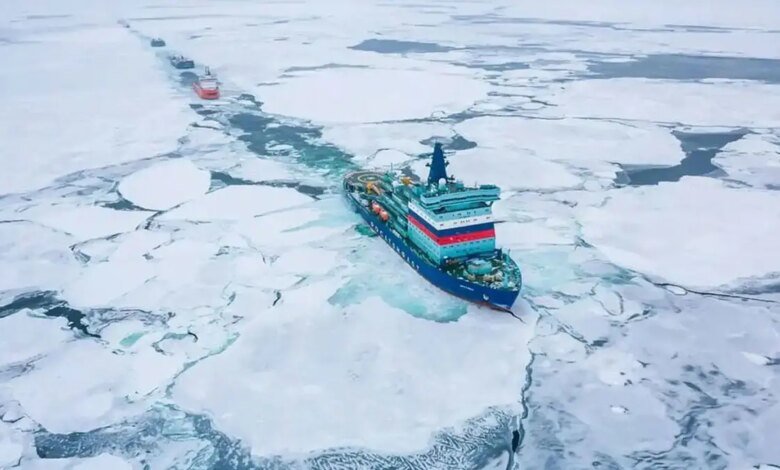
Washington faces mounting security challenges in the polar north as Beijing inaugurates regular seasonal container shipping across Russia’s Arctic coastline, opening a disputed trade corridor alongside its deepening military partnership with Moscow.
Although this initial operational phase involves just over eight scheduled voyages for the season, China specialist Gordon Chang explained to Fox News Digital that the true weight of the initiative extends far beyond current cargo volumes.
“China is pursuing a concerted strategic campaign targeting the Arctic driven by multiple factors,” Chang noted during a discussion, adding that receding polar ice makes the Northern Sea Route tracking along Russia’s northern littoral passable during the peak summer months.
Reporting from China Daily on Aug. 17 indicated that the Dubai Tower, operated by Sea Legend Shipping, set sail from Ningbo-Zhoushan Port on Aug. 15 bound for Europe through Russia’s Northern Sea Route, targeting a roughly 20-day transit time to Felixstowe, England.
This development arrives alongside a fresh staff report from a U.S. congressional commission cautioning that Moscow’s growing isolation and reliance on Beijing confer enhanced leverage upon China, extending to expanded entry into the Arctic.
Emphasizing the need for a more robust American footprint, Chang told Fox News Digital that the U.S. must step up operations, noting that while President Trump has greenlit additional icebreakers, the country remains severely deficient in that capability.
Speaking on background to Fox News Digital, a White House official stated that the Arctic represents a vital zone for American economic and national security, asserting that as an Arctic state, the United States will defend its interests and promote stability against escalating Sino-Russian rivalry.
Issued on Aug. 20 by staff of the U.S.-China Economic and Security Review Commission, a briefing document explained that Moscow’s war in Ukraine and subsequent Western financial alienation have “forced Russia to welcome an expanded Chinese footprint in the Arctic,” a territory historically viewed by the Kremlin as core to its national defense and sovereignty.
According to the findings, state-owned Chinese corporations currently command a cumulative 20% equity interest in the Western-sanctioned Arctic LNG 2 initiative, while both governments collaborate on establishing year-round freight transport along the Northern Sea Route alongside a newly formed joint venture to build ice-class cargo ships slated to launch their first vessel by 2027.
Echoing these concerns, the Department of Defense’s 2024 Arctic Strategy observed that shifting environmental factors are opening up the zone as Beijing pursues broader reach, pointing to the “Polar Silk Road” initiative as a mechanism for resource extraction and infrastructure projects that could “‘alter the Arctic’s stability and threat picture.’”
Historically, maritime cargo transport between East Asian ports and Northern Europe via traditional southern routes spans roughly 13,000 nautical miles through the Suez Canal, whereas navigating the Northern Sea Route can cut transit distances by as much as 40 percent, significantly reducing fuel consumption and travel times during favorable summer ice conditions.
For trade exchanges moving between China and Europe, this northern corridor provides an alternative path starkly contrasting with standard westbound routes transiting the Strait of Malacca, the Indian Ocean, the Bab el-Mandeb strait, the Red Sea, and the Suez Canal.
“Naturally, this bypasses critical maritime bottlenecks including the Strait of Malacca, the Bab el-Mandeb, the Suez Canal, and the Strait of Gibraltar,” observed Chang, emphasizing, “Thus, this holds considerable strategic value for Beijing.”
The latest USCC analysis contends that Beijing reaps growing benefits from a skewed partnership where Russian reliance on China outweighs reciprocal dependence, noting that China’s indispensable status following the 2022 Ukrainian conflict affords it increased bargaining power to secure discounted hydrocarbons and advanced military know-how without formal alliance commitments.
This economic imbalance manifests prominently in the energy sector, where documentation reveals China absorbs roughly half of all Russian petroleum exports, whereas Russian crude constitutes approximately 20% of total Chinese oil imports, bringing total Chinese purchases of Russian fossil fuels to an estimated $372 billion post-invasion.
Furthermore, the Kremlin is deploying this polar route with escalating frequency to dispatch petroleum shipments eastward.
According to an Aug. 11 Reuters report, Moscow dispatched seven oil cargoes equating to roughly 6 million barrels bound for Asian markets via the Northern Sea Route during the current season—approaching half the total volume moved throughout the entire preceding year—with China serving as the primary recipient.
Intensified polar operations unfold against a backdrop of heightened American anxiety regarding joint military and strategic maneuvers by Beijing and Moscow in proximity to Alaska.
Highlighting structural vulnerabilities inherent in the northern corridor, Chang drew attention to the Bering Strait dividing Russian territory from Alaska.
“Nevertheless, a notable strategic choke point exists along the path,” he stated, noting that transit requires passing between Russian landmasses to the west and the 49th U.S. state to the east, “which provides the United States with a degree of leverage in this theater.”
Concurrently, bilateral defense cooperation continues to broaden, with the USCC briefing documenting a minimum of 119 joint military exercises conducted by April 2026, complemented by July naval drills featuring submarine, anti-submarine, and uncrewed aerial systems alongside the historic 2024 incursion of Chinese bombers into the Alaskan Air Defense Identification Zone during a joint patrol.
From Chang’s perspective, the broader stakes transcend whether the polar passage ultimately rivals traditional canals like Suez.
“Certain American national security planners argue that the Arctic is merely a distraction from higher-priority global theaters,” Chang remarked.
“Yet fundamentally, irrespective of differing assessments on the region’s priority, both Beijing and Moscow are asserting a strong presence in the north,” he concluded. “Consequently, we lack the luxury of non-engagement; presence is mandatory regardless of strategic valuation because our rivals are deployed in force.”
The Pentagon’s 2024 Arctic Strategy explicitly warns that deepening cooperation and operational capacity between Beijing and Moscow in the polar north carry the potential to fundamentally alter regional stability and the broader threat landscape near American waters.