Trump Refusal to Rule Out Seizing Iran’s Kharg Island Highlights High-Stakes Military Scenarios
While analysts say capturing the strategic oil hub could take hours, holding it against mainland retaliation presents a formidable long-term challenge.
WASHINGTON — A potential U.S. military operation to seize Iran’s Kharg Island has returned to the forefront of geopolitical discussion after President Donald Trump declined to rule out taking the strategic Persian Gulf outpost. The island, which handles approximately 90% of the Islamic Republic’s crude oil exports, is the critical node in Washington’s economic pressure campaign against Tehran.
During an exclusive interview on “Special Report” on Tuesday, Trump was asked directly by Fox News chief foreign correspondent Trey Yingst whether he planned to seize the island. “I can’t say that to you because if I did, it would be foolish,” Trump replied. He noted that previous American military strikes had intentionally avoided the island’s oil facilities, describing them as “a chunk of the world economy.”
The president’s comments have prompted military planners and regional experts to examine what a U.S.-led operation to take the island would look like—and the severe retaliatory risks it would trigger.
The Tactical Scenario: Speed and Preservation
Military experts envision the opening hours of an operation to seize Kharg Island as a display of overwhelming force. Hundreds of U.S. Marines would storm ashore from amphibious assault ships, supported by attack helicopters, while Navy warships and fighter jets established air and sea superiority. Commanders would then issue a final ultimatum to Iranian defenders: surrender or be overrun.
“There are a lot of ways to skin this cat,” retired Vice Adm. Robert Harward, former deputy commander of U.S. Central Command, said in an interview.
Harward explained that a Marine Expeditionary Unit could conduct an amphibious assault while U.S. naval and air forces established complete control over the battlespace. Such units are the U.S. military’s premier quick-reaction forces, trained to operate from naval vessels to seize beachheads and secure critical infrastructure. In this scenario, giving Iranian forces an opportunity to surrender would serve a dual purpose: minimizing casualties and preserving the island’s infrastructure for a future, post-Islamic Republic government.
“The real objective at the end of the day is to minimize risk,” said Harward, who also served on the National Security Council and is currently a member of the Jewish Institute for National Security of America’s Iran Policy Project. “Not only to your own forces, but to the people you’re coming in contact with,” while protecting facilities that could eventually be handed over to “a government of Iran that is focused on supporting its people, as opposed to proliferating the Islamic Revolution.”
Trump’s remarks aligned with this assessment. The president noted that during previous military actions, he had instructed U.S. forces to “hit everything, but the oil,” recognizing that destroying the export terminal would trigger severe shocks in global energy markets.
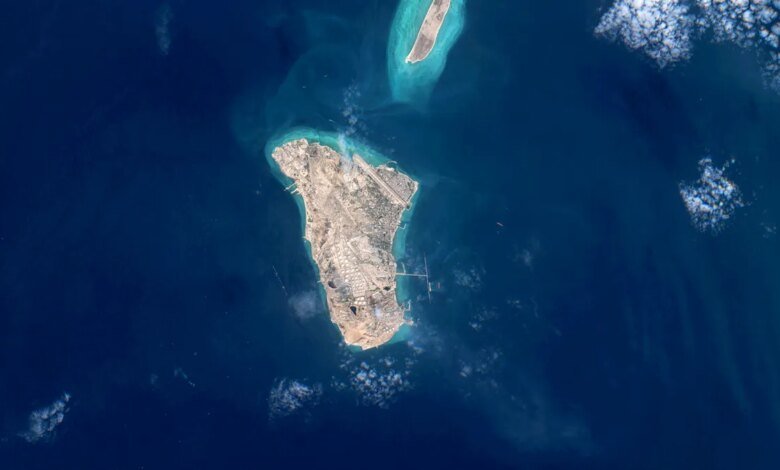
Satellite view of Kharg Island, located in the Persian Gulf off the coast of Iran. (Gallo Images/Orbital Horizon/Copernicus Sentinel Data 2024)
The Holding Dilemma: Asymmetric Retaliation
While military analysts believe U.S. forces could successfully capture the eight-square-mile island within hours, holding it presents a far more dangerous challenge.
Located just 16 miles off Iran’s southern coast, Kharg Island sits well within range of the mainland’s artillery, ballistic missiles, drones, and shore-based anti-ship weapons. Defending the island against sustained retaliation would require a massive, long-term military commitment, significantly increasing the risk of a direct, full-scale war with Iran.
“Everybody talks about seizing Kharg,” said Nicholas Carl, assistant director of the Critical Threats Project at the American Enterprise Institute. “Iran has spent decades investing in denial capabilities designed specifically to keep U.S. forces away from its shores.”
These defensive capabilities form the core of Iran’s asymmetric warfare strategy. Rather than attempting to match the U.S. Navy’s conventional blue-water power, Tehran has focused on anti-access/area-denial (A2/AD) weapons. This arsenal includes anti-ship cruise missiles, swarms of fast attack craft operated by the Islamic Revolutionary Guard Corps Navy, naval mines, and unmanned aerial vehicles designed to overwhelm superior forces in the narrow waters of the Gulf.

U.S. forces conduct a maritime interdiction and boarding of the Veronica III without incident in the INDOPACOM area of responsibility after the vessel allegedly tried to defy President Trump’s quarantine, Feb. 15, 2026. (X/@DeptofWar)
Harward acknowledged that once American troops secured the island, the primary threat would shift from naval engagements to bombardment from the mainland.
“Iran doesn’t really have air power,” Harward said. “The concern is whether they launch missiles and drones at the island with U.S. forces on the ground. That’s the biggest risk.”
He added that the feasibility of the operation would depend heavily on intelligence regarding the strength of local Iranian forces, the presence of booby traps or improvised explosive devices, and Tehran’s broader escalatory calculus. However, Harward noted that mainland strikes on the island would carry a self-inflicted cost for the regime: “If they start striking Kharg itself, they become accountable for damaging their own economic lifeline.”
A Deep-Water Asset with Colonial History
Kharg Island’s strategic value is rooted in both geography and history. Long before it became an oil hub, the island served as a tactical stepping stone. British forces occupied Kharg in 1838 during confrontations with Persia over Herat, and again in 1856 during the Anglo-Persian War, utilizing its proximity to the mainland to exert diplomatic and military pressure on Tehran.
In the late 1950s, Iran selected the island as its primary deep-water oil terminal because its naturally sheltered, deep-water channel could accommodate the world’s largest supertankers. Construction began under the Shah’s administration, and the terminal officially entered service in 1960, permanently shifting the center of gravity of Iran’s petroleum infrastructure to the Gulf.

A satellite image shows an oil terminal at Kharg Island, Iran, Feb. 25, 2026. (2026 Planet Labs PBC/Handout via Reuters)
Alternative Options and Strategic Targets
Given the high risks of a physical occupation, some strategists suggest Washington has other ways to apply pressure. A U.S.-led maritime blockade, which was reinforced on Tuesday, is already severely restricting Iran’s seaborne oil exports. Harward suggested that further economic pressure could target overland trade routes, border crossings, and commercial air traffic without the need to put boots on the ground.
“There is still a lot you could do to enhance the economic challenges to Iran,” Harward said. “Synchronizing military, economic and political pressure is really the strategy.”

The Port of Kharg Island Oil Terminal, 25 km from the Iranian coast in the Persian Gulf and 483 km northwest of the Strait of Hormuz, in Iran on March 12, 2017. (Fatemeh Bahrami/Anadolu Agency/Getty Images)
Other military experts question whether Kharg Island is the most suitable target for direct action. Mark Fox, a retired vice admiral and former commander of the U.S. Navy’s 5th Fleet, previously noted that Kharg functions primarily as a commercial terminal rather than a fortified military base.
Instead, Fox suggested that smaller, disputed islands near the Strait of Hormuz—such as Greater Tunb, Lesser Tunb, and Abu Musa—might represent more manageable military objectives. Seizing these islands, which sit directly along one of the world’s most critical maritime transit corridors, would create a significant strategic dilemma for Tehran while proving easier for U.S. and allied forces to defend.
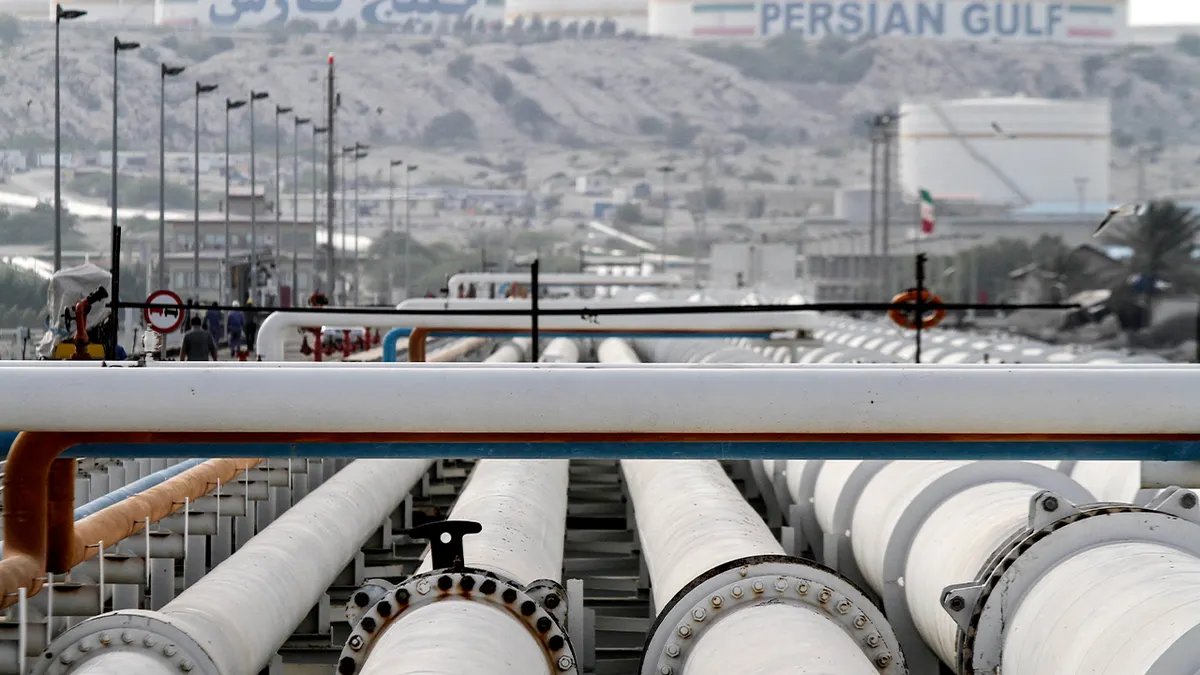
Export oil pipelines are seen at an oil facility on Kharg Island, on the shore of the Gulf, Feb. 23, 2016. (Str/AFP Via Getty Images)
For Harward, any tactical operation must serve a broader, long-term geopolitical objective.
“I think the only real end state to ensure long-term stability and security in the region is a government of Iran that renounces the Islamic Revolution and focuses on the Iranian people,” he said. Achieving that stability, he added, would require Tehran to dismantle its nuclear ambitions, halt its support for regional proxy networks, respect the freedom of navigation through international waterways, and end its domestic repression.
Whether Washington chooses to act on Kharg Island remains an open question. However, military planners agree on the fundamental calculus: taking Iran’s economic lifeline would be a matter of hours, but holding it would mark the beginning of a prolonged and unpredictable regional campaign.