RayNeo Splits Smart Glasses Strategy With AI Productivity Frames and Massive Cinema Displays
Company details everyday translation frames and high-FOV GT cinema models ahead of IFA
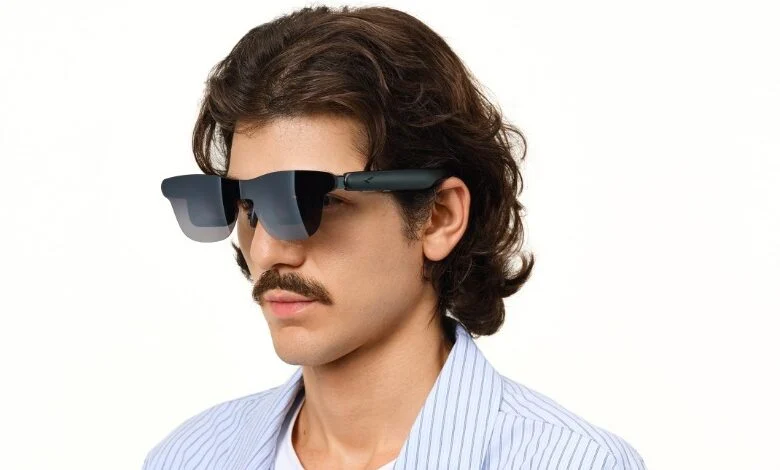
Augmented reality hardware maker RayNeo has introduced a distinct two-pronged wearable lineup ahead of the IFA tech conference in Berlin, detailing the lightweight iO Smart Glasses alongside two large-format spatial entertainment models, the GT and GT Max.
Both product lines are scheduled to make their public debut at the trade show before launching at retail on September 4. RayNeo has not yet disclosed commercial pricing for any of the upcoming devices.
At 33 grams, the RayNeo iO Smart Glasses are built around standard optical frames intended for continuous daily wear. Rather than full-color spatial graphics, the frames house a minimalist monochrome green display offering a 23.5-degree field of view designed to present basic text prompts, live transcription readouts, and teleprompter cues directly in the wearer’s line of sight.
To maintain a compact footprint, RayNeo excluded built-in external audio speakers and onboard camera modules from the iO frames. The design instead concentrates on dedicated voice capture hardware, integrating a quad-microphone array paired with an acoustic bone conduction sensor engineered to isolate vocal vibrations and minimize environmental background noise.
That acoustic hardware powers the built-in Ambient AI Productivity Suite, which monitors ongoing conversations to log notes, extract action items, and create calendar entries. Language processing is handled via Timekettle BabelOS 3.0 software, which RayNeo claims can translate 55 languages and 109 accents with an operating latency of approximately one second.
RayNeo rates the battery life of the iO frames at up to two days under typical conditions, with continuous usage benchmarks rated at 18 hours of audio recording or 6.2 hours of live translation. A visible indicator light activates on the frame during active recording and translation sessions.
Targeting stationary media consumption and gaming rather than all-day utility, the heavier GT-series glasses scale up both optical and audio hardware. The standard RayNeo GT weighs 68 grams, while the flagship RayNeo GT Max weighs 78 grams.
Visual specifications differ significantly across the two GT models. The standard GT projects a virtual workspace equivalent to a 231-inch display with a 46-degree field of view. The GT Max expands that coverage, projecting an image equivalent to a 307-inch virtual screen across a 59-degree field of view to reduce the need for head repositioning.
Both GT models incorporate an onboard 3DoF AR chip to anchor digital viewports at fixed points in three-dimensional space. The frames also feature a quad-speaker array co-tuned by Bang and Olufsen and can render Dolby Vision HDR video streams when tethered to the RayNeo Pocket TV Pro, the company’s dedicated streaming device powered by Google TV.