Democratic Socialist Angie Nixon Ousts Impeachment Star Alex Vindman in Florida Senate Shocker
State Rep. Angie Nixon defeats well-funded moderate Alex Vindman in Florida's Democratic Senate primary.
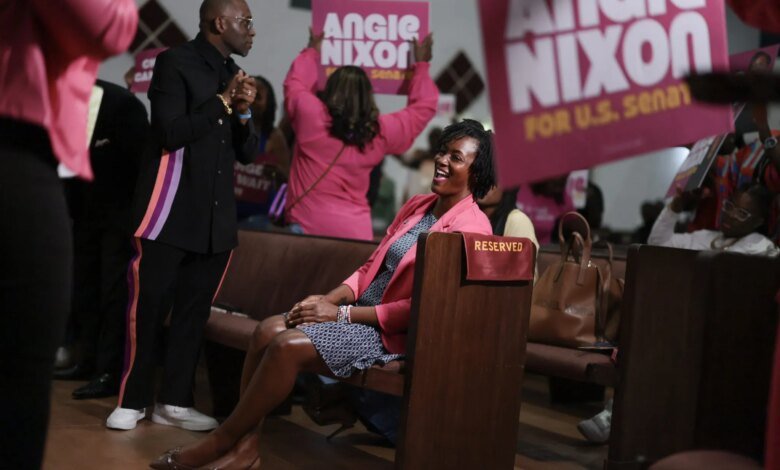
State Rep. Angie Nixon, a democratic socialist, captured Florida’s Democratic U.S. Senate nomination in a major primary upset, defeating Alex Vindman, a moderate former national security aide who gained fame during President Donald Trump’s first impeachment.
Democrats aiming for a resurgence in the populous, diverse, and economically vibrant state have repeatedly struggled to formulate a message that lands effectively across Florida’s political terrain. Nixon’s victory sets up a tough matchup against U.S. Sen. Ashley Moody, a former state attorney general appointed by Gov. Ron DeSantis after Marco Rubio stepped down to become Trump’s secretary of state.
The contest has intensified debate within Democratic ranks over whether the party should rally liberal base voters with bold, confrontational candidates or target the independent and moderate voters historically required to win competitive states.
“If you’re surprised by tonight’s election results, you haven’t been paying enough attention to what’s happening in the South,” said Britney Whaley, the southeast regional director of the Working Families Party, which backs populist candidates. “Tonight’s election results must be a wake-up call to a political establishment that believes a populist message can’t win in the South. Angie’s campaign proves voters will respond to a bold economic vision that meets their basic needs.”
A proud progressive who campaigned with new tactics
Supported by progressive Reps. Rashida Tlaib of Michigan and Ilhan Omar of Minnesota, Nixon is a veteran labor organizer who recently joined the Democratic Socialists of America. Her platform focused on policy proposals like universal healthcare and childcare alongside persistent criticism of U.S. foreign policy and the war in Gaza.
During a May legislative session, Nixon disrupted the floor of the Republican-led Florida House by speaking through a megaphone to protest new congressional district maps. While the action led to an ethics committee reprimand, it drew strong praise from voting rights advocates and Democratic allies.
Financial filings showed Vindman collected nearly $16 million for his campaign and spent upwards of $9 million through July, whereas Nixon accumulated just under $1 million. Rather than purchasing costly television ads, Nixon relied heavily on social media outreach and endorsements from prominent online personalities, including children’s education creator Ms. Rachel.
Nixon’s lean operation reflects a broader national trend where progressive primary candidates bypass traditional, high-cost broadcast advertising in favor of hyper-targeted digital media and grassroots digital networks. Recent campaign finance data shows that digital-first strategies have increasingly allowed lower-funded candidates to achieve high voter contact efficiency at a fraction of the cost per impression compared to traditional television buys in major media markets like Miami and Orlando.
Unlike previous high-profile primary contests featuring democratic socialist candidates, national Democratic leaders and major political action committees avoided mounting a concerted effort against Nixon. Progressives quickly pointed to her outcome as evidence of expanding regional momentum.
Political analysts had long classified the Florida Senate seat as likely out of reach for Democrats and non-essential to their strategy for capturing the Senate majority. Even so, Democratic National Committee Chair Ken Martin released a statement commending Nixon as a “proven leader,” adding that the DNC “is ready to help elect Angie and work together to flip this seat.”
A defeat for ‘resistance’ Democratic politics
Vindman’s political rise began when he served on the National Security Council during Trump’s presidency and provided pivotal testimony in the first impeachment proceedings regarding a phone call where Trump asked Ukrainian President Volodymyr Zelenskyy to investigate Joe Biden and his family. That testimony transformed Vindman into a prominent national Democratic figure, drawing both Trump’s anger and millions of dollars in grassroots political contributions.
His twin brother Eugene, who served on the same council, holds a seat as a Democratic congressman from Virginia.
“Rep. Nixon ran a strong campaign. I will be standing by her side in the fight against Ashley Moody. I hope you’ll join me,” Vindman said in a statement after he conceded the race.
Trump openly celebrated Vindman’s primary defeat on social media.
“The most gratifying loss last night was that of a real treasonous creep, Alexander Vindman, to a Radical Left Lunatic, who can’t speak or think properly, and who will go down to certain defeat at the hands of Ashley Moody, a truly Fantastic Senator, from the Great State Florida,” Trump wrote on his social media platform, Truth Social. Trump added that Vindman “should be prosecuted for what he’d did!”
Top party figures including Senate Minority Leader Chuck Schumer had calculated that Vindman’s national platform and substantial fundraising capacity could pull a reliably Republican seat into competitive territory. Nixon’s triumph instead reinforced Republican confidence in the state while validating the strategy of progressive activists.
The outcome adds Vindman to a growing list of primary defeats for figures whose public profiles were forged in opposition to Trump during his first term, a period when Democrats mobilized around a “resistance” framing. The shift suggests Democratic primary voters may now prioritize forward-looking economic agendas over anti-Trump credentials.
In May, veteran Trump opponent and civil rights figure Rep. Al Green of Texas was defeated in a runoff by Rep. Christian Menefee, a freshman progressive state lawmaker less than half his age.
Former House impeachment counsel Rep. Dan Goldman fell in a June primary to progressive Brad Lander, who campaigned with the endorsement of New York City’s democratic socialist mayor, Zohran Mamdani, while anti-Trump lawyer George Conway placed fifth in a separate New York primary for Congress.
Earlier this month in Michigan, Rep. Shri Thanedar, who had authored articles of impeachment against Trump last year, lost his primary to a democratic socialist candidate in the Detroit area.
Nixon’s win headlined mixed results for progressives
Tuesday’s broader primary results across South Florida painted a nuanced picture, with moderate candidates prevailing in several key congressional matchups. Given Florida’s history as a haven for Latino populations fleeing left-wing regimes in Latin America, political messaging tied to socialism continues to face significant headwind in the region.
Elijah Manley, who finished third with about 14% of the vote in a five-candidate primary won by Rep. Debbie Wasserman Schultz in Broward County, noted the regional divergence. In neighboring districts, moderates Rep. Jared Moskowitz and political newcomer Pia Dandiya won their primaries decisively with 64% and 69% of the vote against progressive opponents.
“I’m a proud moderate. We need more moderates,” Dandiya said in an interview.
Statewide voting patterns in the Senate primary reflected those geographical dynamics, with Nixon winning a majority of counties while underperforming in South Florida’s heavily Latino communities.
Despite the regional split, Manley maintained that Democratic voters overall are demanding a sharper leftward turn.
“They have looked at the Democratic establishment for the past four years, even 10 years, and it’s something that just isn’t working for them,” he said.
“Say what you will about the DSA. They’re organizing. They’re bringing people into the party. They’re exciting people, and they’re getting people. We should be happy that that’s happening,” Manley added.
Nixon’s supporters argue that mobilizing working-class and majority-Black communities offers a viable path forward for the party when aligned with traditional coalition partners, though they warn internal strife and artificial messaging could hurt candidates across the ideological spectrum.
Pointing to her own victory over a Republican for an at-large Jacksonville city council seat, activist Moné Holder emphasized that local grassroots authenticity proved crucial to voter turnout across urban centers.
“I think people are looking for change. They’re looking for leadership who they can trust and who listens,” said Moné Holder, a liberal activist and urban planning committee chair who defeated a Republican for an at-large seat on Jacksonville’s city council. “They’re looking for people to serve who aren’t wrapped up in political drama, but are about people. And I think voters came out to show that, and it proved itself in my election, and Angie’s, and a few others,” Holder said.
___
Associated Press writer Bill Barrow contributed to this report.