US Blocks Exports of Battery Shreds and Scrap Tungsten to Counter China
Commerce Department acts under Trump executive order to secure domestic military supply chains and prevent metal outflow to Asia.
The U.S. Commerce Department has imposed a year-long ban on the export of scrap tungsten and shredded battery material known as “black mass,” executing an executive directive from President Donald Trump intended to prevent critical defense minerals from flowing out of the country.
Announced on Tuesday by the Bureau of Industry and Security, the restrictions mandate that domestic sellers offer scrap tungsten and black mass exclusively to U.S. purchasers, unless a specific government exception is granted. Commodity price reporting agency Argus identified the rules—set to go into effect later this month—as unprecedented in modern U.S. trade history.
Trump ordered the Commerce Department to implement the trade curbs following an executive assessment that deficits in critical mineral supplies create a growing threat to U.S. national security. The move comes as Washington works to reduce its systemic exposure to China, which dominates global refining for critical industrial metals and has increasingly restricted its own raw material exports amid escalating geopolitical frictions.
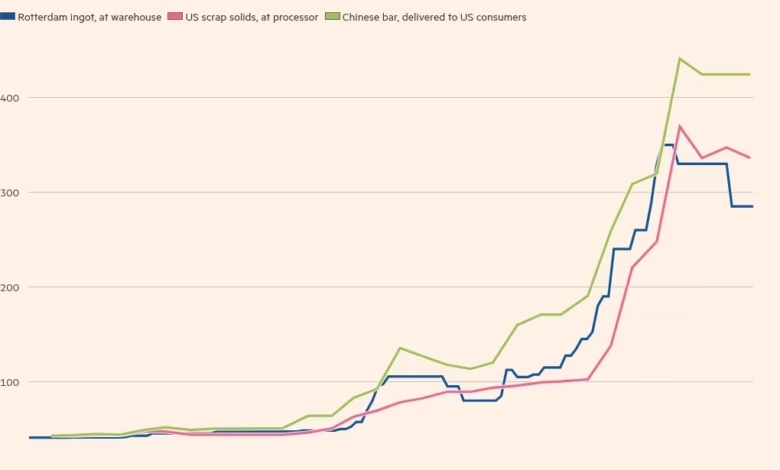
Tungsten, vital for military munitions and heavy industrial manufacturing, has seen sharp price increases this year due to Beijing’s trade limits alongside surging global defense spending driven by conflict in Ukraine and the Middle East. The United States maintains no operational tungsten mines and possesses limited domestic recycling capability.
American manufacturers had actively lobbied the administration for export protections on tungsten waste, warning that Chinese-backed entities operating within the U.S. were outbidding domestic firms to acquire scrap metal and divert it overseas. Research firm Project Blue noted a significant rise this year in U.S. tungsten scrap exports bound for Asian processing hubs including Taiwan, South Korea, Vietnam, and the Philippines.
The export ban also targets “black mass”—the mineral-dense powder produced by crushing spent energy storage units and electric vehicle batteries—which contains valuable elements including lithium, cobalt, nickel, manganese, and graphite. While the U.S. currently lacks adequate processing facilities to convert all locally generated black mass back into battery-grade chemicals, Western allies are similarly moving to restrict shipments. The European Union plans to enforce its own ban on exporting black mass to non-OECD nations starting in November.