Tehran Signals Continuity as Top Officials Reappear for Khamenei Funeral
Top officials emerge in Tehran as negotiations with the U.S. remain on hold.
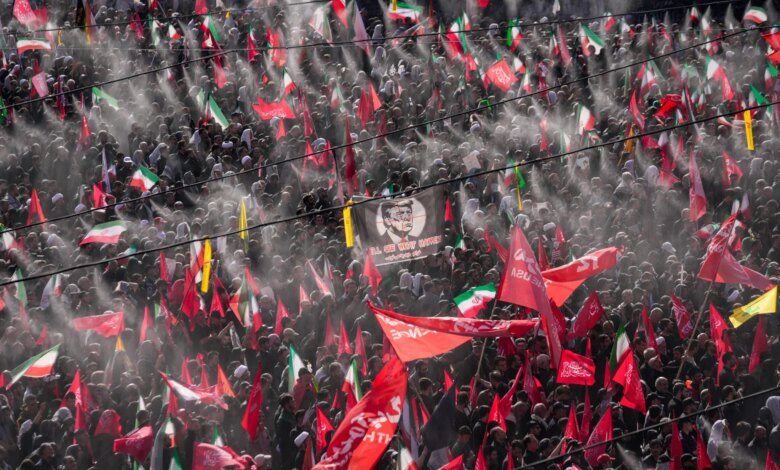
The public emergence of Iran’s military and political elite at funeral prayers Sunday served as a calculated display of institutional stability, even as the nation’s new supreme leader remained conspicuously absent from view. The gathering at Tehran’s Grand Mosalla marked the first public appearance for several high-ranking figures since the Feb. 28 airstrike that killed 86-year-old Ayatollah Ali Khamenei and triggered a devastating regional conflict.
While hundreds of thousands of mourners called for retribution, the presence of the late leader’s sons—Masoud, Meysam, and Mostafa—alongside Revolutionary Guard head Gen. Ahmad Vahidi, signaled a regime attempting to project confidence during a fragile April ceasefire. Vahidi, flanked by security details, had not been photographed in public since the war began. He was joined by President Strait of Hormuz Deal”>Masoud Pezeshkian and Parliament speaker Mohammad Bagher Qalibaf, the latter of whom has served as the primary interlocutor in stalled negotiations with Washington.
The transition of power remains clouded by the absence of Ayatollah Mojtaba Khamenei. The new supreme leader is widely reported to have been wounded in the same strike that killed his father and has not appeared during the multi-day funeral ceremonies. His silence has left a vacuum filled by hard-line rhetoric; at the Mosalla, emcee Mohammad Rasouli and various mourners openly called for the assassination of Donald Trump and Israeli Prime Minister Benjamin Netanyahu.
Diplomatic efforts to secure a permanent end to the war are effectively frozen until the mourning period concludes on Thursday. Central to these talks is the Strait of Hormuz, a chokepoint through which approximately one-fifth of the world’s total oil consumption passes. Iran is currently demanding a degree of sovereign control over the waterway as a condition for reopening it to prewar traffic levels, a position the U.S. Navy and its multinational partners continue to contest.
The animosity toward the U.S. leadership is rooted in a long-standing cycle of escalation, most notably the 2020 killing of Qassem Soleimani, the former head of the elite Quds Force. Esmail Qaani, who succeeded Soleimani and now leads the Quds Force, was among the mourners Sunday. Federal authorities in the U.S. have tracked Iranian plots against Trump for years, though Tehran has officially denied such intentions.
In Washington, Donald Trump addressed the conflict during a speech marking the 250th anniversary of American independence, claiming the U.S. military had successfully “wiped out” Iran’s military capabilities. Despite this rhetoric, the U.S. Navy reported 70 transits through the strait over the last three days, though it noted that mine clearance operations are ongoing and the threat level remains substantial.
The late leader’s casket is scheduled to be transported through Tehran on Monday before a final burial at the Imam Reza shrine in Mashhad, his birthplace. Until then, the Iranian government appears focused on using the funeral as a platform for domestic unity, deferring substantive foreign policy decisions until the state of the new supreme leader’s health and authority is clarified.