Robinhood and Coinbase Disparity Widens Ahead of Second Quarter Earnings
Market valuation gap doubles as Robinhood expands beyond stocks while Coinbase contends with crypto market headwinds.
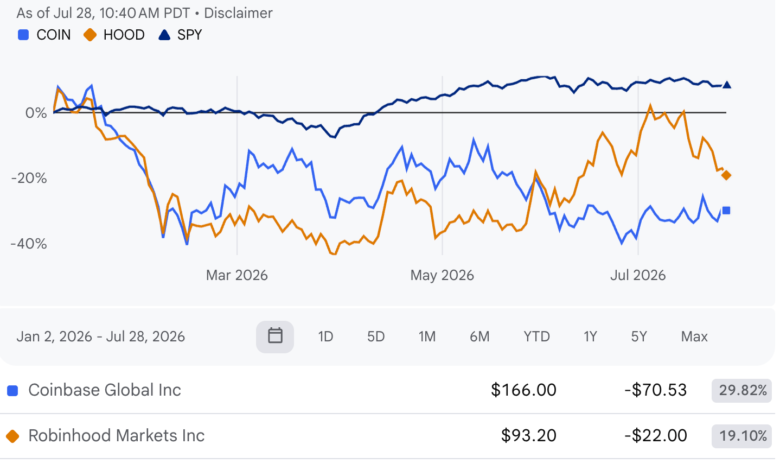
A widening valuation gap between Robinhood and Coinbase will take center stage this week as both retail trading platforms release their second quarter financial results. Despite generating comparable top-line revenue over the past year, Robinhood has reached a market valuation of approximately $85 billion—double that of Coinbase—as investors favor its broader product expansion and lower reliance on volatile digital assets.
Robinhood is scheduled to report earnings on Wednesday at 5:00 p.m. Eastern Time, with consensus analyst estimates projecting earnings per share of $0.40 on revenue of $1.25 billion. Coinbase will publish its quarterly results at the same time on Thursday, where Wall Street anticipates a loss of $0.36 per share on revenue of $1.3 billion.
Analyst outlooks reflect the split in momentum. Mizuho analyst Dan Dolev projected that Robinhood could emerge as the first hyperscaler in the retail brokerage sector, driven by growth in banking services, credit cards, and retail equities. Robinhood derives only 12% of its total revenue from cryptocurrency trading, leaving its core business less exposed to digital asset downturns. Meanwhile, several research firms have issued Hold or Sell ratings for Coinbase due to ongoing weakness across cryptocurrency markets.
Coinbase continues to rely heavily on transaction fees and digital asset yield. During the previous quarter, non-trading revenues contracted, with more than half of its $585.5 million subscription and services revenue stemming from interest on the USDC stablecoin. That revenue stream faces emerging pressure as a coalition of commercial banks and credit card networks prepares to launch a rival stablecoin.
In prediction markets, Robinhood generated over $100 million in revenue during the first quarter alone, establishing itself as the primary market rival to derivative platform Kalshi. Coinbase noted that its prediction markets segment has reached an annualized revenue pace of $100 million, ranking among its fastest-growing corporate initiatives as it seeks to build an everything exchange including traditional stocks.
The long-term battle between the two platforms centers on tokenized stocks and automated digital infrastructure. Following a market rally triggered by Donald Trump winning the presidential election in late 2024, retail crypto engagement cooled significantly. Financial institutions such as JPMorgan and the New York Stock Exchange have moved into tokenized financial instruments, which use blockchain wrappers to offer continuous 24/7 trading and instantaneous settlement. Robinhood CEO Vlad Tenev has promoted this trend as part of a tokenization supercycle.
Coinbase has faced setbacks in its decentralization strategy. Chief Executive Brian Armstrong acknowledged that an effort to orient its Base blockchain toward decentralized social media applications was a mistake, leaving the company behind in tokenized finance applications. Coinbase also faces operational friction from executive churn, high equity compensation expenses, and negligible fee yields from Base sequencer operations. In agentic commerce—where AI software agents make purchases online—Coinbase created the open-source X402 protocol, while Robinhood launched Robinhood Chain earlier this month, quickly matching Base in transaction volume while relying on Visa and Mastercard payment processing networks.