Salman Rushdie Recounts Brutal 2022 Stabbing as Federal Terrorism Trial Opens in Buffalo
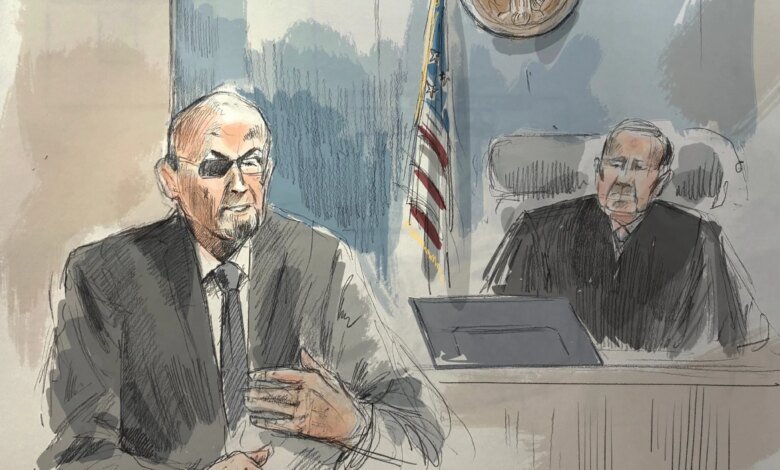
Author Salman Rushdie took the witness stand in a Buffalo federal courtroom on Thursday, confronting the man who nearly ended his life on an upstate New York stage four years ago. Testifying in the federal terrorism trial of 28-year-old Hadi Matar, the acclaimed writer provided a harrowing, firsthand account of the 2022 attack that left him blind in one eye and permanently injured.
During roughly an hour of straightforward testimony, the 79-year-old novelist removed his glasses to show jurors his sightless right eye. He described the moment Matar rushed the amphitheater stage at the Chautauqua Institution on August 12, 2022, delivering 15 knife wounds in a matter of seconds. Rushdie recalled initially believing he had been punched under the chin before realizing he was lying in what he described as an expansive lake of blood. The blade, he told the court, came within a millimeter of his brain, severing nerves in his left hand and damaging his liver.
Matar is already serving a 25-year state prison sentence after being convicted of attempted murder in New York state court. However, federal prosecutors under the U.S. Department of Justice are now seeking a life sentence, charging Matar with committing an act of transnational terrorism. To secure a conviction on federal terrorism charges, the government must prove the assault was driven by an ideological motivation—specifically, allegiance to foreign entities.
Assistant U.S. Attorney Timothy Lynch told jurors that Matar began researching Rushdie in 2020 and wrote notes declaring an intent to kill the author quickly, framing the assault as an act of holy war. Investigators uncovered photos supporting the Lebanese-based militant group Hezbollah on Matar’s digital devices in his New Jersey bedroom, alongside a forged driver’s license bearing an alias linked to a Hezbollah figure. The U.S. government has long designated Hezbollah as a foreign terrorist organization.
Central to the prosecution’s case is the lingering shadow of a 1989 religious decree, or fatwa, issued by Iran’s late Supreme Leader Ayatollah Ruhollah Khomeini. The edict called for Rushdie’s execution following the publication of his novel The Satanic Verses, which contained a dream sequence that some devout Muslims deemed blasphemous. Born in India and raised in the United Kingdom before becoming a naturalized U.S. citizen, Rushdie spent nearly a decade in hiding under police protection. Although the Iranian government formally distanced itself from the decree in 1998, the death order was never officially rescinded. Rushdie testified that he had enjoyed over two decades of unrestricted public life prior to the 2022 attack.
During cross-examination, defense attorney Nathaniel Barone pressed Rushdie on whether he anticipated severe public backlash from his book, attempting to pivot focus onto the security arrangements at the venue, where only a single state trooper and a sheriff’s deputy were present. When asked if he believed Matar acted on behalf of a terror group, Rushdie noted he had suspicions but no direct knowledge, adding that he believed his attacker, rather than his literary work, was the party on trial. That remark was subsequently stricken from the record by the presiding judge.
Barone argued that federal prosecutors lack direct evidence demonstrating Matar’s precise state of mind on the day of the stabbing, characterizing the government’s case as an attempt to connect unrelated dots. Matar, who declined to testify during his state trial, may take the stand in his defense before the federal trial concludes. Following the 2022 attack, Iran’s foreign ministry denied direct operational involvement, though it blamed Rushdie’s writings for provoking the violence. Rushdie, who won the Booker Prize in 1981 for Midnight’s Children, published his latest collection, The Eleventh Hour, last year.