Apple Overtakes Nvidia as World’s Most Valuable Company Amid AI Capex Concerns
Investors embrace Apple's disciplined financial strategy as chipmaker stock volatility highlights growing anxiety over AI spending.
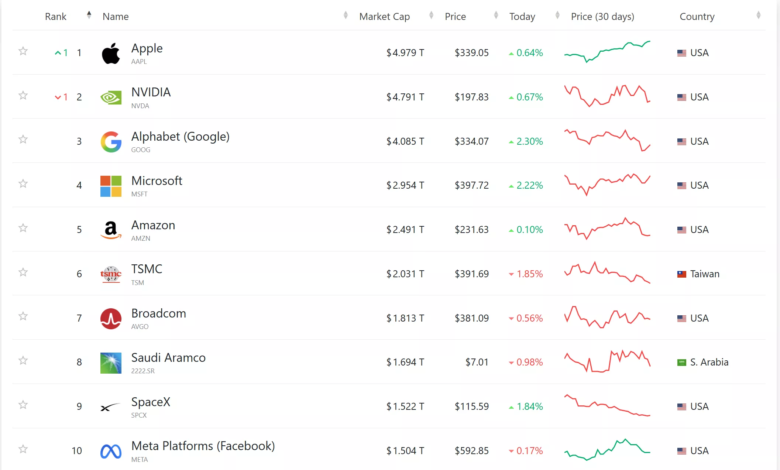
Apple has reclaimed its position as the world’s most valuable publicly traded company, displacing Nvidia as Wall Street recalibrates its appetite for massive artificial intelligence infrastructure spending.
A 1% increase in Apple’s shares over the past week elevated the iPhone maker’s market capitalization to approximately $4.9 trillion. Over the same period, Nvidia experienced a 5% decline, lowering the semiconductor giant’s valuation to around $4.8 trillion. The reversal highlights a growing divide between chipmakers exposed to volatile supply-chain cycles and consumer technology firms with diversified, steady cash flows.
The shift marks a notable retreat for Nvidia, which earlier in 2025 became the first corporate entity globally to eclipse a $5 trillion valuation. That milestone was driven by an unprecedented surge in demand for graphic processing units required to train large language models. As tech giants poured billions into custom data centers, Nvidia’s enterprise value multiplied tenfold. However, mounting institutional concern over the timeline for return on AI investment has introduced fresh volatility to semiconductor equities.
In contrast, Apple has pursued a far less capital-intensive path. Rather than building proprietary mega-clusters of chips, the company focused on custom, lower-power software models designed for on-device processing. To power broader generative capabilities within its Siri voice assistant—which originally grew out of DARPA’s CALO project—Apple opted to integrate third-party cloud architectures, including services from Google, alongside its own specialized models.
Industry analysts view Apple’s restraint as a primary factor behind its renewed market leadership. Daniel Newman, a prominent technology analyst, noted that growing anxiety over an “AI hangover” has driven portfolio managers back toward Apple, describing the stock as functioning “almost like owning an index” due to its liquidity and operational balance. According to financial analysis published by Reuters, institutional investors are increasingly prioritizing capital preservation and balance-sheet discipline over unconstrained capital expenditure.
This financial philosophy is deeply rooted in Apple’s corporate structure. As Chief Executive Officer Tim Cook prepares to conclude his 15-year tenure, senior vice president of hardware engineering John Ternus is widely anticipated to take the helm. Internal expectations suggest John Ternus will maintain Tim Cook’s conservative posture regarding capital allocation and big-ticket infrastructure spending.
The company’s focus remains centered on user application rather than underlying compute power. Craig Federighi, Apple’s senior vice president of software engineering, reiterated this perspective during an address in June, emphasizing that artificial intelligence within the Apple ecosystem is strictly designed to serve user utility rather than drive standalone infrastructure expansion.