AI Hardware Boom Drives TSMC, Tencent, and Asian Tech Giants into Global 500 Elite
Semiconductor supply chains and hardware manufacturers dominate annual revenue rankings amid record AI infrastructure spending.
Surging global investment in artificial intelligence hardware has dramatically reshaped the upper echelons of corporate revenue, catapulting key Asian technology suppliers into the top tiers of the 2026 Fortune Global 500 rankings. Leading the shift, Taiwan Semiconductor Manufacturing Company (TSMC) broke into the top 100 for the first time, securing the No. 82 position on the back of $122.3 billion in annual revenue for 2025—a 35.6 percent increase from the previous year.
The revenue surge highlights the central role of advanced microchip fabrication in sustaining AI workloads. TSMC, which manufactures custom silicon for market leaders like Nvidia and Apple, saw massive demand for its advanced fabrication nodes and proprietary advanced packaging technology. According to CNBC reporting, Nvidia reserved a vast majority of TSMC’s production capacity. The two companies expanded their footprint beyond Asia in October through a joint initiative to build advanced packaging facilities in Phoenix, Arizona, addressing supply chain resilience efforts urged by international regulators.
Further down the hardware value chain, Taiwanese electronics manufacturer Wistron recorded the largest upward leap of any firm on the list, climbing 298 places to No. 198. The company posted 2025 revenue of NT$2.19 trillion ($70.18 billion), marking a 115 percent year-over-year jump. Wistron, alongside regional peers Quanta Computer and Foxconn, experienced skyrocketing demand for its specialized AI server assembly lines that integrate Nvidia’s high-performance graphic processing units.
The shift has fundamentally altered hardware production timelines. “In the past, one server generation typically lasted about two and a half to three years. You’d spend roughly a year designing a product, then it would stay in the market for about two years,” said Simon Lin, chairman of Wistron. “With AI, not only are there new products every year, but each generation is a meaningful technological leap.”
Memory bandwidth has emerged as another critical bottleneck in the AI architecture stack, propelling South Korean chipmaker SK Hynix up 101 spots to No. 210. Generating $68.3 billion in revenue, the firm established a dominant market position in high-bandwidth memory chips, which allow data to move rapidly between processing units. SK Hynix bolstered its capital position through a historic $28.5 billion U.S. stock listing, marking the largest equity offering by a foreign enterprise in American market history.
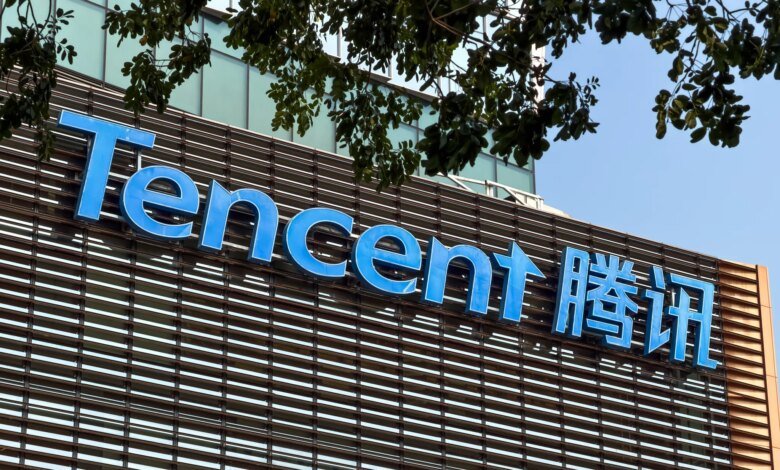
Chinese internet heavyweight Tencent Holdings also crossed the top 100 threshold for the first time, climbing 19 spots to No. 97. The firm posted $104.6 billion in revenue for 2025, a 14 percent gain, bolstered by digital advertising tools optimized through artificial intelligence alongside its gaming properties like Honor of Kings and PUBG Mobile. To maintain competitiveness against domestic tech rivals, Tencent committed to doubling its AI capital expenditures to 36 billion yuan ($5.2 billion) for machine learning model development and engineering recruitment. The expansion comes despite market volatility; rumors of slowing gaming revenues recently sent Tencent’s shares down 7.1 percent in single-day trading.
Beyond computing, structural shifts in global manufacturing enabled several Asian enterprises to enter the Global 500 for the first time. Chinese automaker Chery Automobile debuted at No. 383 with $41.8 billion in revenue. Chery, which has held the status of China’s top vehicle exporter for 23 consecutive years, generates 70 percent of its total sales outside its domestic market. Its export volume—primarily internal combustion engine models shipped to the Middle East, Africa, and Russia, alongside an emerging EV portfolio—reflects a broader trend as China approaches 10 million total annual vehicle exports, up from 7.1 million the prior year.
Taiwanese semiconductor distributor WT Microelectronics entered the index at No. 431 with $37.8 billion in revenue, reflecting the broader commercial throughput of component supply chains established since its founding in 1993.
In the industrial sector, Japanese HVAC manufacturer Daikin Industries joined the list at No. 498 with $33.3 billion in revenue. Extreme weather patterns across Europe drove a near 10 percent increase in European air conditioning and refrigeration sales over the last financial year, outstripping growth in all other regional markets.
Seattle-headquartered e-commerce operator Coupang debuted at No. 479, recording $34.5 billion in revenue. Despite its Delaware incorporation and U.S. headquarters, the company generates more than 90 percent of its top-line revenue through its extensive logistics network and retail marketplace inside South Korea.