Washington Hosts High-Stakes Summits and Memorial Services as Trump Meets Netanyahu and Zelenskyy
Closed-door White House talks on Iran and Ukraine coincide with national tributes for late Senator Lindsey Graham.
Washington became the focal point of global diplomacy and national mourning on Tuesday as President Donald Trump hosted back-to-back White House meetings with Ukrainian President Volodymyr Zelenskyy and Israeli Prime Minister Benjamin Netanyahu while foreign dignitaries gathered to honor the late Senator Lindsey Graham.
The rapid sequence of closed-door Oval Office sessions unfolded amid heightened international tensions, including an escalating conflict with Iran that has disrupted global shipping routes and driven up domestic energy costs in the United States.
The foreign policy consultations began early in the day with Zelenskyy, who traveled to the U.S. capital to secure advanced defense capabilities and offer condolences following Graham’s sudden death on July 11. According to the Ukrainian president, discussions centered on acquiring production licenses for Patriot air defense interceptors, strategic anti-ballistic cooperation, and pressuring Moscow through energy sector sanctions—a measure Graham actively championed during his final official visit to Kyiv.
Later in the morning, Netanyahu arrived at the West Wing for a 90-minute bilateral conference attended by senior administration officials, including Secretary of State Marco Rubio, Treasury Secretary Scott Bessent, and Defense Secretary Pete Hegseth. The talks focused heavily on managing the active military confrontation with Iran, preventing Tehran from acquiring nuclear capabilities, and evaluating security arrangements along the Israeli-Lebanon border under recent framework agreements.
Following the meeting, Netanyahu characterized the dialogue as an excellent, full partnership focused on shared regional objectives. Israeli Ambassador to the United Nations Danny Danon confirmed that establishing a pathway to scale down military operations against Iran stood at the top of the agenda, alongside broader discussions regarding Gaza and the potential expansion of the Abraham Accords.
The geopolitical rift with Tehran has increasingly spilled into global economic markets and maritime commerce. In Iran, government spokesperson Fatemeh Mohajerani disclosed that recent U.S. airstrikes rendered Bushehr International Airport inoperable, damaged a marine control tower, and struck multiple bridges and transit tunnels. The strikes followed Iranian targeting of commercial vessels navigating the Strait of Hormuz, a vital maritime corridor responsible for roughly one-fifth of global oil and gas supply.
In response to threats from Washington to seize frozen Iranian funds overseas to compensate damaged shipping lines, Iranian military command spokesperson Ebrahim Zolfaghari warned that any nation participating in such asset seizures would be barred from passing through the strategic waterway.
The security crisis in the Middle East has created swift economic repercussions inside the United States. According to economic tracking data from The Conference Board, American consumer confidence dropped to 90.8 in July, down from 92.2 in June, driven primarily by rising fuel prices. Average U.S. gasoline costs climbed back to $4.10 per gallon after dipping earlier in the summer, directly weakening household outlooks on business and labor conditions.
Amid the diplomatic talks, Washington leaders paused to pay final respects to Lindsey Graham, whose body lay in state inside the U.S. Capitol Rotunda before a memorial service at Washington National Cathedral. Senate Majority Leader John Thune and Vice President JD Vance led tributes honoring the long-serving South Carolina Republican, highlighting his three decades of military service as an Air Force legal officer and his expansive foreign policy influence.
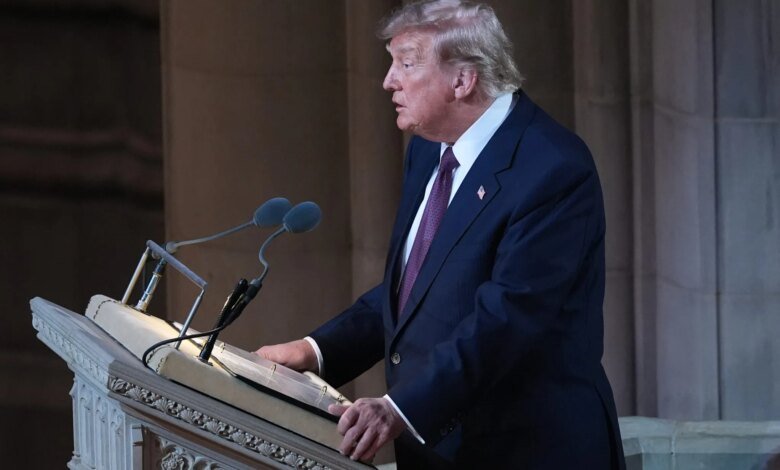
Speaking at the cathedral eulogy, Trump reflected on Graham’s career, specifically praising his passionate 2018 Senate Judiciary Committee defense of Brett Kavanaugh during contentious Supreme Court confirmation hearings as one of the defining moments of his legislative tenure.
In recognition of his military career and legislative advocacy for defense infrastructure, the Pentagon initiated formal administrative procedures to rename Joint Base Charleston in South Carolina. An official memorandum signed by Air Force Secretary Troy Meink officially launched the process to redesignate the major airlift installation as Joint Base Lindsey Graham.
Parallel to the memorial services, Capitol Hill moved forward with key executive branch confirmations. The Senate prepared to vote on confirming Jay Clayton to permanently head the Office of the Director of National Intelligence, replacing interim director Bill Pulte, who recently completed a 30 percent workforce reduction across the agency’s coordinating headquarters.