AI Infrastructure Boom Forces Massive Shift in US Electricity Demand Forecasts
New estimates indicate data centers could account for 20 percent of national power consumption by 2035 as hyperscale AI deployment accelerates.
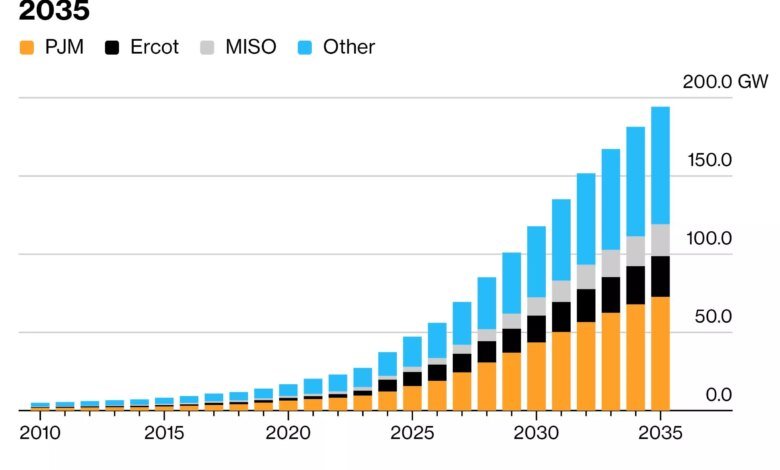
data centers across the United States are projected to consume 20 percent of the nation's total electricity supply by 2035, according to updated estimates from energy research firm BloombergNEF. Driven primarily by the rapid construction of facilities optimized for Artificial Intelligence, the updated figure represents a sharp acceleration in power demands that threaten to overwhelm domestic transmission infrastructure.
By 2030, energy consumption by data centers is expected to reach 12 percent of national supply, more than double the current baseline of approximately 5.9 percent. To sustain this trajectory, total capacity dedicated to data processing must swell to 194 gigawatts by 2035—an 83 percent increase over projections published by the firm just six months ago.
The sheer volume of electricity required highlights the massive scale of hardware needed to train and run complex generative models. In practical terms, one gigawatt of power generation capacity is roughly equivalent to the baseline output of a standard commercial nuclear reactor.
Regional utilities and transmission systems are expected to absorb the brunt of this growth. PJM Interconnection, the regional transmission organization overseeing the power grid across 13 states and the District of Columbia, forecasts that data centers could eventually claim more than one-third of its total generation capacity. PJM's service territory includes Northern Virginia, the world's largest concentration of data facilities, where tech conglomerates continue to secure substantial land and power allocations.
Grid administrators are already confronting severe connection bottlenecks. Lloyd Arnold, an analyst at BloombergNEF and co-author of the report, noted that existing networks are struggling to integrate new generation and storage assets quickly enough. The surge in demand from data centers coincides with broader societal electrification efforts, including the expansion of electric vehicle fleets, residential heat pumps, and municipal infrastructure upgrades.
On a global scale, international energy demand for data infrastructure is on track to hit 1,935 terawatt-hours. According to data tracked by the U.S. Energy Information Administration, that level of annual electricity consumption rivals the total power generated and consumed by entire major industrial economies such as India.
While current market trajectories reflect relentless investments by major tech firms, long-term projections remain subject to broader industry trends. A major contraction in artificial intelligence venture funding or commercial adoption could lead developers to cancel or postpone scheduled builds, echoing historical capacity adjustments seen following the dot-com buildout of the late 1990s. However, current capital allocations suggest tech infrastructure expansion will continue at a rapid pace for the foreseeable future.