Retro Constraints, Modern Cash: Coding Contest Challenges Developers to Fit an Entire Game on a 1.44MB Floppy Disk
With thousands of dollars in prizes, a new competition revives the lost art of extreme code optimization under retro hardware constraints.
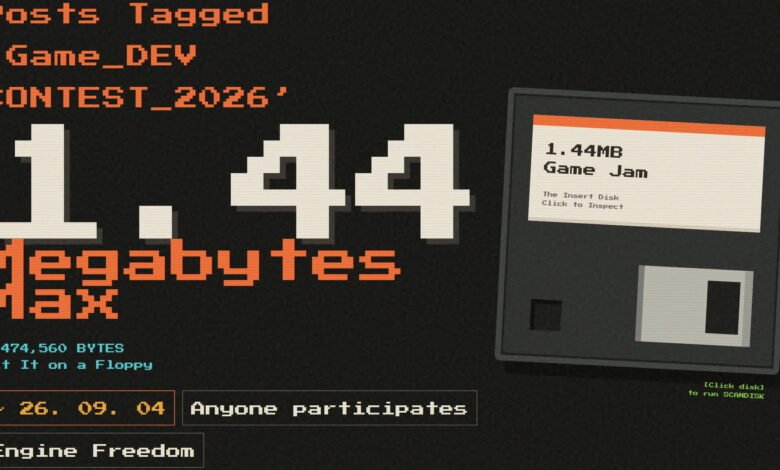
A new global programming competition is challenging game developers to squeeze an entire, fully functioning video game into just 1.44 megabytes—the storage capacity of a traditional 3.5-inch floppy disk.
Organized by the Korean platform 2P Game Arcade, the “1.44MB Game Dev Contest” seeks to revive the meticulous art of code optimization at a time when modern video games routinely demand over 100 gigabytes of storage space. Developers have until October 4 to submit their creations, with substantial cash prizes on the line for the most resourceful programmers.
To qualify, submissions must not exceed 1,474,560 bytes, even after any compressed assets are unpacked. This exact figure represents the standard capacity of the high-density floppy disks that dominated the personal computing landscape during the late 1980s and early 1990s. IBM first popularized this specific format in 1987 with its PS/2 personal computers, rendering the older 720-kilobyte double-density disks obsolete.
According to the organizers, the competition is open to both solo developers and teams from around the world. The rules dictate that all entries must be original, newly developed, and delivered as standalone executable files. Web-based or browser-based games are strictly prohibited. However, participants are granted complete freedom regarding their choice of development tools, meaning they can use popular commercial game engines or build their own custom software from scratch to maximize efficiency.
The financial incentives for mastering these tight constraints are significant. 2P Game Arcade will award three main prizes, with the top winner receiving 72 million Korean won (approximately $48,650). The runner-up prizes scale down to 14.4 million won (roughly $9,730). In a nostalgic nod to the medium, the winners will also receive a physical floppy disk containing their winning game.
This is not the first time the organizers have pushed programmers to their absolute limits. In 1997, 2P Game Arcade hosted a 100-kilobyte game development competition, a challenge that required even greater reliance on procedural generation and assembly-level coding.
The ethos of the new contest heavily mirrors the classic “demoscene,” an international computer art subculture that peaked in the 1990s. In the demoscene, programmers, artists, and musicians collaborated to create real-time audiovisual presentations, often restricted to tiny file sizes like 64 kilobytes or even 4 kilobytes. One of the most famous historical examples of this extreme optimization is .kkrieger, a fully 3D first-person shooter released in 2004 by the German demogroup .theprodukkt that occupied only 96 kilobytes of space by generating its textures and meshes procedurally at runtime. While modern spiritual successors like QUOD occasionally surface, such highly optimized projects have become rare in the commercial gaming industry.
The decline of rigorous optimization has coincided with a dramatic shift in consumer hardware. As microchip supply chain disruptions and inflation have made high-end PC hardware prohibitively expensive for average consumers, the industry’s reliance on raw hardware power over software efficiency has faced growing criticism. By forcing developers to work within the rigid boundaries of retro storage, competitions like the 1.44MB Game Dev Contest highlight how clever programming can bypass the need for expensive hardware upgrades.