Meta Pairs AI Optimism Campaign with David Bowie’s Apocalyptic Track ‘Five Years’
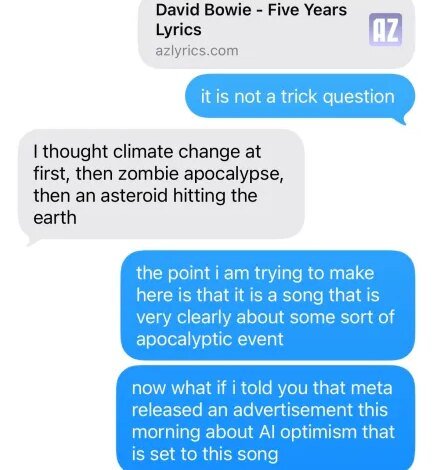
Meta’s latest effort to reframe public anxiety around Artificial Intelligence into tech-optimism has drawn widespread attention for an unexpected reason: its choice of soundtrack. In a new commercial designed to counter fears of job loss and social isolation, the social media giant paired uplifting scenes of human connection with David Bowie’s 1972 song “Five Years”—a track famously written about humanity discovering it has five years before total planetary destruction.
The advertisement opens in stark black and white, showing a close-up of an eye reading panic-inducing headlines about the societal risks of artificial intelligence. A voiceover rejects those warnings, declaring that Meta couldn’t disagree more with predictions that technology will leave people behind. The screen then shifts into vibrant color, presenting shots of friends embracing, teenagers swimming in a lake, and couples dancing on rooftops under a rainbow.
“Call us optimists. Call us dreamers. Call us whatever the hell you want. But we’re betting on people, and we like those odds,” the voiceover states as the commercial concludes. “The future is for everyone.”
Accompanying the ad’s release, Meta Chief Executive Mark Zuckerberg reiterated the company’s position in a social media statement. Zuckerberg noted that Meta remains focused on giving every person the tools to reach their potential as the tech sector moves into its next wave of development, adding that the benefits of the technology must be distributed to everyone.
However, the song driving the commercial carries a vastly different theme. David Bowie’s “Five Years” opens his iconic concept album about an impending end-of-the-world scenario, explicitly describing an Earth that is dying while crowds weep over their impending demise. Meta’s commercial utilizes a section of the track that repeatedly features the word “people,” creating an upbeat tone that contrasts sharply with the song’s apocalyptic narrative.
The musical disconnect highlights a recurring trend across Silicon Valley, where tech leaders frequently cite or adopt media with dark subtexts. Meta’s virtual reality brand Oculus previously distributed copies of Ernest Cline’s dystopian novel Ready Player One to new employees, despite the book depicting an evil virtual reality corporation dominating a ruined world. Similarly, OpenAI CEO Sam Altman has regularly referenced the sci-fi drama Her, a film cautioning against emotional dependency on artificial intelligence, while surveillance firm Palantir takes its name from a magical seeing stone used by the dark lord in The Lord of the Rings to spy on enemies.
Meta is not the only major developer attempting to manage public perception as competition accelerates. Anthropic recently debuted a promotional campaign intended to highlight its commitment to responsible development, though commentators quickly noted its unsettling tone. Altman publicly mocked Anthropic’s advertisement on social media, questioning whether the video was intended as satire.
These promotional pushes come at a time of widespread public concern. According to survey data from the Pew Research Center, only 16 percent of Americans believe that artificial intelligence will have a positive impact on society over the next 20 years, while 40 percent expect the technology’s influence to be largely negative.