Bitcoin Miners Pivot to AI as Multi-Billion Dollar Infrastructure Deals Spark Stock Rally
Hut 8 and IREN lead a sector-wide rally as miners transition to high-performance computing to offset declining mining rewards.
Shares in several major Bitcoin mining companies surged on Monday following the announcement of massive infrastructure agreements, signaling a deepening shift from cryptocurrency extraction toward artificial intelligence and high-performance computing. The rally highlights a growing trend where traditional miners leverage their massive power capacities to meet the insatiable energy demands of the AI boom.
Industry leaders witnessed significant double-digit gains during early trading. Shares in IREN, Cipher Digital, CleanSpark, Hut 8, and MARA Holdings each climbed by at least 11%. The market optimism follows a 15-year, $9.8 billion lease agreement announced by Hut 8 for its AI infrastructure campus, alongside IREN’s disclosure of $2.8 billion in cloud services contracts with AI developers.
This transition comes at a critical time for the sector. Following the Bitcoin halving in April 2024—an event that occurs every four years and slashes the rewards for mining new blocks by half—many firms have faced a challenging Bitcoin mining environment. To maintain profitability, companies are repurposing their data centers to host GPUs required for generative AI models, which offer more stable and predictable revenue streams than the volatile cryptocurrency market.
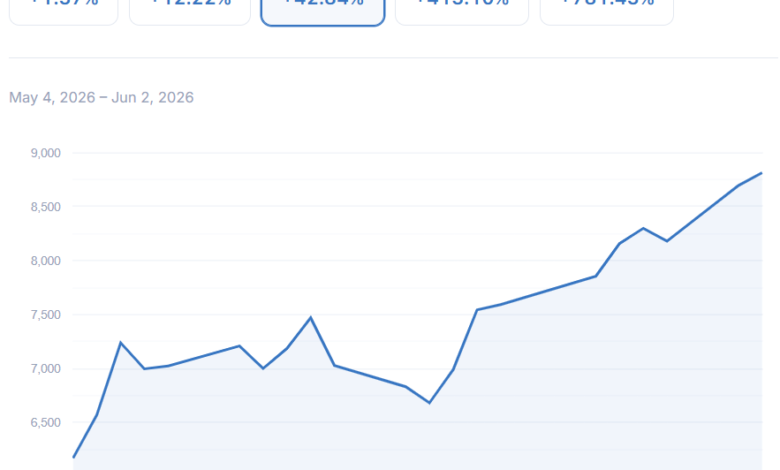
IREN has set ambitious targets for this new direction, projecting that its cloud business will generate more than $4 billion in annual recurring revenue by the end of 2026. The broader sector’s performance was captured by the TEM AI Infrastructure Growth Index, which rose 1.4% on Monday, marking a cumulative gain of over 12% within a single week.
The upward movement in mining stocks mirrored a recovery in the broader technology sector. The Nasdaq Composite Index gained 0.9% by midday, while the Philadelphia Semiconductor Index—a primary benchmark for the chipmakers that power AI hardware—rose 2%. This recovery follows a period of intense volatility where the semiconductor index briefly entered a technical bear market, defined as a 20% drop from recent peaks.
However, the pivot to AI is not without significant financial hurdles. Analysts at Blocksbridge Consulting suggest that the industry may require an additional $50 billion in capital to fully realize its ambitions in the AI space. IREN alone faces a projected funding gap of approximately $21.1 billion to meet its infrastructure goals. This massive capital requirement has led to increased scrutiny of the sector’s financial health and long-term sustainability.
Investor caution has also been piqued by recent reports of insider stock sales at firms like TeraWulf, Riot Platforms, Core Scientific, and Cipher Mining. While many of these transactions were conducted under prearranged Rule 10b5-1 trading plans, they have prompted questions regarding whether executives are capitalizing on AI-driven hype to exit positions at elevated valuations.
Despite these concerns, the sheer scale of the energy infrastructure controlled by Bitcoin mining companies remains their greatest asset. As AI developers struggle to find available power and cooling capacity in traditional data center hubs, the ready-to-use facilities owned by miners have become highly valuable real estate in the global race for computing dominance.