Mira Murati’s Thinking Machines Debuts ‘Inkling’: A 975B Parameter Challenge to AI Secrecy
Former OpenAI CTO Mira Murati debuts a massive 975B parameter open-weights model to challenge closed-source dominance.
Nearly two years after her high-profile departure from OpenAI, Mira Murati has re-emerged with a definitive answer to the industry’s growing demand for transparency and developer sovereignty. Thinking Machines Lab, the venture Murati founded in early 2025, officially released Inkling on July 15—a massive, 975-billion-parameter multimodal AI model that signals a shift toward high-performance, open-weights architecture in the Western market.
The release marks a significant milestone for Murati, whose tenure as CTO at OpenAI was defined by the meteoric rise of ChatGPT and the internal turbulence of November 2023. After briefly serving as interim CEO during the board’s temporary ousting of Sam Altman, Murati returned to her CTO role before leaving the company in September 2024. By February 2025, she had established Thinking Machines Lab, a move that many in the industry viewed as a strategic pivot toward the “open” philosophy that OpenAI’s critics argue the company has abandoned.
Thinking Machines Lab quickly became a magnet for capital, securing $2 billion in a July 2025 seed round led by Andreessen Horowitz. The funding, which valued the startup at $12 billion, included a “who’s who” of the hardware and enterprise tech world, including Nvidia, AMD, Cisco, and ServiceNow. While the company reportedly explored a staggering $50 billion valuation in November 2025, those discussions collapsed by January 2026, leaving the industry to wonder what the lab had been building behind closed doors. With the launch of Inkling, that mystery has been solved.
The Architecture of Inkling
Inkling is built on a Mixture-of-Experts (MoE) architecture, a design that allows for massive scale without the prohibitive computational costs of traditional dense models. In an MoE setup, only a specific subset of the model’s parameters—the “experts”—are activated for any given prompt. While Inkling boasts a total of 975 billion parameters, only 41 billion are active per task. This allows the model to maintain the depth of a trillion-parameter system while keeping inference speeds manageable for enterprise-grade hardware.
The model is natively multimodal, capable of processing text, images, and audio simultaneously. It features a context window of 1 million tokens—roughly equivalent to 750,000 words—allowing it to reason across massive datasets or entire codebases in a single pass. This capability is the result of a pretraining phase involving 45 trillion tokens across diverse media formats.
“Our first model, Inkling. Trained from scratch, weights are open, fine-tunable on Tinker today,” Murati announced via X. The decision to release the model under an Apache 2.0 license on Hugging Face is a direct challenge to the closed-source dominance of her former employer. By providing the full weights, Thinking Machines allows developers to host the model on their own infrastructure, ensuring data privacy and preventing the “vendor lock-in” associated with API-only models.
Benchmarking Agentic Power
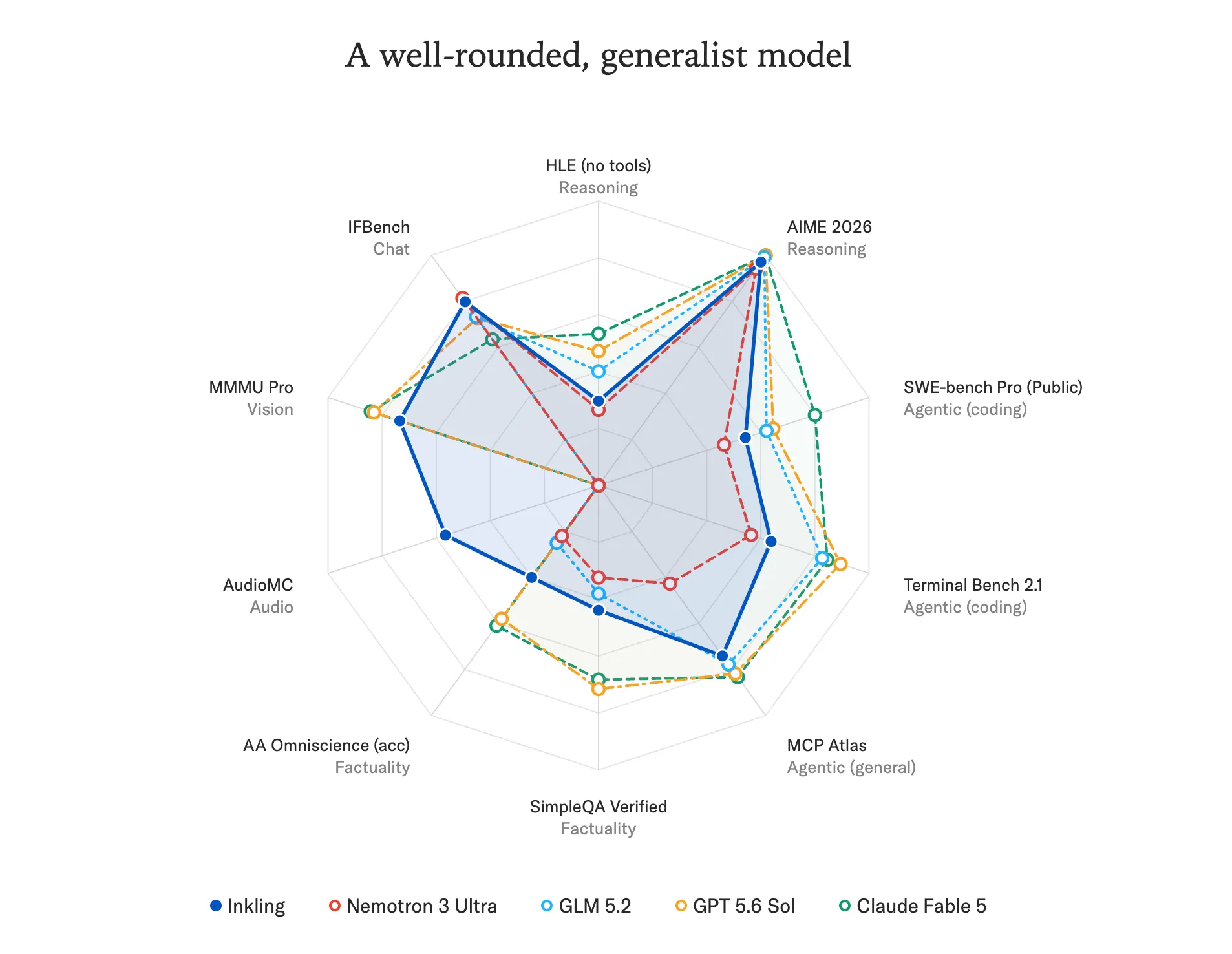
Inkling’s primary strength lies in its “agentic” capabilities—the ability of an AI to not just generate text, but to use tools and execute tasks autonomously. On the MCP Atlas benchmark, which uses the Model Context Protocol to test how AI assistants interact with external services, Inkling scored 74.1%. This performance puts it nearly 30 percentage points ahead of its primary Western open-weights competitor, Nvidia’s Nemotron 3 Ultra.
In the realm of software engineering, Inkling also showed dominance. It achieved a 77.6% score on SWE-Bench Verified, a rigorous test of an AI’s ability to resolve real-world GitHub issues, outperforming Nemotron’s 70.7%. These figures suggest that while Inkling is a generalist model, it is particularly well-suited for the next generation of AI agents that will automate complex technical workflows.
 Source: Thinking Machines
Despite these gains, the global AI race remains fiercely competitive. Chinese models still hold a lead in several specialized categories. Z.ai’s GLM 5.2, for instance, scored 82.7% on Terminal Bench 2.1—a test of autonomous coding in real terminal environments—compared to Inkling’s 63.8%. Additionally, Kimi K2.6 continues to lead on Humanity’s Last Exam, which focuses on PhD-level scientific reasoning.
Thinking Machines acknowledges that Inkling may not be the absolute strongest model in every metric. However, the lab positions it as the most capable Western alternative for developers who are restricted from using Chinese-built models due to legal, security, or compliance concerns. Furthermore, Inkling’s high score of 78.0% on FORTRESS Adversarial—a benchmark for safety and refusal handling—suggests a model that is both robust and ethically aligned with Western standards.
To facilitate adoption, Thinking Machines has launched Tinker, a cloud platform designed specifically for fine-tuning Inkling on specialized datasets. The company also previewed Inkling-Small, a 276-billion-parameter version (with 12 billion active) that aims to match the larger model’s reasoning capabilities in a more efficient package. While a specific release date for the smaller model’s weights has not been set, its existence underscores the lab’s commitment to providing a versatile suite of open tools for the blockchain and broader tech ecosystems.