Jim Hiller admits benching Gavin McKenna cost Maple Leafs
A 30-minute benching during a penalty kill spiraled into a blown two-goal lead as Toronto's roster depth was tested by injuries and fatigue.
Toronto Maple Leafs head coach Jim Hiller conceded he mismanaged rookie Gavin McKenna’s deployment during Thursday’s 5-4 overtime loss to the Buffalo Sabres, acknowledging that leaving the forward on the bench for roughly 30 minutes contributed to a damaging late-game collapse.
McKenna logged just 6:36 of total ice time. His final shift ended at the 10:20 mark of the second period, and he did not return for the remainder of regulation or the extra session. The decision effectively removed a dynamic offensive element from Toronto’s lineup precisely when the team was attempting to protect a two-goal advantage.
“That was my decision,” Hiller told reporters after the game. He attributed the extended absence to a sequence of Toronto penalties that disrupted his rotation plans. Once the intermission arrived, McKenna had been inactive long enough that Hiller hesitated to throw him back into a tight contest, fearing the break in rhythm could lead to mistakes. “He sits through the intermission. Probably should’ve gotten him out at the start of the third. I’ll talk to him about that.”


Bench management during penalty-heavy stretches remains one of the most difficult tactical challenges for NHL coaches. When a team takes consecutive infractions, bottom-six forwards and developing rookies are routinely bypassed in favor of established defensive specialists tasked with killing the penalties. However, allowing a young player to cool down entirely—especially one whose primary value is speed and puck-handling—often creates a self-fulfilling prophecy where the coach feels the player is too cold to use, even when fresh legs are desperately needed.
Toronto paid a steep price for the conservative approach. Kirill Marchenko had staked the Maple Leafs to a 4-2 lead late in the second period by completing a hat trick. But Buffalo seized control of the third period against a shortened Toronto rotation. Defensemen Dennis Gilbert and Mattias Samuelsson scored to erase the deficit and force overtime, capitalizing on tired matchups before Owen Power delivered the winner at 3:14 of the extra frame.
The Sabres’ comeback was aided by another significant blow to Toronto’s depth. Captain John Tavares exited early in the third period following a collision with Buffalo forward Josh Norris. Losing Tavares further compressed Hiller’s available options down the middle, compounding the issues created by keeping McKenna glued to the bench while simultaneously asking veteran forwards to absorb heavier workloads late in the game.
NHL: Buffalo Sabres at Toronto Maple Leafs
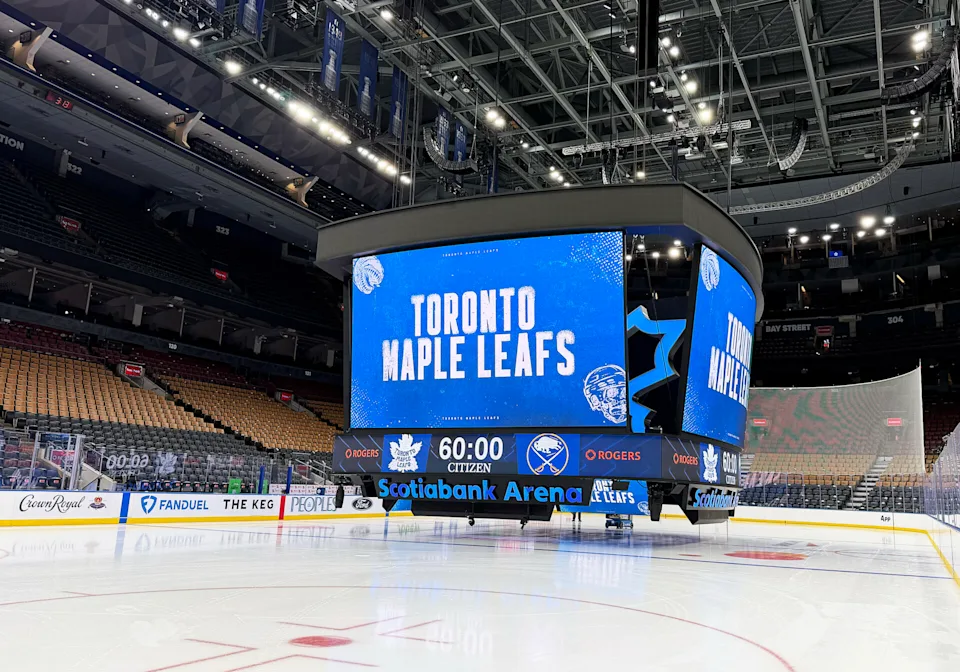
Toronto, Ontario, CAN; A general view of the scoreboard during the game between the Buffalo Sabres and the Toronto Maple Leafs at Scotiabank Arena. Mandatory Credit: Nick Turchiaro-Imagn Images Credit: IMAGN IMAGES via Reuters Connect (Reuters)
Hiller’s postgame remarks clarified that the reduced role was strictly a product of game flow rather than a disciplinary response to McKenna. The rookie has faced external scrutiny earlier this season regarding missed practice sessions, but the coaching staff maintained that Thursday’s situation was purely circumstantial. Still, the optics of scratching a high-profile young player during an overtime loss invite immediate questions about organizational patience and development timelines.
For first-year players adjusting to the NHL pace, erratic ice time can stall development faster than poor performance. Rookies typically require consistent shifts to build timing and confidence. Extended benchings due to special teams situations are common, but failing to reintegrate a player once five-on-five play resumes can leave them physically stiff and mentally disengaged—a risk Hiller publicly recognized he failed to mitigate.
Hiller confirmed he plans to speak directly with McKenna about the sequence of events. Toronto continues to navigate a stretch complicated by mounting injuries, including recent concerns surrounding defenseman Chris Tanev, forcing the coaching staff to constantly recalibrate its nightly lineup construction.