
BRICS Pushes Dollar Alternatives as New Delhi Summit Ends
Expanded bloc targets dollar dependence and Western trade restrictions
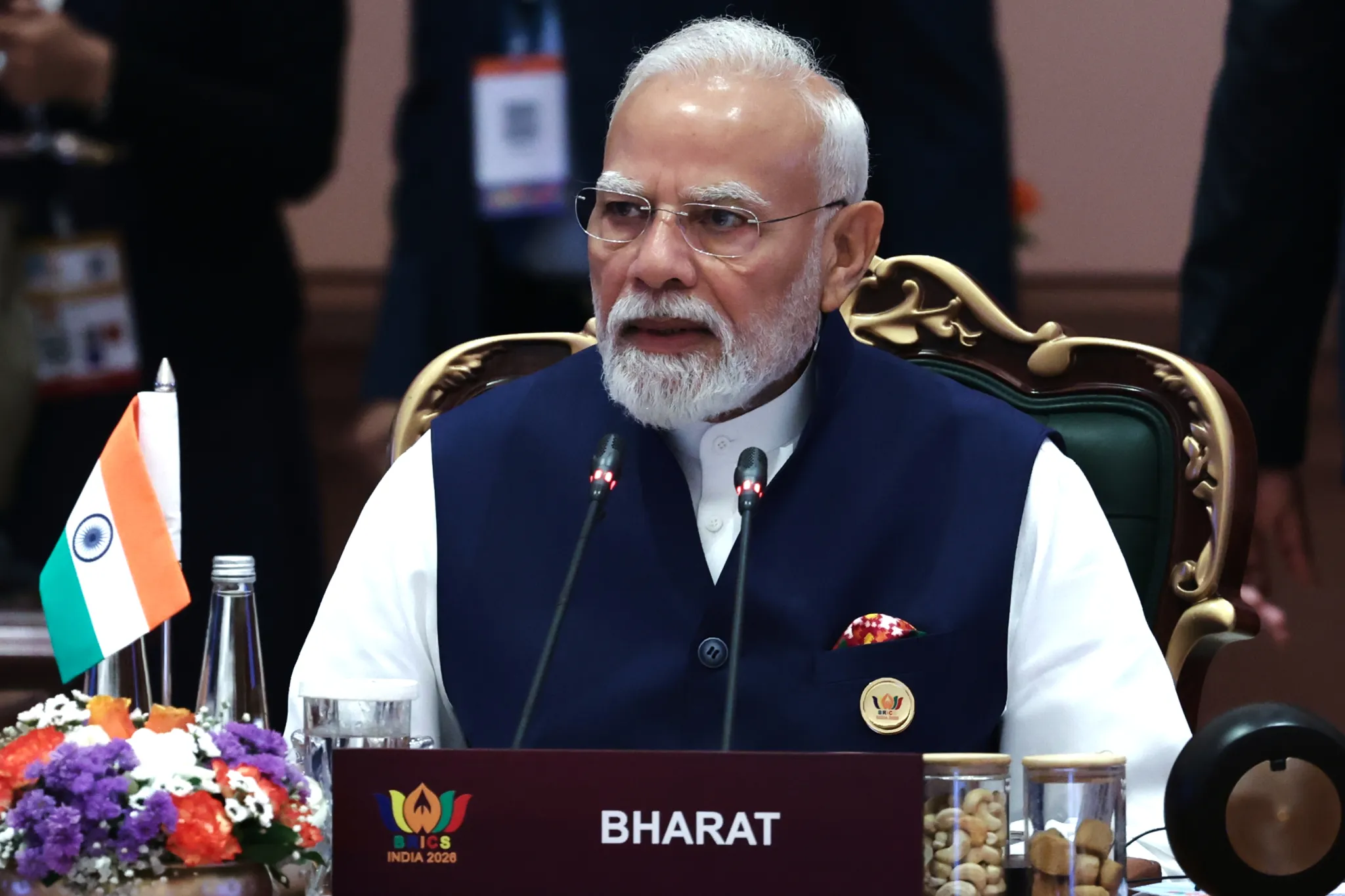
NEW DELHI — The expanded BRICS bloc of major developing nations ended two days of summit meetings in New Delhi with calls to reorder global financial mechanics, reduce reliance on the U.S. dollar, and challenge Western-led economic sanctions and trade barriers.
The group’s final joint declaration called for greater use of local currencies in international commercial transactions and the creation of enhanced cross-border payment platforms. Member states also backed comprehensive reforms to the United Nations Security Council, the International Monetary Fund (IMF), and the World Bank.
BRICS member nations pledged to deepen operational linkages between their central banks and financial institutions as China prepares to assume the bloc’s presidency. The effort is intended to lay the groundwork for alternative clearing systems that can cushion members against international financial volatility and geopolitical trade restrictions.


The declaration criticized unilateral economic sanctions and non-U.N.-mandated coercive measures, as well as rising import tariffs and non-tariff barriers. It said such restrictions distort global trade and destabilize international supply networks. The summit’s discussions also addressed digital trade infrastructure, artificial intelligence governance, energy security, food production networks, and climate mitigation strategies.
Indian Prime Minister Narendra Modi warned that the “weaponization of technology and critical minerals” threatens global development. He urged member states to protect cross-border trade networks while expanding support for countries across the Global South.
“Pandemics, climate disasters, and supply-chain disruptions have shown that in today’s interconnected world, no crisis remains confined to a single region,” Modi said. He announced that BRICS nations had agreed to establish an integrated early warning system to detect and respond to emerging infectious disease outbreaks before they escalate globally.
During a joint session with Chinese President Xi Jinping, Russian President Vladimir Putin, and Iranian President Masoud Pezeshkian, Modi said, “The number of conflicts and tensions in the world is continuously increasing, and this is having an increasingly negative and far-reaching impact on the lives of ordinary people.”
In the summit’s closing session, Modi called on member states to move beyond diplomatic statements and implement their commitments through concrete, time-bound measures, shifting policy agreements from “files to real-life impact.” He described BRICS as “an ecosystem of solutions” rather than a mere geopolitical talk shop and extended best wishes to China, which will assume the rotating BRICS chair for the upcoming term.
Consensus on the final declaration required coordination among members with diverse foreign policy priorities and regional rivalries. In the joint declaration released on Saturday, the group voiced deep concern over escalating military conflicts in the Middle East and the civil war in Sudan, urging all involved parties to resolve disputes through diplomatic negotiations rather than unilateral force. Agreement among traditional Middle Eastern rivals, including Saudi Arabia, Iran, and the United Arab Emirates, accompanied the bloc’s economic alignment.
The present size of the group follows a series of expansions. Goldman Sachs economist Jim O’Neill coined the acronym “BRIC” in 2001 for Brazil, Russia, India, and China. The four countries formalized diplomatic coordination in 2006 on the sidelines of the U.N. General Assembly and held their first official summit in Yekaterinburg, Russia, in June 2009.
South Africa joined in 2010, changing BRIC to BRICS. A landmark expansion agreed upon at the August 2023 summit in Johannesburg, South Africa, brought the bloc to 11 members, adding major energy producers and regional powers including Iran, Saudi Arabia, the United Arab Emirates, Egypt, and Ethiopia.
BRICS now represents approximately 45 percent of the world’s population, or roughly 3.5 billion people, and controls more than 35 percent of global gross domestic product (GDP) measured by purchasing power parity (PPP). That figure exceeds the combined economic output of the Group of Seven (G7) industrialized nations. The inclusion of key Persian Gulf states has also placed over 40 percent of global crude oil production under the umbrella of BRICS member states.
The New Development Bank (NDB) remains central to the bloc’s economic strategy. BRICS nations established it during their 2014 summit in Fortaleza, Brazil. Headquartered in Shanghai and founded with an initial capital base of $50 billion, the NDB was created to mobilize resources for infrastructure and sustainable development projects in emerging economies, offering an alternative to traditional lending conditions imposed by Washington-based institutions like the World Bank.