

AI-Generated Gaboon Viper Photo Triggers Full Police Response and Public Alert in Santa Ana
Herpetologists spotted immediate biological flaws in the fabricated image, but officers were required to treat the threat as real until the caller confessed.
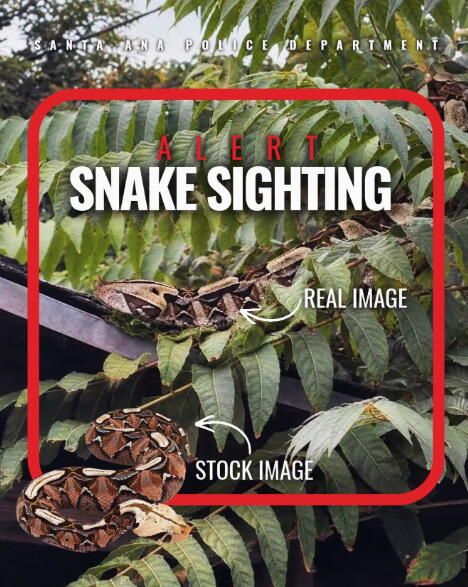
A fabricated image of a massive African viper perched on a thin tree branch forced the Santa Ana Police Department into hours of emergency wildlife tracking before investigators confirmed the photograph was generated by artificial intelligence.
The incident underscores how rapidly advancing synthetic media can hijack municipal emergency resources, compelling law enforcement to treat digital fabrications as active public safety threats until proven otherwise.
Officers and wildlife specialists scoured a residential neighborhood near Main Street and Edinger Avenue on Monday after a man called 911 claiming his dogs had alerted him to the reptile resting on a shed. The caller provided a photograph that authorities immediately broadcast across social media platforms, urging residents to stay vigilant and avoid approaching the animal.


Herpetologists identified glaring biological impossibilities in the image almost immediately. The snake depicted resembled a Gaboon viper, a species native to the rainforests and savannas of sub-Saharan Africa rather than Southern California suburbs. More critically, the physical positioning defied the animal’s anatomy. Gaboon vipers are heavy-bodied ambush predators that can exceed 45 pounds. They hunt rodents and ground-dwelling birds from the forest floor, relying on intricate geometric camouflage patterns to blend into leaf litter.
Greg Pauly, a herpetologist at the Natural History Museum of Los Angeles County, noted that the creature in the photograph was balanced on a weak branch with another branch appearing to pass directly through its body. A snake of that mass would snap such foliage instantly. Reaching an elevated position like the one depicted would require either human placement or digital manipulation.
Despite early suspicions regarding the image’s authenticity, standard police protocol required SAPD to treat the report as credible. The department mobilized a multi-agency search, bringing in the president of the Southern California Herpetology Association and Rescue alongside other reptile experts to assist with identification and capture strategies.
Public advisories warned that the venomous snake was loose in the neighborhood. Gaboon vipers possess the longest fangs of any snake species, capable of delivering massive quantities of cytotoxic venom. While generally placid and unlikely to strike unless stepped on, their bite is a severe medical emergency requiring specialized antivenom rarely stocked in U.S. hospitals. Unlike many pit vipers that strike and release, Gaboon vipers typically bite and hold their prey until it dies.
The search yielded no physical evidence of the reptile. By Monday evening, SAPD cleared the area and announced that no movement consistent with the species had been detected.
During a follow-up investigation, the reporting man admitted the photograph was AI-generated and the initial 911 call was false. Filing a false police report in California is a misdemeanor under Penal Code 148.5, punishable by up to six months in county jail and fines, though prosecutors weigh factors such as the scale of the emergency response when deciding whether to press charges.
Law enforcement agencies nationwide have reported a sharp increase in resource-draining hoaxes fueled by generative AI tools over the past two years. Synthetic images of dangerous animals, fires, and crime scenes routinely bypass initial screening protocols because dispatchers must prioritize potential threats to human life. This structural vulnerability forces departments to deploy personnel first and verify digital evidence second.
SAPD confirmed the case remains closed following the admission.










2 Comments