

AI Infrastructure Boom Pushes Tech Investment Past U.S. Housing
Tech borrowing accelerates while high mortgage rates suppress U.S. homebuilding
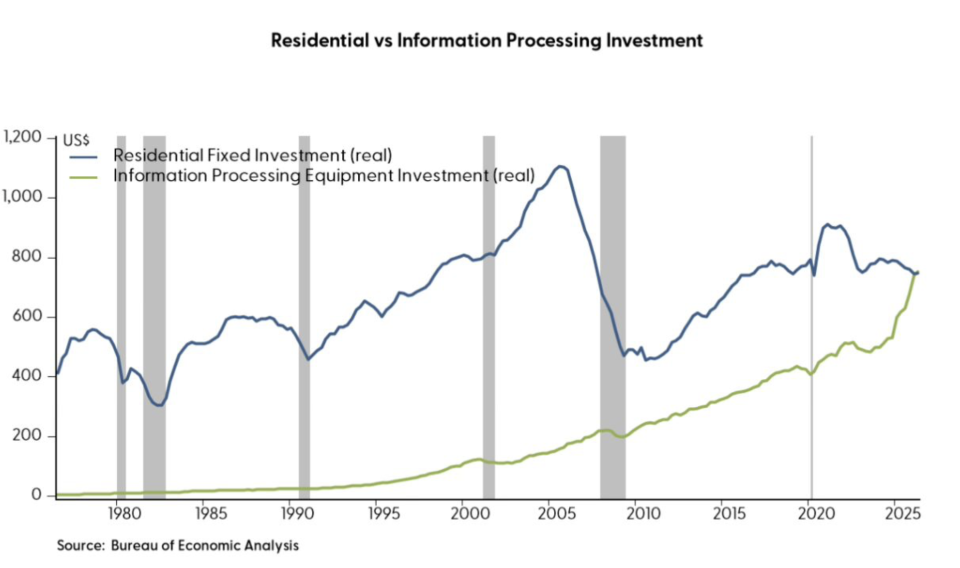
WASHINGTON — Real private spending on information processing equipment, including computer hardware, servers, and data center components, reached an annualized $752 billion in the second quarter, according to the U.S. Bureau of Economic Analysis (BEA). The figure was up 51% from an early 2021 baseline.
Over the same period, real private residential fixed investment fell 18% from its early 2021 peak to $748 billion in the second quarter. Business equipment spending has therefore surpassed residential real estate investment for the first time in recent history.
Adam Shapiro, vice president at the Federal Reserve Bank of San Francisco, wrote in a public analysis on LinkedIn, “We’re seeing a pivotal shift in the US economy: investment is shifting away from residential investment and towards computers,” adding, “The AI investment boom is massive.”


The shift is being driven by major technology companies building artificial intelligence infrastructure. According to S&P Global, capital expenditures from Alphabet Inc., Amazon.com Inc., Microsoft Corp., Meta Platforms Inc., Oracle Corp., and SpaceX are projected to reach $470 billion in 2025. S&P Global estimates the amount will rise to $870 billion in 2026 and exceed $1.3 trillion annually by 2027.
Technology firms are increasingly using corporate bond markets to supplement cash reserves. Earlier this year, Google parent company Alphabet reported negative cash flow as capital outlays increased, while corporate debt issuance from technology firms remained robust despite elevated benchmark borrowing costs.
Treasury Secretary Scott Bessent said technology-sector corporate issuers appear largely unconcerned about high yields when raising money for hardware and facility construction.
“We are also seeing big corporate issuance. And a lot of that corporate issuance, I would say, is almost yield-agnostic, because the build-out for AI, the returns on that, the companies believe they’re going to be so high. They don’t really care what they’re paying,” Bessent said.
The capital spending surge is led by a small group of technology giants and has continued largely undeterred by elevated interest rates. S&P Global warned that spending by the hyperscalers is currently growing faster than their revenue. The credit ratings agency forecasts that the six companies’ combined operating cash flows will turn negative in 2026 and 2027.
S&P Global also warned that the aggressive buildout could create temporary overcapacity if consumer and commercial demand for AI services does not develop as quickly as expected. It expects spending to flatten and revenues to accelerate by an inflection point in 2028.
Residential real estate has faced a different response to monetary policy. The Federal Reserve began an aggressive rate-hiking cycle in March 2022 to combat inflation, after the mid-2000s housing boom had served as the primary engine of U.S. economic growth.
The Fed lifted its benchmark federal funds rate from near zero to a target range of 5.25% to 5.50%. Yields on 10-year U.S. Treasury notes reached their highest levels since 2007, while standard 30-year fixed mortgage rates fluctuated near 7%.
Millions of existing homeowners who secured sub-4% mortgage rates during the pandemic have been locked in by higher borrowing costs. Many have been unwilling to sell, keeping resale inventory depressed. Developers have also faced significantly more expensive construction financing.
U.S. housing starts fell 2.6% in August to an annualized rate of 1.275 million units, with the decline weighed down primarily by a pullback in multi-family apartment construction. Single-family starts recorded a modest gain, but building permits fell, pointing to muted construction activity in the months ahead.
The National Association of Home Builders (NAHB) reported that its builder sentiment index declined to its lowest level in a year. Capital market research firm Capital Economics wrote, “The big picture remains that elevated and rising borrowing costs are holding developers back, supporting our view that the downward trend in housing starts has further to run,” in an analysis.
The divergence between technology investment and residential construction reflects the different ways corporate technology balance sheets and consumer-facing sectors respond to the central bank’s monetary stance. Corporate borrowing for AI infrastructure has continued even as housing activity has weakened.
The physical expansion of AI infrastructure is also producing economic and political friction. Data center installations require massive amounts of electrical power and industrial cooling, contributing to rising utility bills for residential consumers. The buildout is also driving up retail prices for hardware such as AI-capable personal computers and smartphones.
Massive data centers have generated political opposition in local communities ahead of the midterm election season. An NBC News poll found that 64% of registered voters said they would be less likely to vote for a political candidate who supports building a data center in their local area.









