

AI Infrastructure and Sovereign Debt Collide for Global Capital
Sovereign borrowing and AI data-center spending intensify the global fight for long-term capital
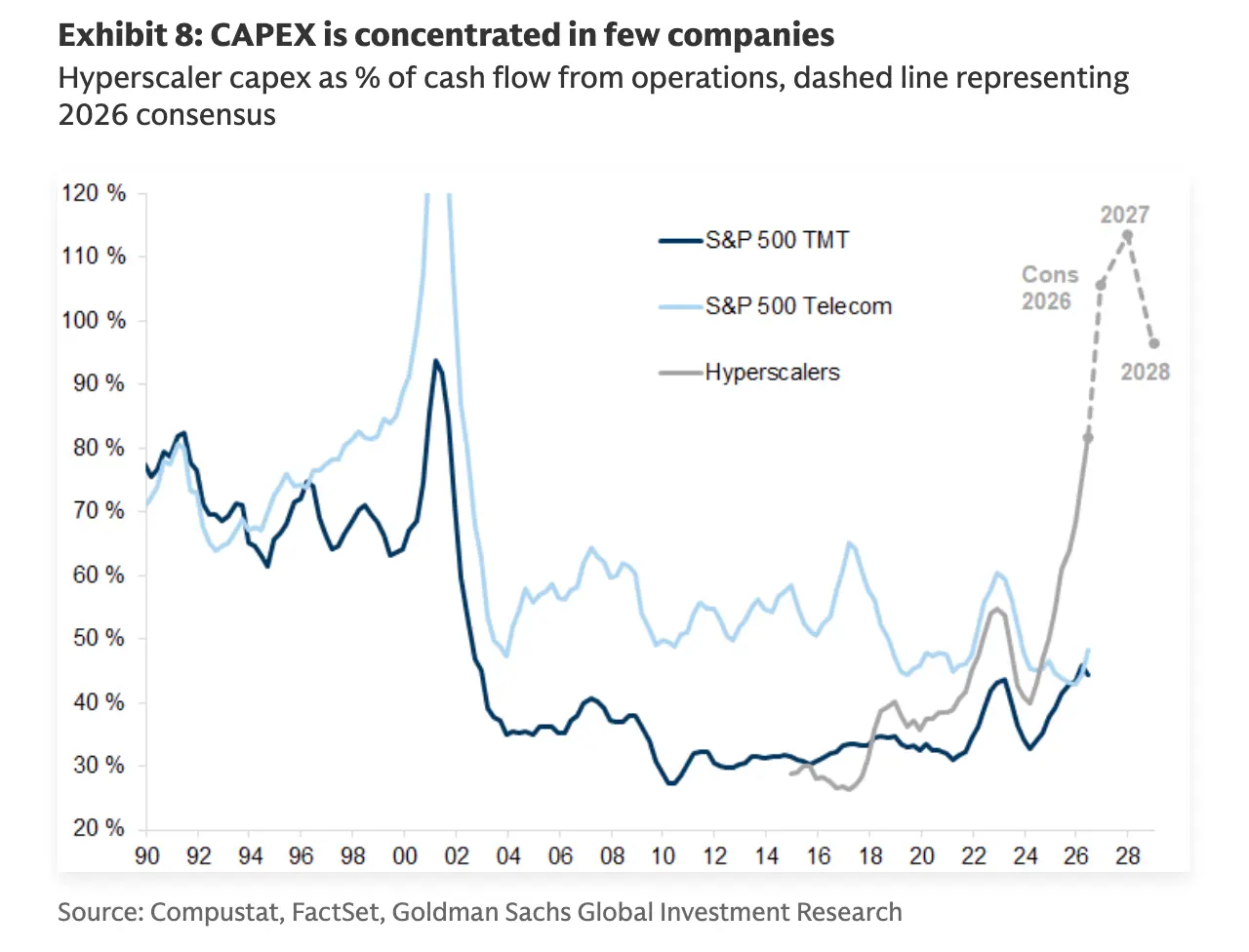
Global fixed-income and corporate credit markets are undergoing a structural shift as expanding sovereign debt obligations collide with the capital requirements of artificial intelligence infrastructure. National governments are increasing debt issuance to fund defense spending, energy grid upgrades, and fiscal deficits, while private technology companies are entering capital markets to finance gigawatt-scale data centers, specialized hardware, and power generation.
Goldman Sachs data shows that credit analysts have raised their full-year forecast for U.S. investment-grade corporate bond issuance by $200 billion, to $2.3 trillion. Borrowers financing AI-related development and physical infrastructure account for approximately 25% of that supply. U.S. convertible bond volume has reached $135 billion year-to-date, and AI infrastructure operators represent 44% of total issuance.
At Goldman Sachs’ Communacopia Technology Conference, executives from semiconductor designer Nvidia reiterated forecasts that the total addressable market for artificial intelligence infrastructure will reach $3 trillion to $4 trillion by 2030. Microsoft, meanwhile, has outlined strategic plans to triple its global data center footprint over a six-year period.


Peter Oppenheimer, Goldman Sachs chief global equity strategist, described the changing capital environment in a research note titled “Competition for Capital.” Sovereign governments require long-term funding for infrastructure, defense, and debt servicing, while technology companies are raising long-term capital to expand energy and compute capacity.
Aggregated capital expenditures among AA-rated technology issuers rose 65% year-over-year in the second quarter. It was the tenth consecutive quarter in which aggregate capex growth for this tier exceeded 35%, adding to the pressure created by the simultaneous borrowing needs of governments and corporations.
Torsten Slok, chief economist at Apollo Global Management, wrote in a separate analysis that the global financial system is moving away from the previous era of a “savings glut,” when abundant capital drove interest rates to historical lows, and toward a regime of capital scarcity. Power plants, electric transmission lines, data center facilities, and sovereign budget deficits are competing directly for long-term private savings.
Because these infrastructure demands require multi-decade funding, pressure has concentrated at the long end of the yield curve. Yields on 30-year sovereign debt in major economies including Germany and Japan, which traded near or below zero as recently as 2022, have adjusted significantly higher.
In secondary debt markets, credit spreads on long-dated corporate bonds issued by major technology hyperscalers have widened. A significant portion of corporate debt paper issued in 2026 now trades at wider spreads than at initial pricing, as institutional investors require higher yields to absorb elevated corporate debt supply.
The financial pressure across debt markets has renewed attention on whether the technology sector faces an “earnings bubble,” in which profit growth fails to keep pace with the elevated cost of capital used to fund capital investments. Oppenheimer cautioned that historical stock market downturns can occur through earnings contractions rather than speculative equity valuation spikes.
Before the 2008 global financial crisis, commercial banks briefly became the largest single sector weight in the S&P 500 without trading at extreme price-to-earnings multiples comparable to technology equities during the 1999 dot-com bubble or Japanese equities in the late 1980s. Bank earnings were instead inflated by rapid growth in balance-sheet leverage tied to underlying U.S. residential real estate assets. When real estate valuations declined, bank earnings collapsed.
Current technology-sector corporate fundamentals differ substantially from the leverage profile of 2008 financial institutions. Interest coverage ratios for the aggregate S&P 500 rank in the 99th percentile of the past 20 years, while the median stock within the index ranks in the 68th percentile.
Demand for computational capacity continues to outpace near-term supply. Yet volatility has appeared among hardware vendors and semiconductor suppliers when expectations for capital deployment are questioned.
On September 14, semiconductor stocks declined broadly after Anthropic Chief Executive Officer Dario Amodei and OpenAI Chief Executive Officer Sam Altman made statements concerning frontier model development timelines and safety parameters. The Philadelphia Semiconductor Index fell nearly 6% during the session, while Nvidia shares dropped over 3%.
Shares of major hyperscale cloud operators, including Alphabet, Microsoft, and Meta Platforms, advanced during the same trading session. Gil Luria, head of technology research at D.A. Davidson, said the structural divergence reflects differing business models within the technology supply chain.
Hyperscale operators funding data center construction have balance-sheet cash flows that allow them to slow capital expenditures and harvest earnings from existing assets if deployment yields moderate. Hardware and semiconductor providers, by contrast, remain directly dependent on sustained capital expenditure expansion from cloud providers to maintain their revenue growth trajectories.









One Comment