$10 Trillion Debt Wall Hits as Bond Yields Shatter Forecasts
Short-term issuance strategy leaves the Treasury exposed as 10-year yields blow past official projections.
More than $10 trillion in U.S. government debt matures over the next 12 months. Treasury Secretary Scott Bessent must refinance that mountain of obligations at borrowing costs that have already blown past every official projection, locking in higher interest expenses for years regardless of what happens to the broader economy.
The 10-year Treasury yield sits above 5%. That single metric dismantled the baseline assumptions the Congressional Budget Office used in February, when it forecast yields of 4.1% this year, creeping to just 4.4% by 2032. The gap between those estimates and current market reality is not a rounding error. It represents hundreds of billions of dollars in additional annual carrying costs on a gross national debt that reached $40 trillion last month.
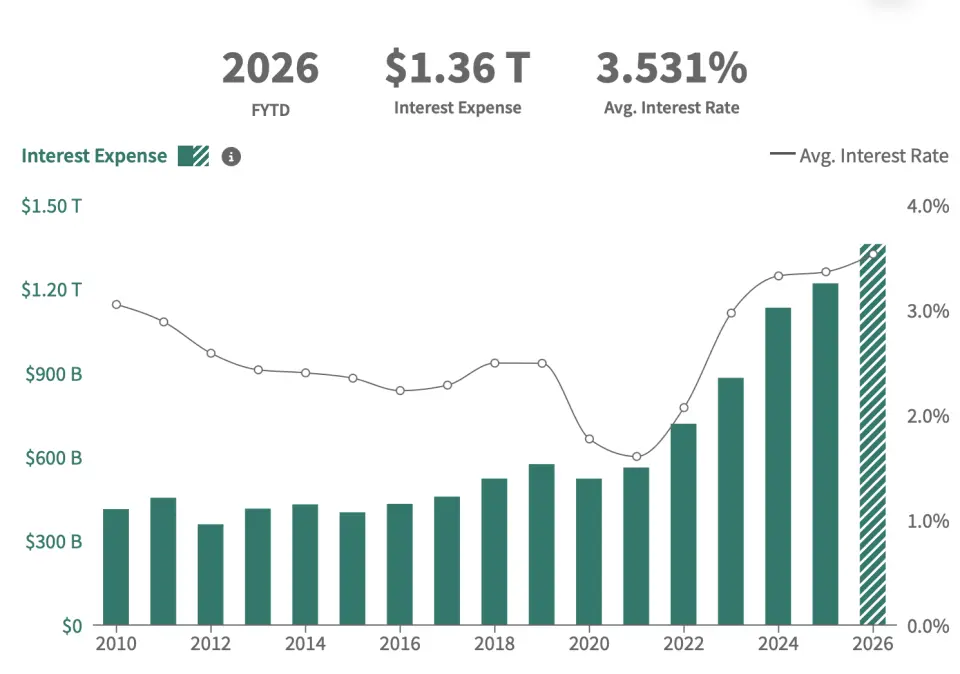
Bessent accelerated the problem before yields spiked. By issuing more short-term debt to finance the deficit and retiring long-term obligations, the Treasury Department concentrated its refinancing risk into a narrow window. Roughly one-third of all publicly held debt now rolls over within a single year. When the average interest rate was 1.7% in 2021, short-term issuance was cheap money. At a 3.53% average rate across fiscal 2026, with net interest payments hitting $1.05 trillion, the strategy forces the government to repeatedly price its liabilities at peak volatility.


Fiscal 2026 closed with a $1.99 trillion deficit. Revenue climbed 3% to $5.4 trillion. Spending jumped 6% to $7.4 trillion. Net interest outpaced both, rising 8% and consuming about $2.9 billion daily. The Peter G. Peterson Foundation calculated those payments at 3.2% of GDP, surpassing the 1991 record.
Geopolitics widened the spread. The Iran war launched by President Donald Trump sent oil prices and bond yields soaring simultaneously. Investors demanded higher compensation to hold U.S. paper. The Committee for a Responsible Federal Budget calculated that if yields remain roughly 1 percentage point above CBO estimates, interest costs will hit $2.8 trillion by the end of the decade, consuming 5.9% of GDP.
“Higher interest begets more debt, and greater debt begets higher rates and higher interest,” CRFB President Maya MacGuineas said last month. “Eventually, the whole thing could come crashing down.”
Washington is moving in the opposite direction. Trump proposed a $5,000 dividend check to Americans contingent on Republican midterm victories and authorized rebate distributions to millions of Medicare and Affordable Care Act enrollees. Bessent argued at Southern Methodist University last month that 3% economic growth would allow the country to “grow our way out of this” once the conflict ends.
CBO Director Phillip Swagel rejected that math last week. Faster growth generates more tax revenue but also drives up wages, which automatically increases Social Security benefit payouts. A hotter economy typically pushes interest rates even higher. Swagel estimated stabilizing the debt under current rate conditions requires nominal GDP growth of 7% to 8%, or real growth of 5% to 6%.
Second-quarter real GDP expanded 2.2%. Bullish Wall Street forecasts target 2.5% for the full year.