

Bitcoin Awaits the Fed as Crypto Investors Look Past Washington
Liquidity, not legislation, drives the next crypto move

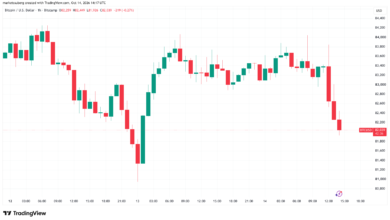
WASHINGTON — Bitcoin traded at approximately $76,140 on Wednesday morning, down 0.9% over 24 hours and 4% for the week. The digital currency reached a 24-hour high of $77,146 and a low of $75,038, while trading volume reached $1.6 billion.
The market’s resilience followed the U.S. Senate’s decision to block the Digital Asset Market Clarity Act on Tuesday. Institutional cryptocurrency investors are shifting attention from legislative roadblocks on Capitol Hill to Federal Reserve monetary policy, with macroeconomic liquidity remaining the primary driver of digital asset valuations.
Financial markets have overwhelmingly priced in a quarter-point, or 25 basis point, rate hike at the Federal Reserve’s upcoming decision. The CME FedWatch Tool puts the probability of that increase at 93%, up sharply from the 33.1% probability recorded one month ago.


Investors are watching the forward-looking guidance from Federal Reserve Chair Kevin Warsh more closely than the rate decision itself. Analysts say the central bank’s language will determine whether digital assets experience a year-end rally or a deeper correction. October and November have historically been Bitcoin’s top-performing months of the year.
A supportive, or “dovish,” signal could characterize the rate adjustment as a protective measure and catalyze a strong fourth-quarter performance for risk assets. Hawkish rhetoric from Chair Warsh, by contrast, could prompt a reassessment of risk and potentially force Bitcoin to retest previous support levels near $63,000.
Institutional traders have reduced exposure ahead of the announcement. Data from digital asset trading platform Talos showed a 28% net buying tilt toward stablecoins, reflecting a pronounced shift toward liquidity. At major Federal Open Market Committee (FOMC) meetings, stablecoins have historically recorded an average 8% selling tilt as investors deployed capital into active trading pairs.
Buying conviction has also cooled for major cryptocurrencies: Bitcoin declined from 10% to 3%, while Ethereum fell from 23% to 9%. Systematic and quantitative trading strategies have pivoted aggressively toward selling to mitigate short-term volatility, although institutional hedge funds have maintained a risk-on stance and remain net buyers with a 25% purchasing tilt.
The accumulation of stablecoin balances on trading platforms leaves substantial capital on the sidelines until macroeconomic uncertainty clears. The strategy resembles the market dynamics of July 2023, the last time the Federal Reserve implemented a rate hike. Bitcoin remained relatively flat after that announcement because the policy move had already been fully integrated into market pricing.
Order-book depth has remained stable. Analysts are monitoring whether stablecoin capital flows back onto active exchanges as a sign of returning risk appetite, while also tracking derivatives funding rates and open interest to determine whether the current market stance is a temporary sentiment shift or a fundamental change in the investment thesis.
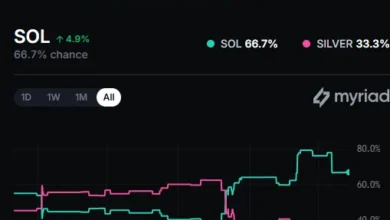
Retail sentiment and decentralized prediction markets remain optimistic despite the near-term macroeconomic headwinds. On the prediction platform Myriad, users have assigned a 72% probability to Bitcoin’s next major directional move targeting the $84,000 threshold.

Market analysts connect the broader correction in digital assets to global dollar liquidity rather than legislative outcomes in Washington. Tighter financial conditions, U.S. Treasury yields moving back toward the 5% threshold, rising global energy prices, and persistent inflationary pressures continue to weigh on speculative assets. From a structural perspective, a sustainable market rally depends on a liquidity bottom rather than a policy bottom.
The failure of the Digital Asset Market Clarity Act underscores the challenges of establishing a comprehensive federal regulatory framework for digital assets in the United States. Without congressional action, federal regulatory agencies are attempting to govern the sector through their existing administrative frameworks.
In August, Commodity Futures Trading Commission (CFTC) Chair Michael Selig directed agency staff to draft a comprehensive crypto market structure regime using the commission’s existing statutory authority. Securities and Exchange Commission (SEC) Chair Paul Atkins likewise indicated that his agency was prepared to outline regulatory boundaries through internal administrative rulemaking.
That approach faces strict legal limits. Under U.S. administrative law, executive agencies cannot invent regulatory powers that Congress has not explicitly authorized. The CFTC’s spot-market oversight of commodities such as Bitcoin and Ethereum, for example, is limited to policing fraud and market manipulation, leaving a regulatory vacuum for day-to-day spot exchange operations.
The uncertainty affects industry sectors differently. Well-capitalized, established institutional platforms can navigate regulatory uncertainty on a case-by-case basis, whereas decentralized finance (DeFi) protocols and smaller startups must devote significant capital to legal opinions and potential litigation, sharply increasing operational costs.
Some market participants expect part of the transaction volume to move toward decentralized, on-chain trading venues designed to provide robust custody protections without relying on traditional centralized legal structures.




2 Comments