Crypto Bunker Mode Debate: Can AI Break Blockchain Keys?
Moving funds to fresh addresses won't protect wallets if extended public keys are already exposed to third-party apps.
Cryptocurrency networks face a theoretical vulnerability that has nothing to do with quantum computers. A growing debate among cryptographers and blockchain engineers centers on whether rapid advances in artificial intelligence could allow classical computing systems to discover new mathematical shortcuts capable of deriving private keys from public keys, effectively dismantling the security model of Bitcoin, Ethereum, and most other digital assets.
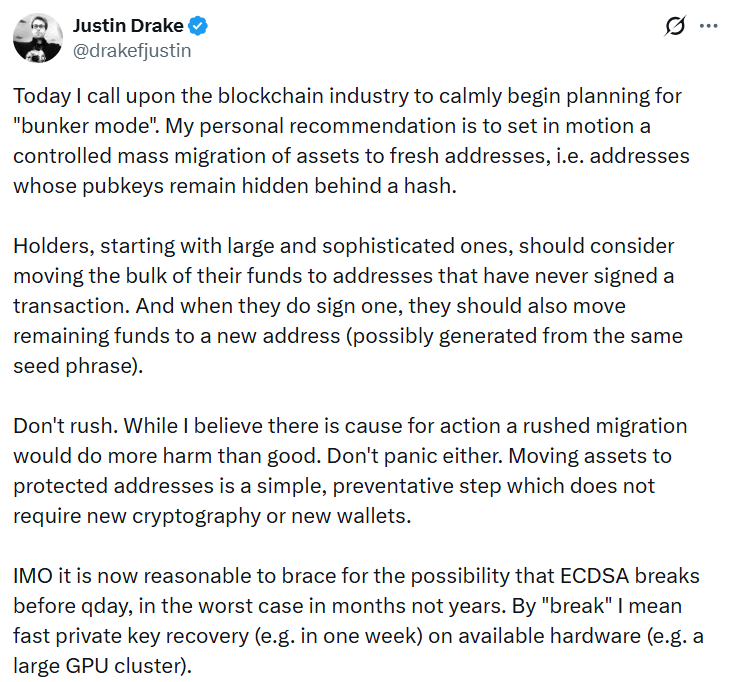
The alarm was escalated last week by Ethereum researcher Justin Drake, who urged the industry to begin planning for “bunker mode” — a coordinated migration of assets to newly generated addresses whose public keys have never been broadcast onchain. Drake argued that recent leaps in AI reasoning capabilities could accelerate the discovery of novel attacks against elliptic curve cryptography (ECC), the mathematical foundation securing the vast majority of blockchain wallets today.
Matthew Green, a cryptography professor at Johns Hopkins University, amplified the concern by suggesting the industry might eventually “lose public key cryptography” entirely if such breakthroughs materialize.

Unlike quantum computing threats, which rely on hardware still years away from practical deployment, an AI-driven classical attack would exploit existing infrastructure. Most blockchains use the Elliptic Curve Digital Signature Algorithm (ECDSA) or its variants. These systems rely on the computational difficulty of reversing a specific mathematical operation — calculating a public key from a private key is trivial, but doing the reverse is considered practically impossible under current mathematics. Drake’s thesis posits that AI systems might identify structural weaknesses in elliptic curves that human mathematicians have overlooked for decades.
Not all experts agree the threat is imminent or even plausible. Yehuda Lindell, head of cryptography at Coinbase, stated there is currently no evidence that the foundational mathematical assumptions behind ECC have been weakened. Lucien Bourdon, a Bitcoin analyst at hardware wallet manufacturer Trezor, noted that none of the recent AI-generated mathematical papers released by major labs contain a functional attack on ECDSA. Bourdon also pointed out that Drake framed his timeline as a worst-case scenario and explicitly advised against rushed action.
Even if the mathematical risk were confirmed tomorrow, the proposed mitigation strategy of moving funds to fresh addresses carries severe technical limitations and immediate risks.
Zach Herbert, CEO of hardware wallet firm FoundationHQ, warned that simply generating a new receiving address within an existing wallet does not guarantee safety. Modern hierarchical deterministic (HD) wallets rely on extended public keys, known as xpubs, to generate infinite receiving addresses without requiring the private key. If a user has ever shared their xpub with a third-party portfolio tracker, tax software, or wallet application, those entities already possess the information required to derive every future public key associated with that account. Moving funds internally offers no protection against an attacker who holds the xpub.
Furthermore, the act of migrating funds introduces acute operational hazards. Every time a cryptocurrency transaction is broadcast, the sender’s full public key is exposed in the mempool — the waiting area for unconfirmed transactions — before the block is finalized. If an AI system could crack ECDSA rapidly, this brief window of exposure during a transfer could be enough for an attacker to intercept the private key and drain the funds mid-flight. Panic-driven migrations historically lead to user errors, lost seed phrases, and increased susceptibility to phishing scams exploiting the very fear being discussed.
The vulnerability profile varies drastically depending on the blockchain architecture and the specific address type a user employs.
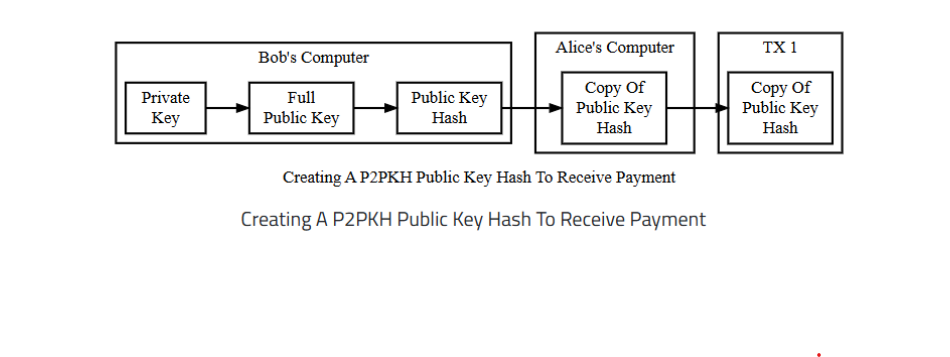
On the Bitcoin network, older Pay-to-Public-Key-Hash (P2PKH) addresses and modern SegWit addresses (which typically begin with “bc1q”) conceal the full public key behind a cryptographic hash until the moment the coins are spent. If hash functions like SHA-256 remain resistant to AI-driven attacks — a distinction Drake acknowledged, noting that elliptic curves possess more exploitable mathematical structure than hash functions — these dormant Bitcoin addresses retain a layer of defense. Conversely, Bitcoin’s newer Taproot addresses expose a tweaked public key directly on the blockchain at all times, making them theoretically more susceptible if ECDSA falls.
Ethereum operates differently. The network does not use unspent transaction outputs (UTXOs) like Bitcoin; it uses an account-based model where public keys are permanently exposed once an address sends its first transaction. Eli Ben-Sasson, co-founder of Ethereum scaling protocol StarkWare, emphasized that a cryptographic break would extend far beyond individual wallets. Ethereum’s consensus mechanisms, validator signatures, and the Kate-Zaverucha-Goldberg (KZG) polynomial commitment scheme used for rollup data availability would all require immediate replacement. Ben-Sasson predicted gas prices would spike dramatically as core functionalities failed or required complex workarounds.
Blockchain developers are already engineering architectural solutions that bypass the need for emergency fund migrations altogether.
Networks utilizing account abstraction, such as Starknet, decouple the signature verification logic from the user’s address. This allows smart contract wallets to swap out compromised ECDSA signature schemes for post-quantum alternatives via a simple software update, without forcing users to move assets to new accounts. Ben-Sasson noted that while the core account abstraction technology supports any signature scheme, underlying dependencies on Ethereum’s base layer for security still require broader network upgrades.
Solana faces a unique challenge because its architecture exposes public keys by default for all accounts. However, Jacob Creech, vice president of technology at the Solana Foundation, stated that users would not need to enter bunker mode if the current signature scheme became vulnerable. The network is developing an upgrade path allowing users to prove ownership of their secret seed phrase using a hash-based proof, enabling a seamless migration to a safer signature scheme at the protocol level. A working proof of concept exists, though the mainnet upgrade has not yet been deployed.
The NEAR Protocol has taken a more immediate approach, allowing users to append FIPS-204 compliant, lattice-based cryptographic keys to existing mainnet accounts in a single transaction. Wallets like Meteor already support this quantum-safe signing. However, Ethereum creator Vitalik Buterin has previously expressed reservations about lattice-based cryptography, suggesting it may carry its own undiscovered vulnerabilities compared to hash-based alternatives.
For Ethereum specifically, the long-term roadmap involves transitioning to hash-based signatures and zero-knowledge proof aggregation. In March 2024, Buterin outlined a theoretical emergency hard fork designed for a scenario where mass theft begins. The proposal involves rolling back blocks to a point before the attack, disabling standard wallet transactions, and requiring users to reclaim their funds by submitting zero-knowledge proofs demonstrating knowledge of their original seed phrases. Max Shannon, a senior research associate at Bitwise Europe, clarified that this remains a theoretical proposal with no established timeline for implementation.
Skeptics within the industry urge caution regarding the motivations behind the current panic. Bourdon highlighted that Drake’s warnings conveniently align with the cryptographic transitions he advocates for Ethereum’s development roadmap, suggesting the alarm serves a dual purpose as a pitch for specific technological upgrades.
Taylor Monahan, founder of MetaMask, offered a stark reminder of the macroeconomic reality: if the fundamental cryptography securing global digital finance collapses, the fiat value of the tokens themselves would likely be the least of investors’ concerns, as the breach would simultaneously threaten traditional banking, military communications, and internet infrastructure worldwide.
As of October 2026, no AI laboratory or independent researcher has published a functional classical algorithm capable of breaking ECDSA, and standard cryptographic hygiene — avoiding address reuse and securing seed phrases offline — remains the industry’s primary defense.