Bitcoin Drops to $82,142 as Hot U.S. Inflation Lifts Rate Hike Odds
Gasoline prices surged 9.1% in September, pushing core CPI to 2.6% and triggering $281 million in crypto liquidations.

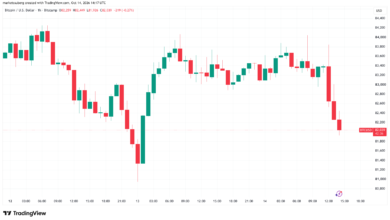
U.S. consumer inflation accelerated unexpectedly in September, immediately reshaping Federal Reserve rate expectations and forcing a sharp selloff across risk assets. Bitcoin dropped 1.5% to $82,142 as traders recalibrated for the possibility of tighter monetary policy just two weeks before the central bank’s next decision.
The Consumer Price Index climbed 3.7% year over year, surpassing the 3.6% consensus forecast and marking an increase from August’s 3.4% reading, according to the Bureau of Labor Statistics. Monthly prices rose 0.6%. Core CPI, which excludes food and energy to capture underlying demand pressures in categories like housing and services, advanced 2.6% annually against expectations for 2.5%.
Energy costs drove the headline miss. Gasoline surged 9.1% in a single month, responsible for more than half of the overall index increase. Crude oil has remained above $90 a barrel for most of the past two months amid the ongoing conflict between the U.S. and Iran, pushing transportation and manufacturing expenses higher across the supply chain. Unlike core price pressures, which the Fed can influence through borrowing costs, energy-driven inflation presents a structural challenge because raising interest rates does not directly lower global commodity prices.


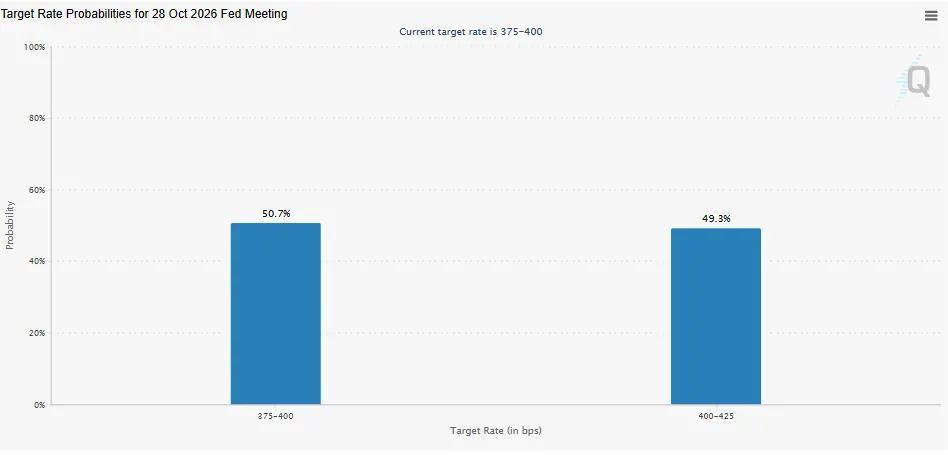
The hotter-than-expected data instantly altered the interest rate outlook. Traders now assign roughly 44% to 49% probability to another rate hike at the Fed’s October 27-28 meeting, nearly doubling the 22% odds priced in before the report, based on CME FedWatch data. The central bank already lifted its benchmark rate to a 3.75%-4.00% range in September.
Treasury yields responded aggressively. The 10-year yield climbed to approximately 5.3%, hovering near levels unseen in 24 years. The 2-year yield, which tracks near-term policy expectations most closely, jumped about 10 basis points to 4.9%. A government bond yielding 5.3% with virtually no default risk directly competes with non-yielding assets like Bitcoin, draining capital from speculative markets. The S&P 500 fell 0.6% and the Nasdaq Composite dropped 0.8% on the same data.
Cryptocurrency markets absorbed the shock unevenly. Ethereum declined 2.8% to $2,440, Solana lost 1.9%, and XRP slipped 1.3%. The total digital asset market capitalization contracted 0.7% to $2.8 trillion. Crypto derivatives experienced severe stress, with more than $281 million in positions liquidated over 24 hours. The vast majority of those forced closures occurred within a four-hour window following the release, heavily concentrated among Bitcoin long positions. Because many crypto traders use leverage, automated exchange mechanisms close out losing bets once prices breach specific thresholds, generating cascading sell orders that amplify initial moves.
From a technical standpoint, Bitcoin opened Wednesday at $83,066 and retreated into a Fibonacci retracement zone between $81,847 and $82,305. This band historically attracts buyers during pullbacks within broader uptrends. The 50-day moving average remains above the 200-day moving average, preserving the longer-term bullish structure. However, momentum indicators show fading conviction. The Relative Strength Index dipped to 48.7, crossing below the neutral 50 threshold, while the Average Directional Index eased to 27.7 from 29.9, signaling a weakening trend despite remaining in bullish territory. The Squeeze Momentum Indicator has flashed compressed volatility for eight consecutive sessions, suggesting a significant directional move is building, with its current -0.76 reading leaning slightly bearish.
A daily close below $81,603 would invalidate the current support zone and expose the $80,365 swing low, followed by the trend band near $80,284 and ultimately $78,003. Reclaiming upside momentum requires a push back above $84,245 to target $85,301, $86,644, and the October peak of $87,422.

Market participants will look to Thursday’s Producer Price Index release to determine whether September’s cost pressures extended beyond consumer-facing goods into wholesale and industrial inputs. The Federal Reserve delivers its next policy decision on October 28.