Villa Vie Odyssey Residents Paid for the Ship Twice and Still Lost Their Home at Sea
The residents were the company's capital. The fuel figures, the contract terms and the July sales claims are what is left to check.
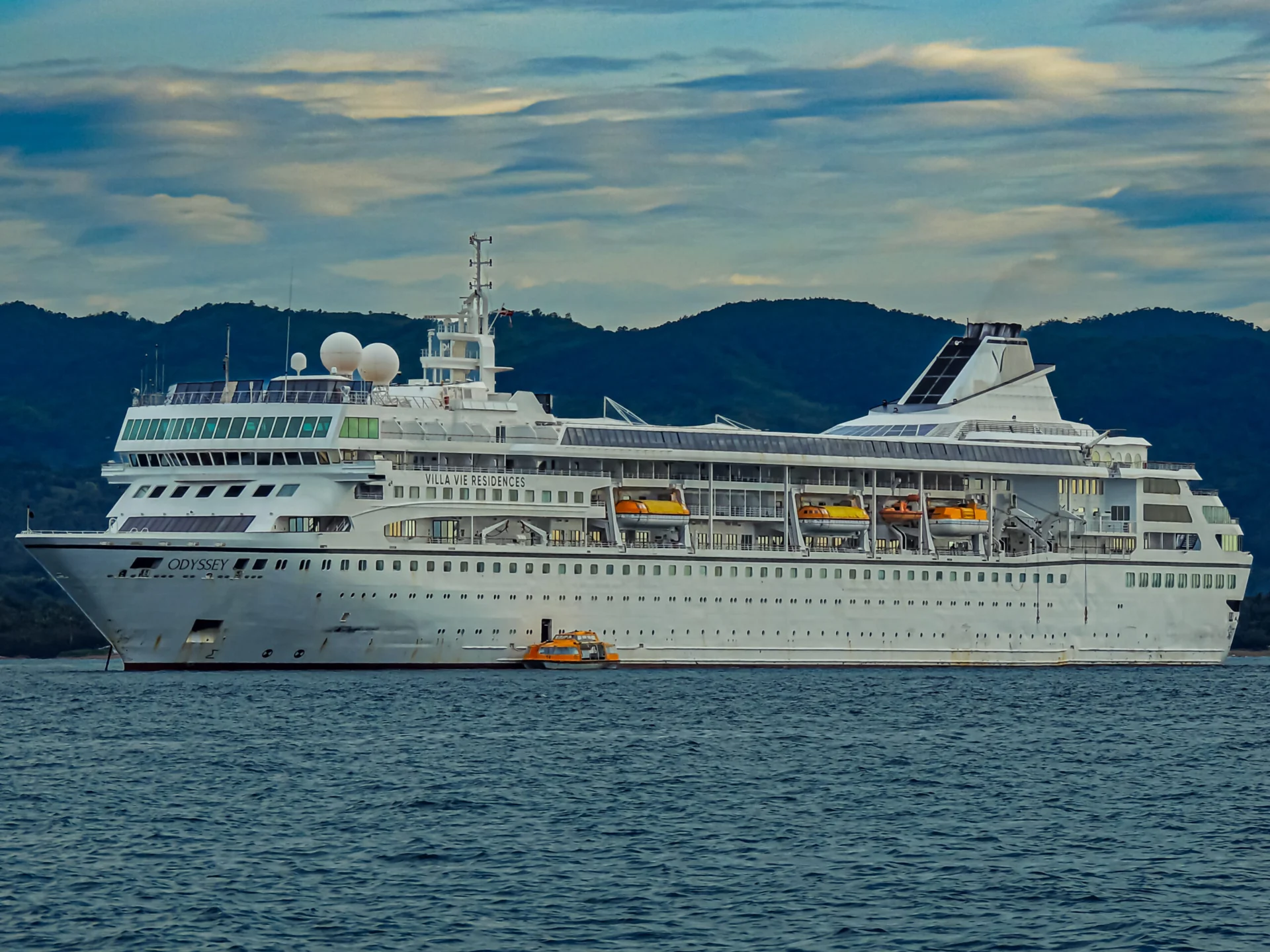
Randy Cassingham had heard the order before, over the loudspeakers, in the weekly drills. “Abandon Ship!” was always a drill, delivered by the captain himself. On 27 October, in Sihanoukville, Cambodia, the order came differently: not from the captain and not in those words, but as a post on the ship’s internal messaging board from the chief executive, Kathy Villalba, at 7:08 a.m. ship time. It said the Villa Vie Odyssey would enter a temporary layup that afternoon because Villa Vie Residences had been unable to secure the fuel to keep sailing, and that all residents must disembark by 2 p.m. Cassingham published the notice verbatim on his blog, and counted less than seven hours between the post and the deadline.
For the people aboard, the Odyssey was home in the literal sense, not a holiday they were taking. Cassingham and his wife Kit had sold their house and cars and given away almost everything they owned to live aboard, and he wrote that they had no true home to go to. “We are effectively homeless,” he wrote on his blog, ResidentialCruising.com. The residents behind the Facebook page Living Life on a Cruise filmed themselves packing and wrote: “Two years of our life packed into suitcases. Come along as we pack up our cabin, say our goodbyes, and leave the ship we called home.” Joel Greiff’s version was shorter. He paid $350,000 for a cabin, moved aboard on 1 October after selling his condominium and drawing on his retirement savings early, and was ashore 26 days later. That works out at $13,461.54 for each day aboard, and he told PEOPLE he might lose the money.
Petterson put the ownership plainly to Business Insider. Villa Vie Odyssey residents owned roughly 88 per cent of Villa Vie, he said, with the rest held by the founders, the management team and himself. Villa Vie had no private equity and no big owner behind it. When money was needed, residents were the natural people to ask. CBS News reported, from internal records, that about $400,000 went to a fuel supplier from one resident’s personal checking account while the Odyssey was in Singapore. In April, Villa Vie offered residents an emergency loan at 12 to 24 per cent interest, and Petterson said it raised about $2 million. A fuel surcharge Villa Vie first tried to make mandatory became voluntary when the residents’ contracts would not allow it, and residents bought discounted extra cabins instead. When the crew went unpaid, residents collected about $12,000 in cash outside a café and handed it out in $100 bills.


Sagar Capital, a group backed by residents, spent two months negotiating to buy the Odyssey, gathered 169 pledges from residents and collected no money, and quit on 31 October. Business Insider reviewed its letter, and three residents confirmed its contents. The letter gave five reasons for quitting. There was no agreement with the lender. The group had found more debt than it expected. A takeover carried legal exposure. A Chapter 11 case would cost about $3 million for its first 60 days. And there was no monthly fee that would both cover operating costs and stay affordable. The letter also said the lender and the ship manager had taken control and intended an auction. That claim has not been independently verified, and Villa Vie told CBS no sale had been scheduled.
The 27 October release put the explanation at fuel. Monthly fuel costs per cabin had risen from a historical average of about $1,800 to an estimated $6,000 to $8,000 in parts of Asia, it said, and Villa Vie could not pass the increase on. That is a rise of 233 to 344 per cent. The market assessments published over the same period do not reach it. Singapore very low sulphur fuel oil, the grade most large ships burn, cost $509 a tonne on 27 February and $886 by early October, a rise of 74 per cent, according to Ship & Bunker data reported by Splash247. The same assessment put the grade at $1,003.50 on 2 November, 92 per cent above its pre-war level of $521.50, after a March peak of $1,120.50. Marine gasoil, a lighter grade, was assessed at $1,263 to $1,270 a tonne in Singapore on 3 and 4 November.
In August, Villalba had told residents the Odyssey needed about 650 tonnes of fuel at nearly $800,000, against about $450,000 under ordinary conditions. That is a rise of about 78 per cent, close to the market assessments and far below the per-cabin figure in the release. Petterson told CBS the price had gone from about $700 a tonne to between $2,000 and $3,000. Ship & Bunker data put marine gasoil near $2,000 a tonne in March, and the assessments for early November were far lower. Fuel grades, ports and dates differ across these figures, so they do not settle into one price, and none of them produces the 233 to 344 per cent in Villa Vie’s per-cabin number. The release never says how many cabins its figure is spread across. The Odyssey arrived in Cambodia with 203 residents aboard, against a company capacity of about 650, and the choice of denominator changes a per-cabin figure more than threefold. CBS also reported an internal projection that put monthly operating expenses at $3.1 million against $2.5 million of revenue even with every cabin filled, a shortfall of about $600,000 a month. A source close to Villa Vie told CBS the real monthly costs were below $1 million. The two figures were never reconciled in the reporting, and Villa Vie has not published accounts that would settle it.
Changes to an itinerary do not constitute a breach, Villa Vie’s General Terms and Conditions state. The Terms, effective 30 January 2026, allow Villa Vie to cancel or suspend a voyage for force majeure, mechanical failure, regulatory action or other causes beyond its reasonable control. For suspensions for repairs, maintenance fees may be prorated or suspended only during lay-ups lasting more than 90 consecutive days, and then only at Villa Vie’s discretion. No refunds are promised for missed ports, programming changes or inconvenience. Refunds and economic rights are governed not by the Terms but by each resident’s purchase Agreement. Disputes, governing law and venue sit in sections 15 to 17 of that Agreement, with Fort Lauderdale, Florida, as the venue for claims outside arbitration. Those Agreements are not public. What residents can recover, and from whom, cannot be read from any document Villa Vie has published, and the 60-day restructuring window in the October release is a statement of intent, not a term in the contract residents signed.
Villa Vie’s 27 July release said the Odyssey had passed 85 per cent of its available residences sold. It announced a second ship, Legacy, for early 2029, with residences about 50 per cent larger and prices about 30 per cent higher. Owners of Endless Horizons places aboard the Odyssey would move to Legacy automatically, it said. The 2024 release that launched Endless Horizons had priced a single-occupancy place at $299,999. The July 2026 release described the programme as originally introduced at $349,999. A Legacy Bridge offer gave the first 24 buyers immediate Odyssey residency if they bought by 30 September 2026. An itinerary update dated 20 October was still showing future sailings. Seven days later residents were told to leave by 2 p.m.
The Odyssey had been late before. Built in 1993 and previously Fred. Olsen’s Braemar, it was handed over in February 2024 and was due to sail from Belfast on 30 May. Business Insider reported the refit, including work on the rudder, ran about $15 million over budget, and the Odyssey did not sail until 3 October, about four months late. Two lawsuits by passengers over the delay were still going when Business Insider reported them, and Villa Vie disputed them. Cassingham’s blog notes that he and Kit spent those four months in Belfast as part of the group he calls “stranded” there, and treated it as part of the adventure. In 2026 the waiting happened in a port where they had no homes to return to, and the Odyssey did not come back.
Petterson told Bloomberg that Villa Vie was covering lodging and local transport in Cambodia, though not flights out of the country. Cassingham’s account gives a different sequence. “The company has done absolutely nothing to help,” he wrote: residents could not walk out of the port, an active cargo port, and shuttle buses dropped them in the middle of Sihanoukville without even a list of hotels, let alone payment for them. His later update records what arrived, and when. At 5:06 p.m. ship time on 28 October, about 27 hours after the deadline, Petterson announced a hotel list, passport assistance, a $1,100 charter flight if at least 20 residents signed up, and financial help with lodging that came not from Villa Vie but, Cassingham wrote, from a former resident. Cassingham also wrote that passports were held until bills were paid, including November bills residents had already paid.
Interior Minister Sar Sokha said immigration officials had issued tourist visas to passengers of 15 nationalities, and provincial officials recorded 203 passengers and 156 crew arriving from Thailand on 23 October. Those were the only firm numbers anyone had. Mary Ann Demsar, a 67-year-old retired teacher from Ontario, told Reuters there had been no clear indication from the owners and that information for residents stranded in Cambodia had come only from the Cambodian government and its representatives. Cassingham, in a Facebook post on 4 November, objected separately to the way the story was being told abroad. “But I’m angry that my name and face is being used for propaganda purposes,” he wrote, and added, in the image attached to the post, that it was the Financial Times that had raised the “scam city” description, which he had not heard before the reporter mentioned it to him. He wrote in the same post that every Cambodian person he had met had been gracious, hospitable, kind and helpful.
The lender had taken possession by 1 November, CBS reported, with responsibility for crew pay, fuel, operations and safekeeping, and residents had the weekend to remove their belongings. The Maritime Executive reported the Odyssey seized by creditors and, on 4 November, leaving Sihanoukville around midnight bound for Singapore on tracking data, with residents’ possessions still aboard. Xinhua’s account put the departure at 00:25 on Wednesday, after refuelling, with a partial crew aboard and the rest leaving by air, and the destination unknown. Petterson told CBS that Villa Vie had 30 to 90 days to restructure, and had said Villa Vie planned a Chapter 11 filing. No filing had been confirmed as of 3 November. Shirine Thomas, from Wilmington, North Carolina, told Reuters: “There are still many things on the ship that I wish I could take with me.”
A partial crew sailed with the Odyssey, Xinhua reported, and the rest of the crew left Cambodia by air. It had refuelled before leaving, and its destination was listed as unknown. The belongings residents had not been able to collect were still aboard when it left.