How Villa Vie Odyssey’s $6,000-a-Cabin Fuel Bill Broke a Forever Cruise
Residents who bought homes at sea were given hours to leave in Cambodia. The paperwork had priced in the stop all along.
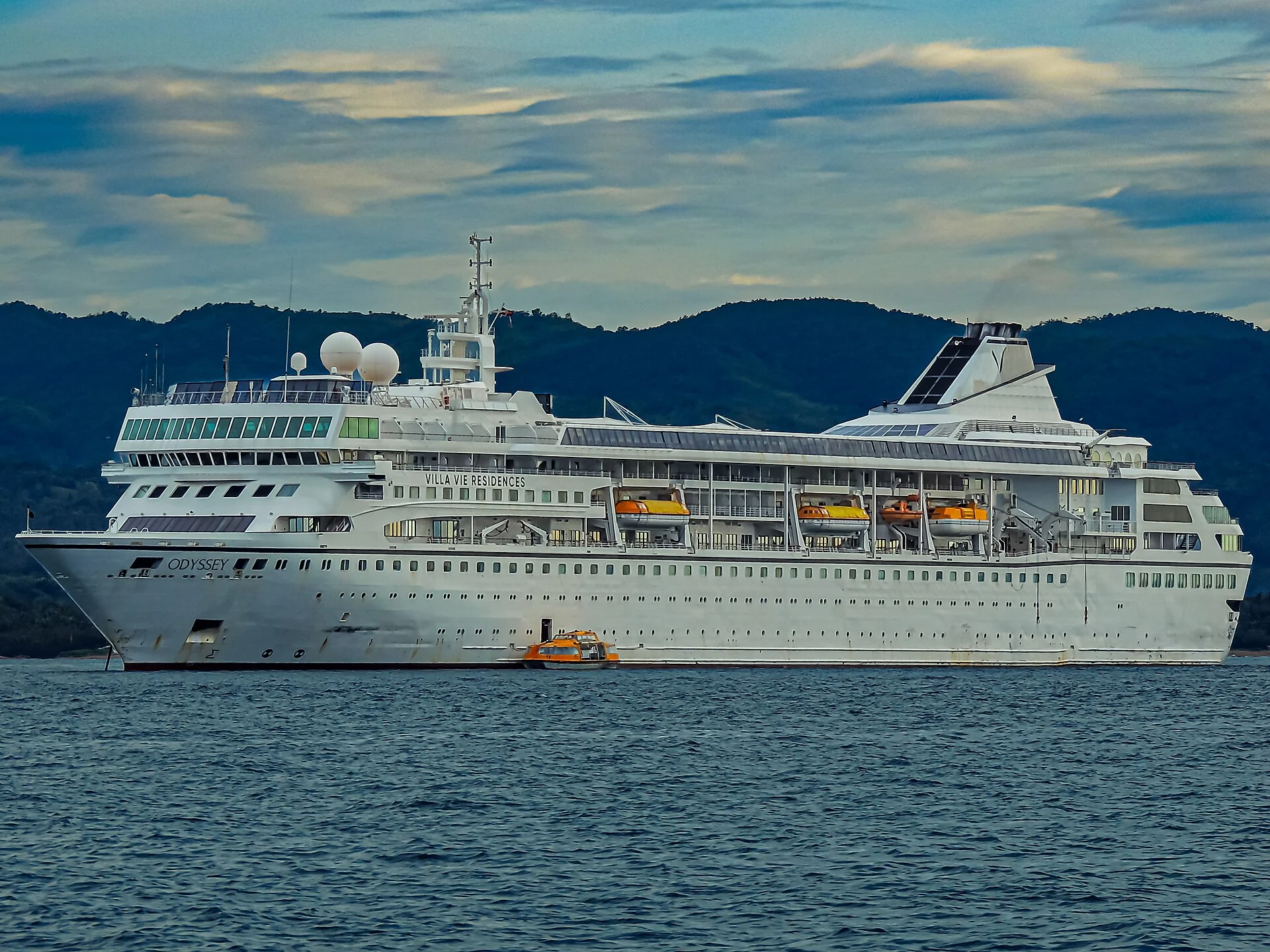
Cambodian provincial officials put the number aboard Villa Vie Odyssey at 203 passengers and 156 crew when the ship stopped in Sihanoukville. The passengers, mostly Americans from 15 nationalities, had reached the port on October 23 for a scheduled five-day stop on a voyage meant to circle the globe every three and a half years. Two years in, the company told them to pack and leave within hours, and the ship stayed behind with its crew.
The message came from chief executive Kathy Villalba on the ship’s internal board, posted late on October 26 in Florida, early on October 27 in ship time. Randy Cassingham, a resident aboard with his wife, Kit, published the notice verbatim on his site ResidentialCruising.com. He added a caveat of his own: the times were “not 100% clear since Circle doesn’t put a time zone on messages.” Villalba’s message read: “Unfortunately, we were unable to secure the fuel necessary to continue operations. As a result, the Odyssey will enter a temporary layup this afternoon, with crew remaining onboard to maintain the vessel and its essential systems.” The deadline in the same message read: “All residents must disembark by 2:00 PM today.” Residents who could not carry everything at once could use shuttles back to their cabins until 6 p.m. the next day.
Villa Vie had reserved the right to do this in writing months before the ship reached Cambodia. Section 11.2 of the company’s General Terms and Conditions, effective January 30, 2026, says Villa Vie “may cancel or suspend a voyage or series of voyages due to force majeure, mechanical failure, regulatory action, public health emergency, or other causes beyond Villa Vie’s reasonable control.” The same document sends every economic question somewhere else. Section 1.2 states that “all economic rights, Cabin Rights, transfer mechanics, buyback and trade in options, refund rights, limitations of liability, governing law, venue, and dispute resolution provisions are governed by the Agreement and are not altered by these Terms.” That agreement, the Cabin Rights Purchase Agreement, is not public.


Section 11.3 deals with suspensions for repairs. It says maintenance fees “may be prorated or suspended during extended lay-ups exceeding ninety (90) consecutive days, in Villa Vie’s discretion.” Villa Vie described this layup as a fuel stoppage, and its restructuring window runs 60 days. Section 11.2 adds that “any refund rights are governed exclusively by the Agreement.” The company’s October 27 statement said nothing about refunds. Reporting since then has said Villa Vie is covering hotel lodging and local transport in Cambodia, and that onward international flights are the residents’ own cost.
What residents bought, on the company’s own brochure, was permanence at a price fixed in advance. The Program Overview lists ownership from $129,999 for an Inside villa, $149,999 for a Porthole and $169,999 for an Ocean View. Balcony villas start at $329,999, a Deluxe Balcony at $379,999 and a Suite at $439,999. Monthly fees run from $1,995 a person for two people sharing an Inside villa to $9,999 for one person in a Suite. The fees were fixed for a guaranteed minimum of 15 years, with a buyback guarantee at varying percentages depending on how long the ownership lasts. Endless Horizons, launched in May 2024, went further. A one-time payment of $349,999 for one person or $599,999 for two bought a guaranteed Ocean View villa, with no monthly fees at all, sold with the words “Pay Once and Never Worry About It Again.”
Villa Vie’s October 27 statement put monthly fuel expense per cabin at a historic average of about $1,800. In parts of Asia, it said, the figure had recently reached an estimated $6,000 to $8,000. An Inside villa shared by two people carried monthly fees of $3,990 between them, below the bottom of that fuel range. Only the Suite’s single-person fee of $9,999 sat above it, and the comparison itself is uneven: the company counts fuel per cabin while the brochure counts fees per person. A cabin with one resident paying $2,499 a month faced the same fuel range as a cabin with two paying $3,990, and a lifetime buyer paying nothing monthly faced it too.
Founder Mikael Petterson gave CBS News the tonnage behind the company’s figures. Villa Vie had paid an average of $700 a ton for fuel before the war with Iran broke out in late February, Petterson said. Since then it had paid $2,000 to $3,000 a ton, for a ship burning 700 to 800 tons a month. At the middle of those ranges, 750 tons at $700 costs $525,000 a month and 750 tons at $2,500 costs $1,875,000, a gap of $1,350,000 every month. Petterson put the company’s monthly expenses at $400,000 before the rise and $2 million after, and divided the higher figure by 300 people aboard to explain the strain. Against the official count of 203 passengers, the same $2 million divides to about $9,852 a head. Independent prices point the same way without reaching Petterson’s top end. Ship & Bunker’s October 29 averages put marine gas oil at $1,539 a metric ton across 20 ports and $1,279 at Singapore, roughly double the $600 to $700 Petterson cited for the pre-war months.
The fuel bill had been arriving as requests to the people aboard for most of 2026. Cruise Industry News reported seeing a copy of an April letter in which Villa Vie sought a $3 million “Emergency Loan Investment Opportunity” from residents. The letter offered 12 to 24 percent interest, with interest paid monthly and principal returned after 12 months, and the outlet could not determine how much was raised. On August 1, Villalba wrote to residents in a message Business Insider later reviewed as a screenshot. She said an earlier fuel contribution had not included everyone, and urged those who had not contributed to do so. In early September at Ha Long Bay in Vietnam, Pamela Reckamp, a 59-year-old rental resident, told NBC News that a company official asked cabin owners to help raise $1 million so the ship could leave. The official warned, in her account: “If we don’t get this money, we have about four days of the ship running. Then the lights will go off and the AC will go off.” Cruise Industry News also reported, from sources aboard, a further $360,000 fuel request shortly before the suspension, which Villa Vie has not confirmed.
Legacy, the second ship, was announced on July 27, 2026, for early 2029, with residences about 50 percent larger. Villa Vie said Odyssey had passed “85% of available residences sold after two years.” Petterson said the company had “set out to prove that residential cruising wasn’t just possible — it was sustainable.” The announcement offered 24 Bridge Positions, one for each month of sailing, through September 30, 2026, with a guaranteed move to Legacy at no additional purchase price and Odyssey maintenance rates honored. The company did not say whether Legacy would be a newbuild or a secondhand purchase, and gave no specifications or itinerary. The voyage itself had started late. Odyssey left Belfast in October 2024, about four months behind its planned May departure after yard work and paperwork. On October 20, 2026, its itinerary still showed plans running to August 2030.
Life at Sea, Petterson’s earlier residential cruise venture, collapsed in November 2023. In June 2022 he conceived Life at Sea, developed the brand with Miray International from November 2022, and opened sales on March 1, 2023, reserving over half of 400 cabins in the first month. The ship changed from MV Gemini to the larger MV Lara. Petterson resigned in May 2023 as 22 team members left with him, the departure slipped twice, and Miray cancelled the voyage on November 17, 2023, under two weeks before sailing, leaving passengers in Istanbul. A letter from 78 passengers to the United States Attorney in Florida in January 2024 alleged about $16 million had been collected. Refunds were promised in tranches, and most were never paid. Miray denied using passenger money for the ship deposit, and Petterson’s role there was sales and marketing managing director. The contrast on the water is The World, launched in 2002. Its operator ran into serious financial difficulty by 2003, the residents bought the ship on September 30, 2003, and the resident-owned vessel still sails, with resales marketed at about $3.5 million to $15 million. The World still sails under resident ownership, and Villa Vie’s residents hold contracts, not a ship.
A lawsuit filed in May 2025 already tests what residents bought. SignalWave, LLC sued Villa Vie Residences Corporation in Broward County, Florida, case number CACE-25-006694. The complaint alleged breach of contract, conversion and negligent misrepresentation after a $469,000 purchase price and about $8,000 a month in maintenance. The complaint alleged Villa Vie misrepresented its financial stability and that the business model was precarious, and sought a jury trial and unspecified damages over $100,000. Villa Vie denied the allegations, and the suit was still ongoing in NBC’s reporting. Residents, CruiseNews reported, bought contractual residency rights and access rather than equity in the ship, so recovery turns on the restructuring rather than the sale of an asset they own. The published terms set a one-year limit for bringing contract and refund claims from the date the cause of action accrued.
Cassingham, who has lived aboard with Kit, wrote that the end “didn’t come from out of the blue.” He described “a cascade of problems piling up on one another, from the business model to mistakes by management to the mentioned crisis in fuel cost and availability, and more.” He also noticed what the disembarkation message left out: “The simple, human expression of ‘I’m sorry.'” Kit posted a photograph of an unfinished concrete shell in Sihanoukville, a leftover of the city’s building boom, with the words: “The Odyssey has reached the end of its sailing days — at least for now. It abandoned us in Cambodia.”
Frances Paroissien, 78, from Melbourne, told 7NEWS: “I am angry. I am cheesed off.” She had sold everything to live aboard and has no house left in Australia. Rina Cavazza, from Brisbane, paid $170,000 and had 18 months left on her contract. She told the same outlet she felt “more numb than anything.” Cassingham wrote that “ALL the evacuated residents are exhausted both physically and emotionally,” and most were still in Cambodia as the company worked through its 60 days.
The plan now, Petterson told CBS News, is to file for Chapter 11 bankruptcy. The company’s statement said it was evaluating restructuring and recapitalization over the next 60 days, that no financing or transaction had been finalized, and that “no outcome is assured.” The company said it would provide further updates as material developments occur.