The Learjet 60 Crash Jet Is Registered to a Delaware LLC at an Address Shared by 285,000 Firms
Austin airport officials could give only the tail number. The jet fell from cruising altitude near Greenacres on Sunday, and by evening no official had named the nine people on board or the operator.
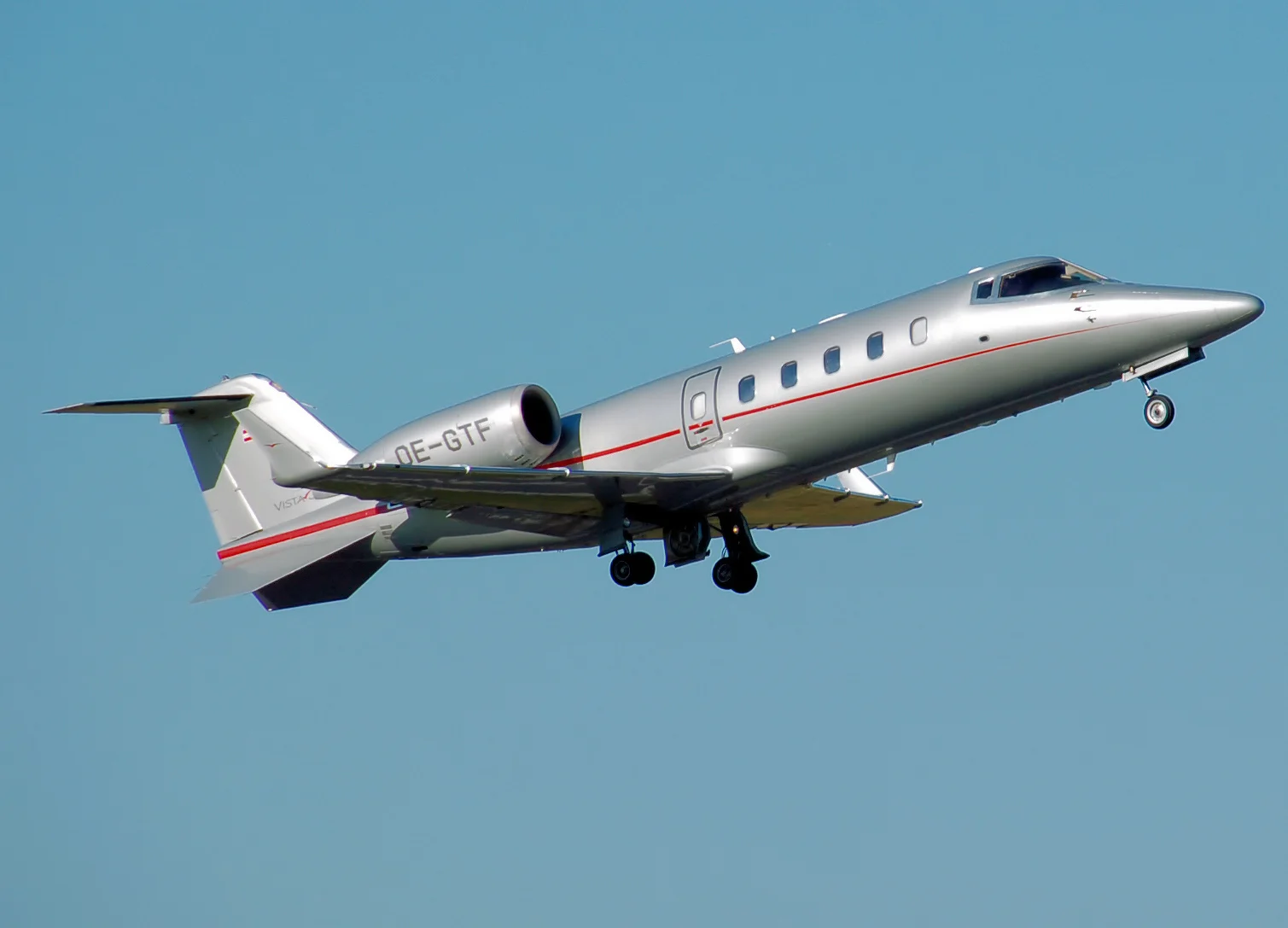
Jim Reynolds, a spokesman for Austin-Bergstrom International Airport, could say two things about the jet that left his airport on Sunday morning. It was a private aircraft, and its tail number was N722BD. He called the crash “definitely a tragedy,” and he could not say who was on the flight. The public record behind that tail number gives little more. By Sunday evening, Transportation Secretary Sean Duffy had confirmed that all nine people aboard were killed when the Learjet 60 came down near Greenacres, Florida, on its way from Austin to North Eleuthera in the Bahamas, and no official had named any of them.
The Learjet 60 crash happened about 12:50 p.m. Eastern time in a residential area near Cresthaven, beside South Military Trail between Cresthaven Boulevard and 10th Avenue North, and the jet exploded in a fireball that left a crater in the road. The Federal Aviation Administration said nine people were aboard. It cautioned that its information was preliminary and subject to change. As of Sunday evening, officials had not confirmed any deaths or injuries among people on the ground, and the sheriff’s office had closed Military Trail in both directions until further notice.
The FAA registry entry for N722BD is short. It lists serial number 271, manufacturer Learjet Inc., model 60, and a registration certificate issued on Jan. 4, 2023, that runs to Jan. 31, 2030. The aircraft is registered as a fixed-wing multi-engine turbo-fan, owned by an LLC, with no fractional owner. The entry leaves the year of manufacture blank. It lists the engine manufacturer and model as unknown, and gives no airworthiness date. A temporary certificate, numbered T266760 and dated April 1 to May 1, 2026, is also listed. The registry page warns that the entry should not be used to judge whether an aircraft is airworthy.


The registered owner is LR60271 LLC, at 1209 N. Orange St. in Wilmington, Delaware. That address is the Corporation Trust Center, the Wilmington office of CT Corporation, which sells registered-agent services. In 2012, the building was the registered-agent address of at least 285,000 businesses. A registered agent takes delivery of lawsuits and official papers for companies that need a Delaware address; the agent does not run the business, and Delaware law does not require the registered office to be a place of business. The address shows where the company behind the jet can be reached with papers. It says nothing about where the jet was kept, who maintained it, or who flew it.
A charter broker’s page for the same tail number gives different identifying details. FlyUSA invites inquiries to book the aircraft, describes it as operated by a private owner, and lists its serial number as 60-186 and its owner as a private individual. The registry says 271 and LR60271 LLC. FlightAware, the flight-tracking service, returns the same owner name and Wilmington address from its own records, lists the aircraft as blocked from public tracking, and returned no flight history for it. The jet’s movements were visible only through ADS-B aggregators that collect signals the aircraft itself broadcast.
The operator’s name has not appeared in any statement from the FAA, the Transportation Department, the sheriff’s office or the airport. One aviation site reports that the jet had appeared on several charter platforms, while adding that it is not clear whether Sunday’s flight operated as a charter. That distinction matters because a flight sold as a charter operates under the FAA’s Part 135 rules for on-demand air-taxi operations, with their own requirements for crews, maintenance and oversight, while a private flight does not. Whether either set of rules governed the flight to North Eleuthera has not been established in any public statement.
The recorded flight, as Flightradar24 data shows it, left Austin at 15:37 UTC, climbed to 41,000 feet, and tracked southeast toward Florida. Near Naples it descended to 35,000 feet and turned toward the Palm Beach area. At 17:48 UTC it climbed briefly, then entered a steep descending turn to the right, with its rate of descent reported at more than 32,000 feet a minute and a last recorded point at 8,750 feet. Another reading of the same tracking data put the descent rate near 20,000 feet a minute at 28,950 feet. The two readings disagree on the peak rate and agree on the shape of the last minute. In the air-traffic recording CNN cited from LiveATC, the pilot reported light, clear ice that was “manageable” and moderate turbulence, then declared an emergency as the descent rates climbed. Scattered storms were in the area, and CNN reported the jet had passed through a stronger storm cell minutes before the descent began. It is not known whether the weather played a part.
The last fatal American accident involving this model of jet turned on the kind of questions the Greenacres record leaves open. On Sept. 19, 2008, a Learjet 60 registered N999LJ, operated by Global Exec Aviation as an on-demand charter flight, overran the runway at Columbia Metropolitan Airport in South Carolina during a rejected takeoff. Both pilots and two passengers were killed. Two passengers were seriously injured. The National Transportation Safety Board found the aircraft’s tires were greatly underinflated, the captain rejected the takeoff after the speed past which a takeoff should continue, and tire damage disabled a sensor that let the thrust reversers return to their stowed position, so the engines kept producing forward thrust. The board also found that the FAA and Learjet had not adequately reviewed the design after a similar accident in Alabama in 2001. The FAA followed with a directive requiring Learjet 60 operators to check tire pressures every four days. None of that bears on what happened on Sunday. It shows where such an investigation starts: with the operator, the maintenance record and the aircraft itself.
Devin L. Smith wrote on Facebook on Sunday that a small plane had crashed near Military Trail and 10th Avenue North “and people are without power.” A woman working nearby told the AP the power in the area had been out for about two hours. In a comment on a local scanner page’s post, CJ Grise wrote that he lived “about 30 seconds from the site” and that it “sounded absolutely insane,” very loud, “like a missile flying overhead.” The scanner page itself, Slcscanner, posted early that it could not confirm whether the object was a plane. The residents’ posts described sound, power loss and early uncertainty. The official statements said less about the ground and more about the toll: Duffy confirmed all nine aboard had died and asked people to pray for the families, while the sheriff’s office said only that the incident was under investigation, the road was closed, and residents should call a non-emergency line for access to their homes.
The National Transportation Safety Board leads the investigation, with the FAA taking part. Its investigators work in groups covering operations, the wreckage, engines, systems, air-traffic control, weather and human performance, and the parties to the inquiry normally include the operator and the manufacturers of the airframe and engines; no operator has been named for this flight. A preliminary report, confined to facts gathered in the first days, normally appears within about a month; a final report with a probable-cause finding commonly takes a year or more. The wreckage, the maintenance history, the air-traffic recordings and the weather data are all part of the work the board has ahead of it.
By Sunday evening, the nine people on board had not been named, and no injuries on the ground had been confirmed. Military Trail stayed closed between Cresthaven Boulevard and 10th Avenue North, and the sheriff’s office said it would provide updates as they became available.