HMS Medway, Sea Lion, and the 3,600 People Who Are Not Party to the Case
The ship's own post is dated 26 October, a week before the reporting wave. The tribunal hears Argentina's four measures on 10 and 11 November.
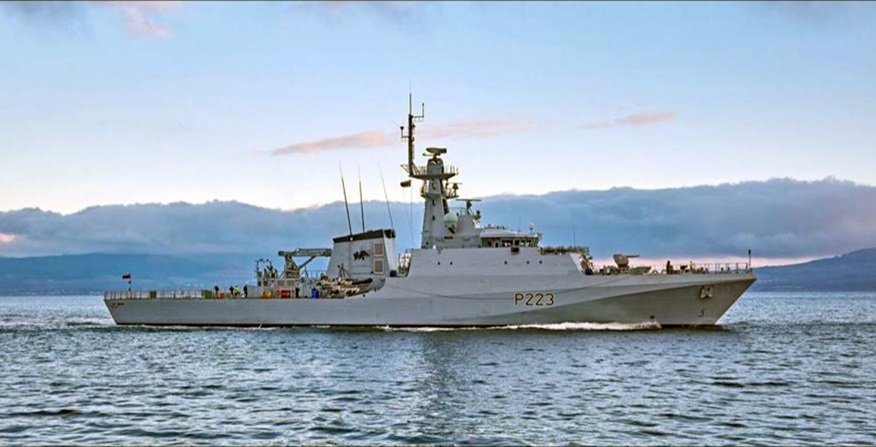
HMS Medway’s own account posted the shoot at 11:54 p.m. on 26 October. “120 rounds downrange,” the ship wrote, with Flag Officer Sea Training staff embarked. The 30mm gun had been put “through its paces again.” The post closed with “Practice = Precision.” Reports on 2 November described the same firing as though it had just happened. The post went up a full week earlier, and the ship described the firing as routine training.
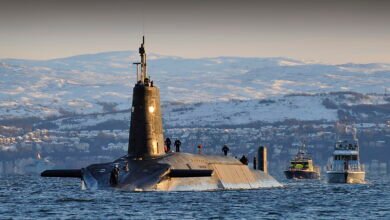
Medway is a Batch 2 River-class offshore patrol vessel, 90 metres long and about 2,000 tonnes. She was commissioned in September 2019 and took over as the Royal Navy’s permanent South Atlantic patrol vessel in January 2026, after HMS Forth held the station for about six years. She is the only Royal Navy vessel permanently stationed in the region. Her work runs from fishery protection and sovereignty patrols to maritime security as far as South Georgia, humanitarian aid and counter-narcotics work with law enforcement. Her only gun is the 30mm. She is a constabulary ship, not a warship. The islanders know her that way. More than 200 residents went aboard her at an open day in Stanley on 27 September.
The same ship was at the centre of the last row, in July. Argentina’s protest note of 13 July was lodged by Foreign Minister Pablo Quirno. It recorded the “strongest rejection” of a transit it said was “not properly notified.” The note said Medway had passed through Argentine territorial waters on 1 and 2 July, en route to Punta Arenas, with the Argentine Navy tracking her. It called the movements incompatible with United Nations resolutions and said they heightened tensions.
The British account says the embassy had told Argentina’s foreign ministry, defence ministry and joint chiefs in advance. The ministry first said the Navy had tracked her in good time, and that communications had gone through established bilateral mechanisms. Medway had sailed an 8,000-mile humanitarian run to Tristan da Cunha, carrying medical aid and recovering a health team deployed over a suspected hantavirus outbreak. She then sailed along the coast to Punta Arenas and berthed at the Prat pier from 5 to 8 July. The Strait of Magellan is open to all nations under the 1881 treaty between Chile and Argentina, reaffirmed in 1984. The protest surfaced within hours of Argentina beating England in the 2026 World Cup semi-final. Days earlier, Vice-President Victoria Villarruel had called England “usurping pirates.”
Stanley’s own paper on the field is dated 10 December 2025. It is a Falkland Islands Government press statement. The statement notes that Navitas Petroleum Development and Production and Rockhopper Exploration have taken their final investment decisions for the Northern Area of the Sea Lion field. It records that the government’s Executive Council considered reports on tax treatment, valuation, investor security and land access in October 2025. The Council then approved the development and production programme for phases 1 and 2 of the Northern Development Area, under the model clauses of the existing production licences. The condition the Council had set was met. The approvals, the statement says, “have gone live.” The licences were granted by the government elected by the islanders, under Falkland Islands legislation. New petroleum licences require the British Foreign Secretary’s consent. The regulation of the field, and the approvals at issue, sit with Stanley.
Rockhopper’s announcement of the same day puts numbers to the approval. The licences moved into a 35-year Exploitation Phase. The bill runs to US$1.8 billion to first oil and US$2.1 billion to project completion, including US$1.0 billion of senior debt. An independent evaluation by Netherland, Sewell and Associates in June 2025 put the field’s gross full-field resource at 917 million barrels, 321 million net to Rockhopper. Phase 1 targets 170 million barrels at a peak of about 50,000 barrels a day, with first oil planned for 2028. Phase 2 adds 149 million barrels. The same announcement records a £30 million tax settlement with the Falkland Islands Government, paid in instalments. The field was discovered in 2010. Rockhopper’s chief executive called it “over 20 years of work.” The figure most coverage repeats, 1.7 billion barrels, circulates unattributed. The evaluation the companies themselves filed says 917 million.
Argentina’s answer began before the investment decision and sharpened after it. On 28 September 2026, Argentina notified the United Kingdom that it was starting arbitration under the United Nations Convention on the Law of the Sea. President Javier Milei wrote on X the same day, under the heading “DEFENDING WITH FACTS.” He gave the project a two-week deadline to halt or face the tribunal. He called the development the “illegal plundering of our resources.” Argentina’s foreign ministry had already rejected the investment decision in December 2025. It called Rockhopper and Navitas illegitimate licensees, acting without the permission of the competent Argentine authority. The claim is that the field lies in the North Malvinas Basin, offshore from islands Argentina calls the Malvinas, and that the licences were granted without Argentine permission.
A decree of 3 September 2026 made the Foreign Ministry the enforcing authority. By 5 September, sanctions proceedings were under way against about 45 companies and individuals, according to the Buenos Aires Herald. A criminal complaint followed on 8 and 9 September against five firms and their directors and managers, under a 2011 law that carries bans of five to 20 years. The five were Navitas Petroleum Development and Production, Navitas Petroleum Atlantic United, JHI Associates, Navitas Petroleum LP and Eco (Atlantic) Oil and Gas. The earlier bars named different entities. Rockhopper had already been declared clandestine in 2012 and barred for 20 years in 2013. Navitas Petroleum LP was barred in 2022. The operator actually running Sea Lion, Navitas Petroleum Development and Production, is a British subsidiary. Legal analysis carried by MercoPress says it is not automatically covered by the earlier bars. The pressure worked where companies have Argentine business to lose. Halliburton, SLB and Baker Hughes said they would not work on Sea Lion. Shares in both partners fell on the Friday the sanctions were announced.
Argentina filed its request for provisional measures in Hamburg on 13 October. In the House of Commons that day, Foreign Office minister Uma Kumaran said the Sea Lion field “lies on the Falkland Islands’ continental shelf.” The project, she said, is “lawful and regulated by the democratically elected Falkland Islands Government.” Argentina, she added, “has no jurisdiction over it.” She set out four responses, including deploying Protection of Trading Interests measures and engaging the operator and the supply chain. Jack Ford, chair of the islands’ Legislative Assembly, watched from the gallery. Foreign Secretary Ed Miliband announced the Protection of Trading Interests measures on X the same day. The islanders, he said, “have a right to develop their natural resources as they see fit.” Attempts to intimidate companies in legitimate commercial activity were unacceptable, he said. That was a shield for companies facing Argentine threats, not a fresh consent for the field. The consent for the field itself had been given in Stanley ten months earlier.
The tribunal hears Argentina’s request on 10 and 11 November, in a public sitting broadcast live. Judge Maurice K. Kamga presides. Judge ad hoc Vaughan Lowe, Oxford’s emeritus professor of international law chosen by the United Kingdom, makes his solemn declaration on the morning of 9 November. Argentina asks for four measures. The United Kingdom should prevent the start or continuation of hydrocarbon exploitation in the North Malvinas Basin by the “so-called ‘Sea Lion’ project.” It should refrain from using exploration information against Argentina’s rights. It should stop preventing Argentina from meeting its marine-environment obligations. And it should take no step aggravating the dispute, in particular by granting new permits. Before it can order anything, the tribunal must be satisfied of two things: that the arbitral tribunal not yet constituted has prima facie jurisdiction, and that the situation is urgent. A provisional-measures order cannot decide sovereignty. The Convention covers the interpretation and application of the Convention itself, while territorial sovereignty belongs to the International Court of Justice. In the Chagos case, Mauritius and the Maldives could settle a maritime boundary without deciding who owned the islands. Sea Lion turns on exactly that question. Drilling is expected in early 2027, and first oil is planned for 2028.
Lewis Clifton’s family has lived on the islands since the late 1870s. He is a member of the Legislative Assembly. He told TheBullPost he was concerned that the Argentine pressure this time carried a tone “more vehement and belligerent” than anything since 1982. The reason, he said, was its potential to “threaten our very economic development.” The feature paraphrased his point as an economic war waged by a country of 46 million people against a community no bigger than an English village. Andrea Clausen, the government’s chief executive, was ten years old at the invasion and lived through it at Goose Green. She said the islands had since 1982 ensured they were financially independent, save for defence. “We had no money in 82 and we never want to be in that position again,” she said. Dot Gould, an assembly member from Pebble Island, called it probably the most serious moment since 1982. The islanders would get on with it, she said, because they had to.
Roxy King-Clarke, a Falkland Islander who posts as Roxy in the Falklands to about 60,000 followers, wrote on 18 October about a Guardian article on the increasing pressure from Argentina. She wrote about the abuse islanders receive online for defending self-determination. “My family has lived in the Falklands since 1842. This is our home, our history and our future,” she wrote. Her post was about the pressure and the claim. It was not about Sea Lion or the ship. In Argentina, two commenters on a September video about Milei toughening the sanctions put the claim in domestic terms. Ramon Alvez wrote that if Milei won back the Malvinas he would be the very best. He asked him to pay his pension, stuck at the ANSES social security agency (translation). Irma Alustiza asked why Argentina could not keep 50 percent of the benefits if the zone belonged to it (translation).
Milei and Quirno frame the field as plunder and theft. The commenters frame it as return, a pension unstuck and a share kept. The islanders frame it as independence, licensed by their own government. The Falkland Islands Government’s representative in London put the official islander reply in a post on 13 October. She thanked an MP for calling out what she called unjustified Argentine intimidation of businesses on the project. She welcomed the prime minister’s defence of the islands and Sea Lion.
The tribunal’s press releases say verbatim records of each sitting will follow. The hearing will be broadcast live from the main courtroom. The licences at the centre of the case entered a 35-year Exploitation Phase when the investment decisions were taken. Medway remains the only Royal Navy vessel permanently stationed in the region.