NASA Swift Telescope Reentry Follows a Rescue That Photographed It and Fell First
LINK got close enough to photograph Swift and no closer. The fall NASA could not stop is now the test of whether the next one can be predicted.
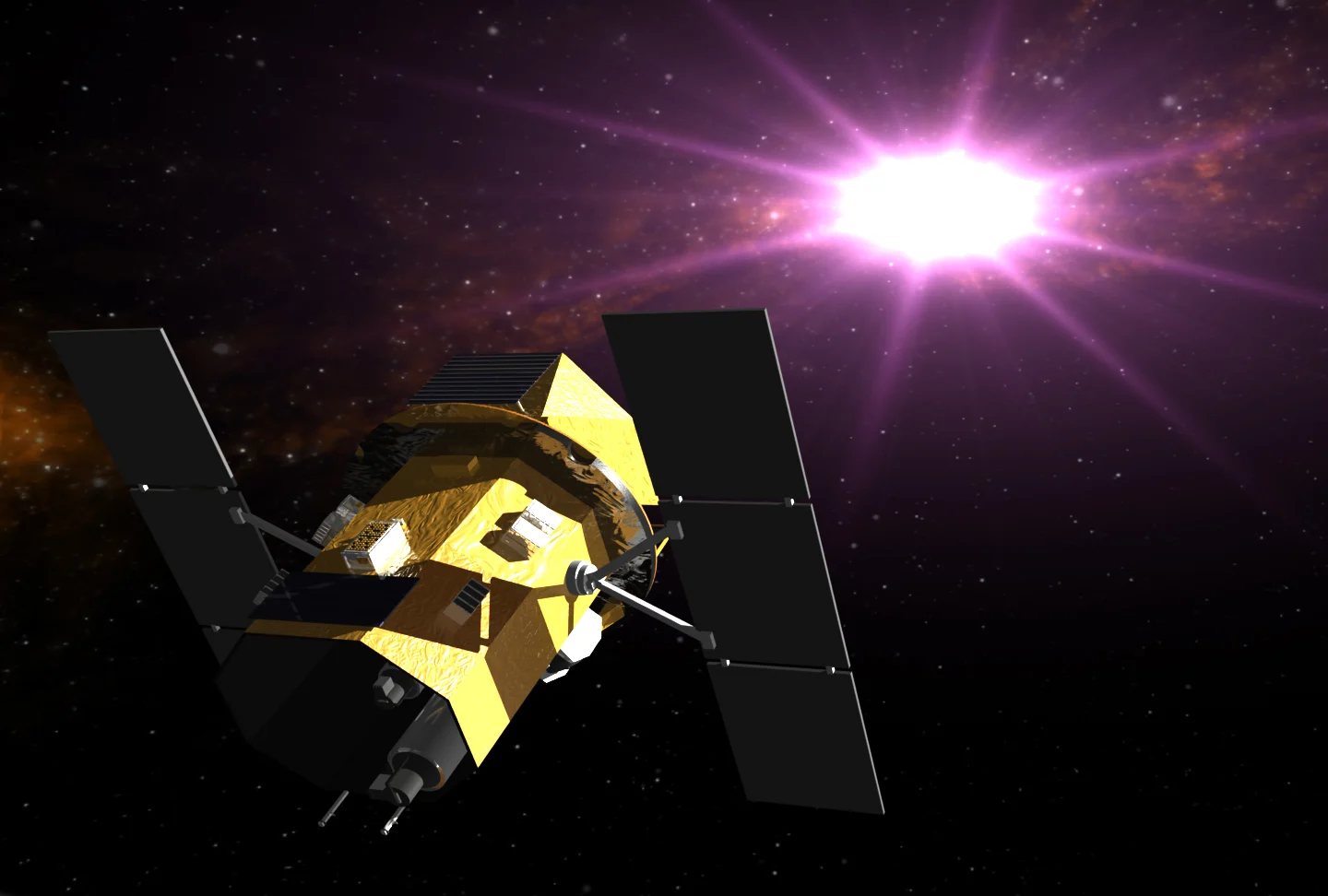
The last close picture of Swift is not a portrait. Katalyst Space’s LINK spacecraft took it as it passed 12 to 15 kilometers from the observatory. In the frame Swift is a streak, a line of light against black. LINK was moving too fast and too far away for anything sharper. The image was taken on LINK’s closest pass, and it is the record of how near the rescue came: close enough to see its target, and no closer. The NASA Swift telescope reentry is now expected in the coming days, and the photograph is the closest any rescue attempt got.
LINK was a 400-kilogram robot, about 1.8 meters tall, with three arms and three xenon-fueled thrusters, built in under a year under a $30 million contract NASA awarded Katalyst Space Technologies in September 2025. It launched on July 3, 2026, on a Pegasus XL rocket dropped from Northrop Grumman’s Stargazer aircraft at about 40,000 feet over Kwajalein Atoll, in the Marshall Islands. The atoll was chosen because it sits close to Swift’s low-inclination orbit near the equator. The plan was for LINK to spend several weeks surveying Swift for places to grab, latch on, and fire its own ion thrusters for months to lift the observatory to a higher orbit. Swift has no propulsion of its own to fight atmospheric drag. A second spacecraft had to do the pushing.
Late in July, LINK started spinning. NASA’s July 28 update said two of its three reaction wheels were not operable and its cold-gas thruster system had lost some functionality, leaving the spacecraft turning and its communications sporadic. The Katalyst team used burns from one electric-propulsion thruster to slow the spin. By August 6 it had fallen from about 9 degrees per second to about 1.47 degrees per second. On August 11 the team uploaded new flight software, with attitude-control algorithms written for the spacecraft LINK had become, running on its remaining actuators. By then Swift was at about 347 kilometers, and NASA’s own marker for trouble was 300 kilometers: below that average altitude, raising the orbit gets more difficult.


On August 19, NASA and Katalyst said LINK would not capture or boost Swift. NASA Administrator Jared Isaacman said the agency should be willing to move quickly and take smart risks “when the potential return is worth it,” and that the outcome did not change why the mission was worth attempting. Shawn Domagal-Goldman, who leads NASA’s Astrophysics Division, called it a “high-risk, high-reward mission” built on “an unprecedented timeline driven by the Sun’s activity.” LINK kept working on rendezvous demonstrations instead of a capture. NASA formally ended its part in the LINK mission on September 3, and LINK re-entered the atmosphere on September 25.
Katalyst was not NASA’s only idea. In August 2025 the agency paid Cambrian Works of Reston, Virginia, and Katalyst $150,000 each for concept-design studies under its small-business research program, and asked Starfish Space of Seattle whether its inspection spacecraft could be adapted for the job. Katalyst won the $30 million build-and-launch contract the next month, and the winning design went from contract to launch in less than a year.
While LINK was being built, the people flying Swift were already running their own rescue. Swift’s operations team at Penn State started swapping science targets in December 2025 for pointings that put the spacecraft in its most streamlined attitude, about a quarter of the targets at first. By February the team had switched over entirely. The ultraviolet/optical and X-ray telescopes stopped observing, and in April it paused the Burst Alert Telescope so the solar panels could sit at the angle that cut drag furthest. John Nousek, the mission director at Penn State, said the changes “bought valuable time for the boost mission and can be carried forward for future NASA missions.” The pointing came with limits of its own. Swift could not aim too close to Earth, the Moon or the Sun without risking heat damage to its instruments. Flying streamlined also tilted it toward the thin air itself, where particles could strike the telescopes.
The telescopes came back on August 26, two of the three instruments at first, after the boost attempt was scaled back. NASA’s October 23 account says Swift then observed hundreds of targets, from supernova remnants to active supermassive black holes in distant galaxies and comets in our own solar system, and that returning to normal pointing increased the drag again. On October 20 Swift sank to 275 kilometers, entered safe mode because it could no longer hold its pointing steady against the drag, and the Penn State team sent the command that ended operations to prepare it for re-entry. Its final observation was that day, and NASA announced the end on October 23.
The Aerospace Corporation’s CORDS database, read on November 2, put re-entry at 09:30 UTC on November 4, plus or minus 26 hours. A Space-Track prediction message quoted by the tracking site KeepTrack put the nominal decay at 00:30 UTC on November 4, and the message itself carried an 840-hour window, 35 days wide, around that nominal time. The U.S. Space Force estimate reported by the Associated Press on October 31 was vaguer still: on or around Friday, November 6. The three forecasts do not agree, and each new orbit measurement moves the answer, because the air Swift is falling through cannot be measured precisely from the ground.
“Ever notice that 90% of the time they say they have no clue where it will land?” Lori Howe wrote on Facebook under a news post about the fall. Bertus Ehmke answered her that the spacecraft was not built for re-entry, so there was “very little predictability in terms of drag and rotation.” The trackers say the same thing in numbers. Alain Grycan posts Swift’s decay estimates on X. The satellite observer moved his forecast from November 5 on October 30 to November 4 at 12:54 UTC, plus or minus 8 hours, by November 2. Alice Davis, also on Facebook, wrote that she hoped any debris would come down in a desert or an ocean “where no animals, fish, man or woman get hurt.”
Swift’s path stays within about 20.6 degrees of the equator. The 14 top-level replies read on a Clarín post in Argentina in late October mixed jokes about the country’s luck with hopes that the pieces would fall in the sea. One reply noted that the ocean was the most likely outcome, as with most space debris. One reply, translated from Spanish, hoped it would fall in the sea “because if it falls in Argentina, they’ll want to keep it to sell as scrap.”
NASA’s Community Coordinated Modeling Center is running a modeling challenge built around Swift’s fall, working with the Collaboration for Observational and Numerical Thermosphere with Integrated Geospace Orbits. The challenge invites forecasting groups to submit solar and geomagnetic driver forecasts, thermosphere density forecasts, and re-entry times and trajectories. Their submissions will be scored against what Swift actually does as it drops from below 300 kilometers to about 100. The challenge page names thermosphere density as the dominant source of uncertainty in drag and orbit prediction, and says no orbit predictions from participants will be posted publicly until Swift has come down. A preliminary report is planned for a workshop in 2027, with a final publication after that.
What is falling was built to be fast. Swift’s Burst Alert Telescope watched a wide sky for gamma-ray bursts. When one appeared, the spacecraft swung its X-ray and ultraviolet/optical telescopes onto the spot. Principal investigator Bradley Cenko put the turn at about a minute. In May 2005 it caught a burst that lasted 0.03 seconds and still found 11 X-ray photons from its afterglow, the first short burst located well enough to study, and the evidence that such bursts come from merging neutron stars. NASA has named no successor for that job and says it is exploring how to use its existing telescopes, commercial fast-to-orbit options and future missions to fill the gap in the meantime.
The archive Swift leaves behind holds about 12 terabytes of data, including more than 1.5 million images from its ultraviolet/optical telescope. NASA says the full dataset is publicly available.