Pero’s Bridge Collapsed Into Bristol Harbour Days Before the Barge Arrived
The council had flagged the bridge in July 2025, funded the investigation from culvert money, and scheduled its removal for the week of 2 November.
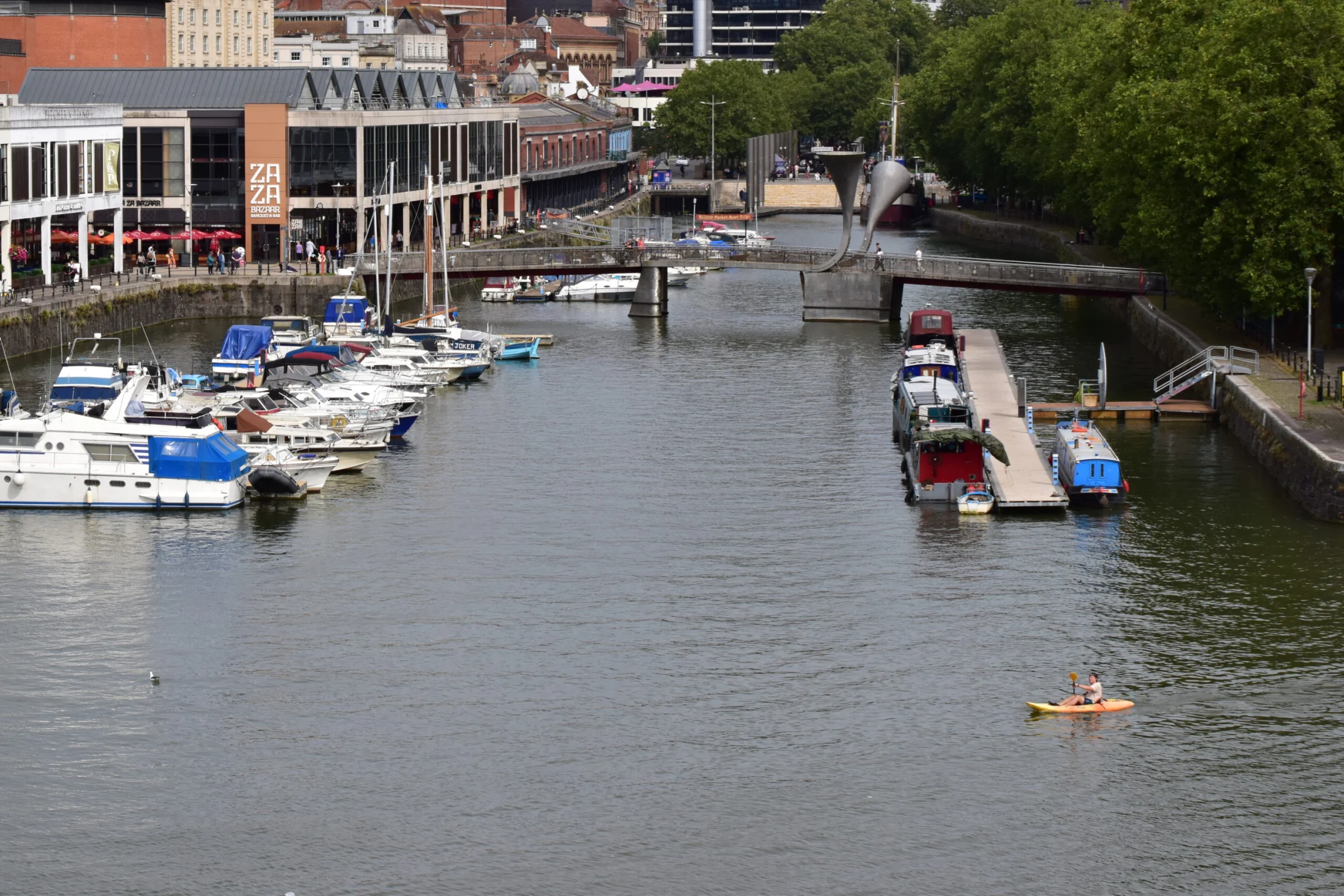
One of the horn-shaped sculptures that counterbalanced Pero’s Bridge was in the water by Sunday morning, and the walkway it had held up had gone down with it.
Pero’s Bridge collapsed further on the night of 31 October, with part of the walkway falling into St Augustine’s Reach in Bristol Harbour. The BBC reported on 1 November that a section of the bridge was twisted downward and partly submerged, with one of its horn sculptures in the water. The crossing had already been shut to pedestrians since August, and the BBC’s report carried no comment from Bristol City Council, which it said it had contacted.
The bridge that fell was a pedestrian bascule bridge, three spans across the reach, with the central span built to lift so boats could pass into Narrow Quay. Its most recognised feature was the pair of horn-shaped sculptures, which worked as the counterweights for the lifting section and gave the bridge its local nicknames, the Horned Bridge and Shrek’s Bridge. It linked Queen Square with Millennium Square. The lifting span measured 11 metres. The navigation channel beneath it measured 9 metres. The artist Eilis O’Connell designed it with engineers from Ove Arup & Partners, and Paul Boateng, then a Home Office minister, opened it in 1999.

Pero Jones, the man the bridge was named for, had been bought as a child. Bristol Museums records that John Pinney paid £115 in 1765 for Pero, then about 12, his sisters Nancy and Sheeba, and an adult. Pero became Pinney’s manservant, came with the family from Nevis to Bristol in 1783, and lived at 7 Great George Street, the house that is now the Georgian House Museum. He died in 1798, probably still enslaved. When the council asked for a name for the new bridge, Pero’s Bridge was suggested and supported by Black groups in the city and by Bristol’s Member of the European Parliament, Ian White. The Liberal Democrat councillor Stephen Williams attacked the choice at the time as “gesture politics” and wanted a statue or permanent memorial instead. In June 2020, the toppled statue of the slave trader Edward Colston lay on the harbour bed directly south of the bridge for four days before the council retrieved it.
Long before the bridge dropped in August, it had stopped lifting. Couples had fixed padlocks to its railings for years, and by June 2025 the locks weighed an estimated three tonnes. Patsy Mellor, the council’s director of management of place, told the harbour committee on 24 June 2025: “We have got a ‘no lift’ notice on Pero’s Bridge due to the weight of the locks. It’s three tonnes, the estimated weight of the locks.” The locks were cleared before the Harbour Festival that July, and the council looked at moving them to another structure nearby rather than throwing them away. The council had cleared the railings once before, about a decade earlier, and people had covered them again within a few years. A campaign launched in 2023 had called for the locks to go, on the ground that they jarred with a bridge named for an enslaved man. In October 2025 the harbour committee discussed melting the locks down into a sculpture, with no budget set aside to make it, and selling them for scrap to pay for it.
A programmed Principal Inspection on 19 July 2025 raised major structural issues that required an urgent structural assessment, according to the council’s Decision Notice. The same day, the Capital Investment Board approved taking £200,000 from the £1 million allocated for work on the Frome Culvert. The money was for emergency investigation works for Pero’s Bridge. The remaining £800,000 went to sluice repair at Underfall Yard. The Economy and Skills Committee verified the decision on 22 September 2025. The Decision Notice listed the alternative considered, doing nothing, and what it would have meant: the instant closure of Pero’s Bridge. A 1-tonne weight limit and the no-lift notice stayed in place.
In March 2026 the Harbour Committee agreed that planned maintenance would take place in the autumn, including the removal of the bridge’s two fixed spans and the central span for refurbishment. The test lift on 13 August was preparatory work for that programme. The Harbourmaster’s Report to the September committee says that as the span was being lowered, an incident occurred which left it unable to return to its normal operating position. No one was injured. There was no pollution. The bridge stayed closed to pedestrians and to vessels, which could not pass beneath it. Ferry passengers for the Cascade Steps landing were directed to the landing by Prince Street Bridge.
Money for the refurbishment had been approved in March as part of the harbour capital programme, £1.35 million for Pero’s Bridge. A briefing on the committee papers by Joanna Booth reported that the council’s own inspection had found the bridge in better condition than feared. The budget carried no contingency. Officers warned a further funding bid was likely. The Harbour Asset Management Plan considered by the same September committee put the bridge in a wider picture. The harbour manages about £1 billion of assets. Many are ageing and deteriorating, and operational failures in locks, bridges and engineering systems are increasing. Current maintenance revenue runs £650,000 to £1 million a year. The estimated lifecycle need is £8 million to £10 million. Councillor Andrew Brown, chair of the economy and skills policy committee, had said the bridge “will be fully refurbished with significant upgrades made to how it operates, improving the bridge’s reliability and functionality.”
Helen Bevan, posting on Facebook on 1 November, wrote: “The damaged structure has now tonight completely collapsed into the water.” Tony Wilkins, posting a video on Instagram on 31 October, wrote: “Bristol is falling apart by the day under this Green council.” The officials’ record is inspections, reallocations and a reopening aim. The posts are loss, and blame aimed at the council. Sarka Kolarova had written in the Facebook group The weird and wonderful of Bristol on 25 August, after the first failure: “Two iconic places in Bristol are now in the past.”
Notice to Mariners 48/26 said a heavy-lift barge and a supporting tug would work in the Floating Harbour in the week commencing Monday 2 November. The barge would lift the three spans and carry them to Albion Dry Dock. The work was daylight only. Vessels moored at Marina South and the Arnolfini Pontoons were to be moved out of the way. The harbour’s update of 21 October said the spans would be repaired and refurbished at the dry dock. They would return to the harbour in summer 2027. Once they were removed, boats would be able to pass through St Augustine’s Reach. Ferry services would return to Cascade Steps. The council aimed for the bridge itself to reopen in spring 2027, with the warning that the date could change if the repair works took longer.
Boats still could not pass under what was left of the bridge, and the Cascade Steps ferry landing stayed closed. Prince Street Bridge was the alternative landing.