Pascal’s $8.5M Bet on CO2 Could Rewrite Refrigeration Economics
A Harvard lab anomaly led to a sealed-cartridge cooling design that bypasses the extreme pressures limiting competing solid-state technologies.
Commercial refrigeration accounts for roughly 1% of global electricity consumption, a figure that forces multinational food and beverage corporations to absorb billions of dollars in annual energy costs. A Massachusetts-based startup called Pascal is targeting that specific expense line with a new cooling architecture that it says improves efficiency by 20% compared to conventional systems.
The company recently closed an $8.5 million funding round, co-led by Sazze Partners and LB Investment with participation from KDB Silicon Valley, according to TechCrunch. The capital injection followed the signing of a pilot contract with an unnamed multinational beverage company. Pascal plans to deliver its first prototype early next year, followed by a refined batch of refrigerators in 2028.
Pascal’s technology diverges sharply from both traditional vapor-compression systems and emerging solid-state cooling methods. Rather than circulating chemical refrigerants or mechanically squeezing solid blocks of material, the system compresses carbon dioxide into cartridges filled with a proprietary sponge-like substance, CEO and co-founder Adam Slavney told TechCrunch. Co-founder Jinyoung Seo serves as CTO.


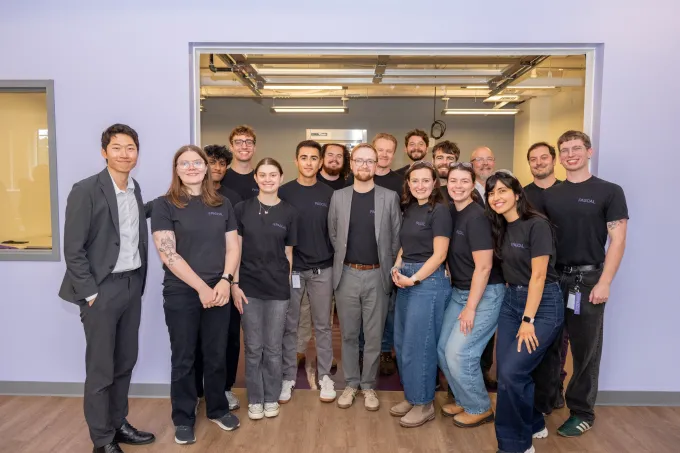
The Pascal team at their lab in Massachusetts.Image Credits:Pascal
When CO2 molecules enter the porous material, they collide with the internal walls. Those impacts transfer kinetic energy, heating the cartridge. A heat exchanger vents that thermal energy. Reversing the process pulls heat out of the exchanger and pushes it back into the gas. A working Pascal unit cycles two cartridges simultaneously—one drawing heat from the interior compartment, the other dumping it outside—before reversing flow once temperature differentials peak.
The discovery originated as an anomaly during high-pressure materials research at Harvard University. Slavney and Seo were testing solid-state refrigerants using instruments that required a pressurizing gas. Swapping one gas for another produced inexplicably different thermal readings. “Why are these things different? What did we change?” Slavney recalled asking. Definitive proof of the underlying mechanism took up to two years to establish.
Manufacturing economics drove the engineering choices. Competing solid-state refrigeration concepts often require extreme pressures, demanding expensive, specialized components. Pascal relies on conventional compression hardware adapted for CO2, a deliberate decision to keep unit costs low enough for mass deployment. “That means we believe we can make it cheap, and that means we can make it widespread,” Slavney said.
Durability testing has pushed the proprietary material through 300,000 operational cycles, which Slavney equated to approximately one year of continuous use.
The push toward alternative cooling arrives as regulators tighten restrictions on synthetic refrigerants. Older chlorofluorocarbons like Freon were phased out after depleting the stratospheric ozone layer. Their replacements, including R-134a, carry extreme global warming potentials. For nearly four decades, the appliance industry has cycled through chemical substitutes without resolving both environmental and thermodynamic inefficiencies simultaneously. Because Pascal uses CO2 locked inside sealed solid cartridges rather than free-circulating gases, atmospheric leakage risks are structurally eliminated.
The beverage industry pilot represents the first commercial test of whether this laboratory anomaly can survive the rigors of industrial supply chains.