NFL Survivor Pools Wipe Out 95% of Entries in Six Weeks — The House Always Wins
95% elimination rate after six weeks exposes the true cost of entry
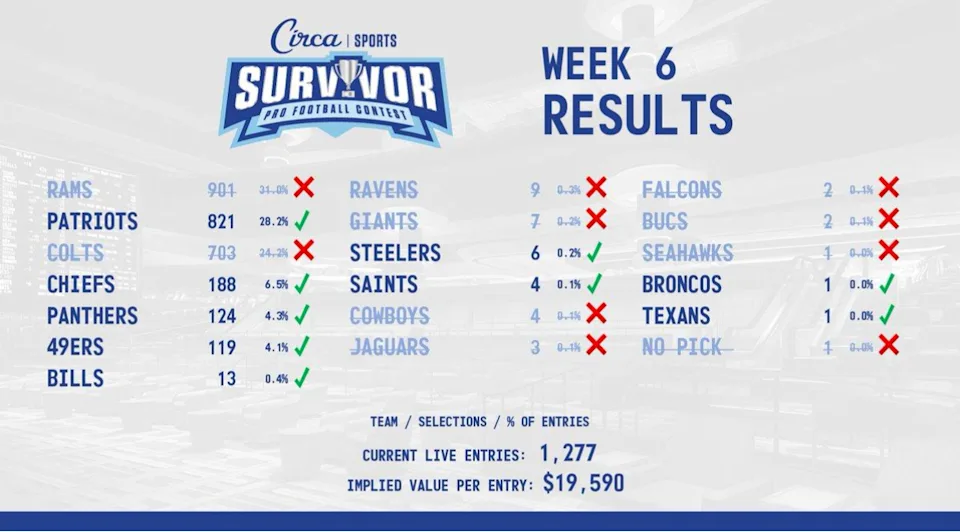
The math is brutal. Ninety-five percent of the money is gone after six weeks.
Circa Sports’ flagship NFL Survivor contest started the season with thousands of entries at $1,000 each. By the time the Rams blew a 13-point favorite assignment in Week 7 and the Tennessee Titans finally won a game, the field had shrunk to 5% of its original size. That is not variance. That is the business model.
Survivor pools are marketed as skill games. Pick one winner each week, never use a team twice, last entry standing splits the pot. The appeal is obvious: unlike traditional sports betting, there is no point spread, no vigorish on each play, just a binary win-or-go-home decision. But the attrition rate reveals the true product. Circa collects every entry fee upfront. The prize pool is funded entirely by the 95% who lose. The house takes a cut — typically 10% off the top — and the remainder gets redistributed to the few who survive the gauntlet.


Week 6 was a perfect storm for the operator. The Los Angeles Rams, installed as 13-point favorites over the Raiders, lost outright. The Titans, perpetual underdogs, beat the Chargers. Those two results alone eliminated more than half the remaining field. In a normal week, the biggest favorite wins 80-85% of the time. When the chalk fails, the pool operator wins twice: the entry fees are already banked, and the remaining contestants face steeper odds with fewer teams left to use.
The most-traveled survival path through six weeks reads like a chalk-eater’s dream: Jaguars or Steelers in Week 1, 49ers in Week 2, Chiefs in Week 3, Vikings or Ravens in Week 4, Texans or Jaguars in Week 5, Patriots in Week 6. Notice the pattern. Almost every optimal pick was the week’s biggest or second-biggest favorite. The strategy that keeps you alive is the same strategy that maximizes correlation risk — everyone clusters on the same teams, so when one fails, the field evaporates together.
This week, the Houston Texans sit as the largest favorite at 80.9% implied probability against the New York Giants. Circa’s availability matrix shows 52.5% of remaining entries still have Houston unused. The Vikings, second on the board at 75% implied probability, are available to 58.3% of the field. But here is the structural trap: using Houston now burns a team that projects as a 4.5-point favorite at the Chargers in Week 9, a 7.5-point favorite against the Colts in Week 11, and an 11-point favorite over the Titans in Week 18. The contestants who survive longest are the ones who zig when the market zags — but the market rarely zags without reason.
Historical data from Circa’s contest shows the median entry lasts 4.2 weeks. The 95th percentile — the threshold to cash — typically requires 15-16 correct picks in an 18-week season. That means you need to navigate nearly the entire NFL calendar without a single loss, using a different team each week, while the betting market prices every favorite with razor-thin margins. The implied probability of a perfect 18-week run using optimal favorites each week is roughly 0.3%. The other 99.7% of the prize pool funds the winner and the house.
Entries who burned the Texans in Week 5 — 47.5% of the remaining field, according to Circa’s data — now face a menu of unpalatable options: the Jets as road favorites, the Cowboys at home, the Steelers playing in Paris. Each carries implied win probabilities below 70%. The mathematical expectation for a $1,000 entry at this stage, assuming optimal play, is approximately $340. The other $660 has already been transferred to the prize pool and the operator.
Yahoo Sports betting contributor Matt Russell publishes weekly Survivor analysis at THE WINDOW. His content drives engagement. But the economics are indifferent to analysis. The pool is designed to extract maximum value from the 95% who believe they can outthink the market. Six weeks in, the market has collected.