

NTangible Scores Athlete Mental Toughness for Recruiters
The startup adapts 1930s projective psychology to help Division I programs quantify mental resilience amid soaring NIL contracts.
College athletic departments spending millions on player acquisitions now have a new metric to evaluate before signing a contract: a numerical score predicting how an athlete will handle high-pressure situations.
NTangible, a sports technology startup founded by former professional baseball player Dan Connerty, built a psychological assessment that converts mental resilience into a number between 0 and 1,000. The company is presenting its platform this week as a competitor in the Startup Battlefield at TechCrunch Disrupt in San Francisco, which runs through Thursday, October 15.
The evaluation tool relies on projective psychology rather than standard questionnaires. Developed alongside Dr. Ed Levine, a professor emeritus at the University of South Florida, the Clutch Factor assessment adapts principles from the Thematic Apperception Test (TAT). First developed in the 1930s by psychologists Henry Murray and Christiana Morgan, the TAT asks subjects to interpret ambiguous images. NTangible applies this framework to sports by having athletes describe scenarios they see in photographs. A neurolinguistic scoring guide then analyzes their word choice, semantic phrasing, and narrative construction to generate the final score.


According to Connerty, athletes who score above 750 are twice as likely to commit to a Division I program. That threshold has become a focal point for recruiters navigating a collegiate landscape transformed by name, image, and likeness (NIL) policies and revenue-sharing agreements that have pushed quarterback valuations past $4 million. Programs historically relied on physical measurables like sprint times, throwing velocity, and vertical leaps, leaving psychological readiness largely to subjective coaching evaluations during campus visits.
Projective tests carry inherent vulnerabilities when used in high-stakes environments. Because the assessment lacks definitive right or wrong answers, motivated test-takers can theoretically reverse-engineer desirable responses. During independent testing of the platform, answering honestly yielded a below-average score of 584. When the same assessment was retaken using the calculated phrasing expected of a top-tier recruit, the score jumped to 802. This malleability mirrors long-standing criticisms of projective assessments in clinical psychology, where faking good remains a documented challenge.
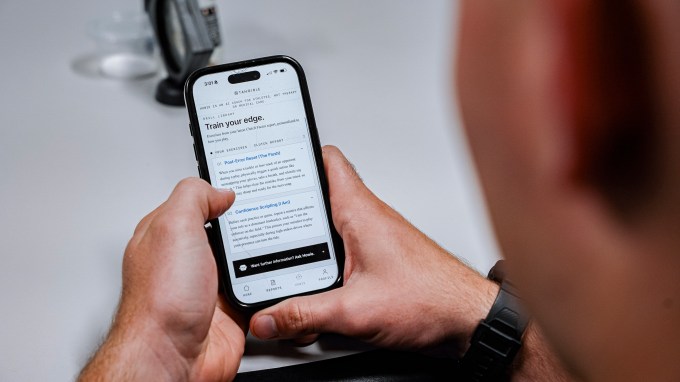
Connerty views the resulting data less as a rigid gatekeeper and more as a developmental baseline. He asserts that performing under pressure is a trainable skill. While NTangible operates strictly as an assessment platform rather than a training application, the company partnered with former Major League Baseball sports psychologist Howie Schwartz to compile targeted exercises athletes can use to address specific cognitive weaknesses identified by their scores.
The platform currently supports testing across nine sports. Beyond athletics, NTangible is developing corporate applications for human resources departments. Its secondary product, NTerpret, shifts the focus from competitive pressure to workplace dynamics, evaluating how employees process feedback, respond to coaching, and act on managerial instructions.
The company’s primary commercial strategy targets direct enterprise sales to sports organizations and corporations, bypassing individual consumer subscriptions. NTangible is among the top 20 startups competing for the grand prize at Disrupt, where investor judges will determine the winner.









