Kalshi Scales to $4B Revenue Run Rate With Flat Hierarchy as Supreme Court Looms
Startup avoids bureaucracy as Supreme Court weighs state gambling challenges
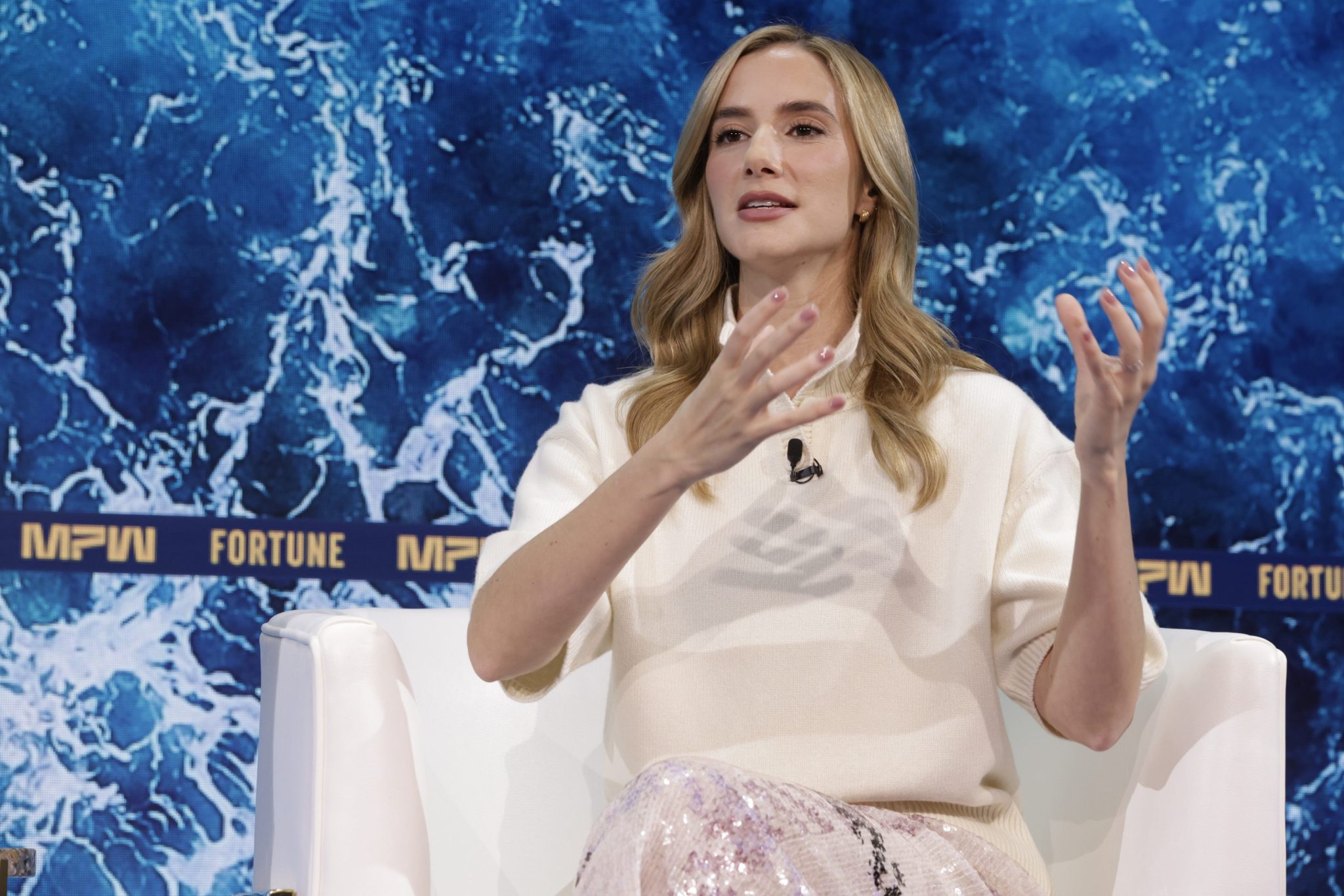
Prediction market startup Kalshi has cracked the code that trips up most fast-growing companies: how to add headcount without drowning in bureaucracy. Cofounder and COO Luana Lopes Lara revealed the company’s unconventional management structure at the Fortune Most Powerful Women Summit in Santa Barbara this week — a flat organization where every employee reports directly to her or sits just one layer removed, eliminating the traditional VP and department-head tiers that typically calcify decision-making as startups expand.
“We are able to very quickly make decisions, and adjust very, very quickly,” Lopes Lara said. The model appears to be working. A June estimate from one research firm placed Kalshi on a $4 billion annualized revenue trajectory, a more than fivefold jump from $775 million in December. The surge coincides with an explosion in election-year sports wagering volume and the launch of novel contracts like futures on compute capacity — a first for the North American prediction market sector.
But the company’s steepest test isn’t organizational. It’s legal. Dozens of state attorneys general have sued Kalshi, arguing its sports contracts constitute illegal gambling. The cases have produced conflicting rulings across federal appeals courts, creating a circuit split that virtually guarantees Supreme Court review. Oral arguments are widely expected during the Court’s next term, with a decision likely by June 2025. The outcome will set precedent for the entire prediction market industry, which operates under Commodity Futures Trading Commission oversight but faces state-level gambling statutes that predate the internet.


Kalshi’s core legal argument rests on a structural distinction: its users bet against each other on an exchange, not against a house that sets odds and holds the counter-position. That peer-to-peer model, the company contends, makes its contracts more akin to financial derivatives than traditional sportsbook wagers. Several lower courts have rejected the distinction. The CFTC, which designated Kalshi a designated contract market in 2021, has largely stayed on the sidelines of the state litigation.
The regulatory uncertainty hasn’t slowed product velocity. Beyond sports and political contracts — Kalshi currently lists a 92% probability on Democrats retaking the House in November — the platform has pioneered markets on economic indicators, climate metrics, and now computational resources. The compute futures contracts let AI labs and cloud providers hedge GPU pricing risk, tapping into a derivative need that didn’t exist three years ago.
Lopes Lara, 30, became the world’s youngest self-made female billionaire earlier this year on paper, a milestone she described as “very weird” and largely invisible in her daily routine. “I’m still in the office over 12 hours every day,” she said. Her cofounder, Tarek Mansour, serves as CEO; both are MIT graduates who launched Kalshi in 2018 after stints at Goldman Sachs and Citadel.
The company also faces a softer challenge: probabilistic literacy. Lopes Lara cited the House control market as a case study in how audiences misread prediction market outputs. An 8% outcome isn’t a market failure when it materializes — it’s the 8-in-100 scenario the price implied. The distinction matters as prediction markets gain citation in mainstream political coverage, where they’re often treated as definitive forecasts rather than priced probabilities.
On the competitive front, Lopes Lara distanced Kalshi from rival Novig’s recent marketing push, which featured actor Sydney Sweeney in a near-nude advertisement. “It’s not an ad that we would ever put out, or that I, as a woman, would feel comfortable putting out or seeing,” she said. “I don’t think it’s the brand that we want to build.” Novig, which operates a similar exchange model but focuses exclusively on sports, has not responded to the critique.
With the Supreme Court poised to hear the state challenges next term, Kalshi’s flat structure will face its ultimate stress test: navigating a ruling that could reshape or restrict its core product lines across the country.