Epic Games Launcher Preview Debuts With Linux Support
First native Linux client arrives as Epic rebuilds anti-cheat systems to eventually support Fortnite
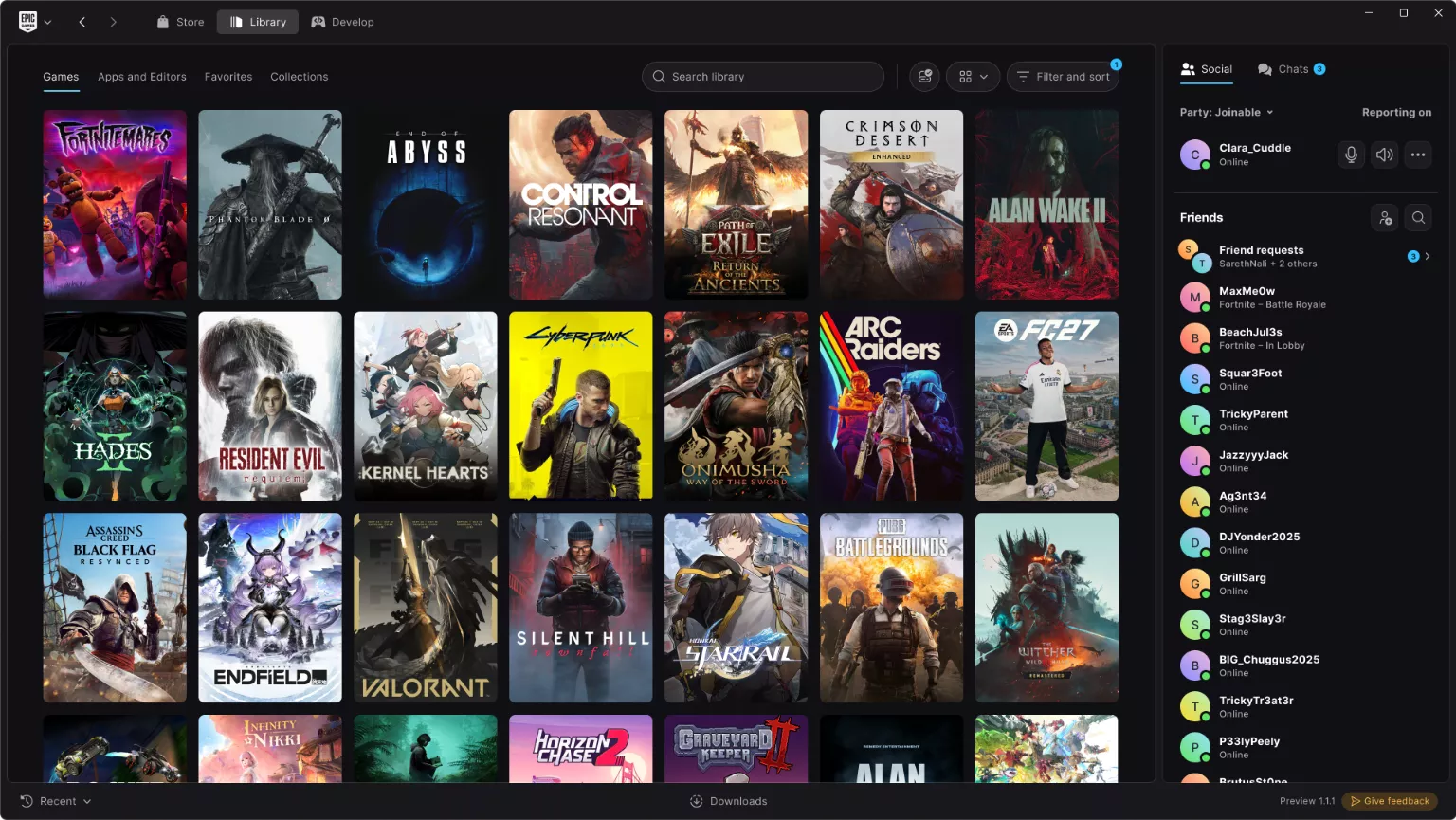
Epic Games has released a public Preview of a rebuilt desktop launcher, delivering its first official client for Linux alongside sweeping performance and interface changes across Windows and macOS. The release signals a strategic shift for the company as it attempts to transform its storefront software from a purchasing portal into a centralized PC gaming hub.
The most consequential change extends beyond visual updates. By shipping an official Linux build, Epic is directly challenging Valve’s long-standing dominance on the operating system. For years, Linux gamers have relied almost exclusively on Steam, which runs natively on distributions like Ubuntu, Arch, and Fedora through Valve’s Proton compatibility layer. Third-party open-source clients such as Heroic Games Launcher previously filled the gap for Epic’s catalog, but this marks the first time Epic has engineered and supported its own native client for the platform.
Performance deficits that plagued earlier iterations of the Epic Games Store application drove much of the redesign. Users frequently reported sluggish cold starts and heavy background resource consumption compared to rival platforms. The new architecture targets those bottlenecks directly, prioritizing faster boot times, smoother transitions between the storefront and local libraries, and lower memory overhead when idle.


Epic is also attempting to solve library fragmentation. The updated client allows users to connect external PC game libraries, consolidating titles purchased across different storefronts into a single unified view. This aggregation mirrors functionality popularized by third-party tools like GOG Galaxy and Playnite, but integrates it natively into Epic’s ecosystem. Players can organize these combined catalogs using customizable collections, switch between grid and list layouts, and pin frequently played titles or applications directly to the top navigation bar.
Individual game management received a dedicated overhaul. Rather than burying launch options behind menus, the client now routes users to specific game pages displaying installation status, recent play activity, and direct launch controls. Search capabilities were rebuilt to deliver real-time filtering results, while download monitoring expanded to surface granular metrics including disk read speeds, write speeds, and the status of active, queued, scheduled, or failed transfers.
Social infrastructure within the client now centers on Epic Parties, integrating voice chat directly into the launcher so players can communicate across Fortnite, standalone Epic Games Store titles, and other supported applications without relying on third-party software like Discord.
Despite the broad rollout, the Linux version carries significant caveats. Fortnite remains unplayable on the platform through the new client. The barrier is not the launcher itself but kernel-level anti-cheat requirements. Epic is currently rebuilding Easy Anti-Cheat (EAC) support specifically for Linux environments. EAC, originally developed by Kamu and acquired by Epic in 2018, requires deep operating system integration to prevent cheating, making cross-platform parity difficult. Until those security protocols are fully adapted and certified for Linux, flagship competitive titles will remain restricted to Windows and macOS.
Because the current build operates as an early Preview with a reduced feature set, Epic advises competitive players and developers managing live projects to continue using the stable release branch.
All existing Epic Games accounts retain full compatibility with the new client. Purchased games, local installations, cloud saves, and account progression transfer automatically without requiring migration steps or separate credentials.