Alphabet Plans to Top $200B AI Spending as Chip Stocks Tumble
Semiconductor shares plunge in Asia after Broadcom questions enterprise AI returns, even as Alphabet commits to expanding its massive infrastructure buildout.
Semiconductor shares across Asia cratered Tuesday after Broadcom CEO Hock Tan warned that enterprise artificial intelligence spending resembles gambling more than strategic investment, a sharp rebuke arriving just as Alphabet signaled it will push capital expenditure well beyond this year’s estimated $200 billion.
The divergent signals from two of the industry’s heaviest hitters exposed a widening fracture in how technology leaders view the immediate returns on generative AI infrastructure. South Korea’s SK Hynix dropped more than 10%, Samsung fell 7.39%, and Dutch lithography equipment maker ASML slid 1.48% following Tan’s remarks at an event in Singapore.
Tan compared current corporate AI experimentation to children burning through arcade tokens without learning anything. He argued many customers are wasting money while fruitlessly searching for productivity gains, suggesting investors have set extreme expectations without understanding the underlying mechanics of the technology they are funding.

That skepticism directly collides with the strategy outlined by Alphabet President and Chief Investment Officer Ruth Porat at the Fortune Most Powerful Women Summit in Santa Barbara, California. Porat confirmed the company remains capacity constrained and expects next year’s spending to increase significantly from its current massive baseline.
Alphabet’s trajectory traces back to its 2016 strategic pivot from mobile-first to AI-first development. Unlike competitors racing to retrofit legacy systems, Google spent the last decade restructuring its architecture around machine learning. That long-term positioning now drives demand across enterprise and government contracts, forcing the company into what Porat described as a sustained buildout phase rather than a temporary sprint.
The tension between infrastructure builders betting on long-term dominance and chipmakers warning about short-term customer fatigue defines the current market environment. While U.S. S&P 500 futures edged up 0.02% Tuesday morning and Europe’s Stoxx 600 gained 0.58%, Asian indices absorbed the brunt of the sector anxiety. Japan’s Nikkei 225 fell 1.82% and South Korea’s KOSPI plunged 5.46%.
Broader economic headwinds are compounding investor unease. Brent crude climbed to $105 per barrel, tightening margins for energy-dependent economies. Bitcoin traded at $83,586.
Geopolitical instability is simultaneously dragging on global consumer activity. HSBC analysts Maitreyi Das and Prachi Mathur reported that Middle East conflicts reversed a 2% first-quarter gain in international travel, pushing second-quarter global tourism into a 1% decline. Roughly 690 million tourists traveled in the first half of 2026, representing just a 0.4% increase over the prior year.
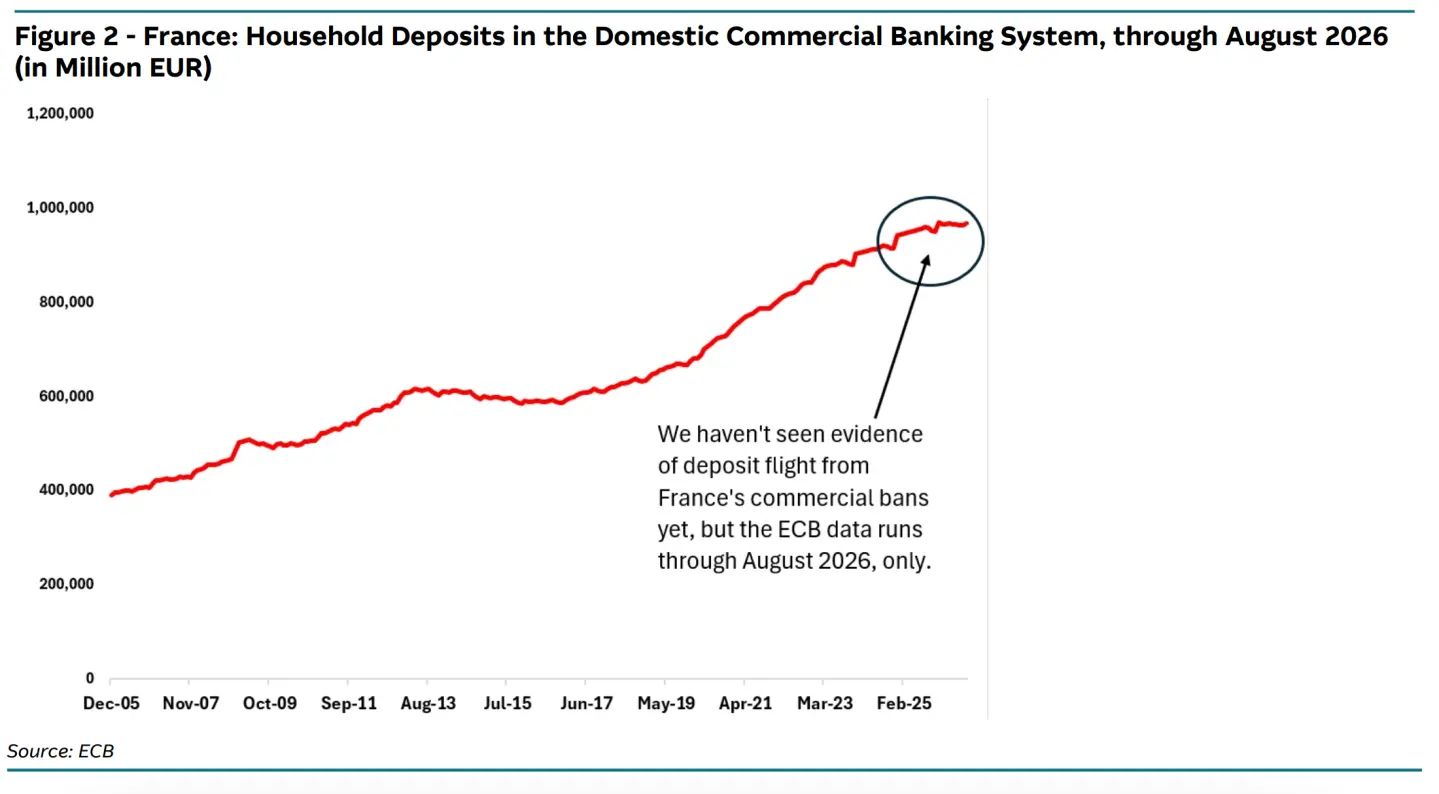
Financial stability concerns are also surfacing in Europe. Macquarie analysts Thierry Wizman and Gareth Berry cautioned that rising French sovereign bond yields, fueled by protests over dilapidated public schools, could theoretically trigger deposit flight from commercial banks. They drew parallels to the rapid yield spikes that precipitated the collapse of Silicon Valley Bank and Republic First Bancorp in early 2023, though they noted no such capital exodus is currently underway.
Domestically, U.S. consumers continue to spend aggressively despite elevated interest rates. Bank of America data showed household credit and debit card spending rose at a 6.2% annualized rate in September, marking the third strongest monthly reading in four years according to analysts Liz Everett Krisberg and David Tinsley.
Deutsche Bank strategists Binky Chadha and Parag Thatte pointed to historical midterm election patterns to project near-term equity resilience, noting the S&P 500 has advanced in 21 of the past 23 cycles during the window spanning one month before to two months after midterm voting.
Corporate dealmaking continues alongside the macroeconomic turbulence. The Wall Street Journal reported dating-app operator Bumble is in advanced negotiations to go private at a $1 billion valuation. Meanwhile, federal agents searched the home of Rep. Ilhan Omar as part of an immigration probe, according to Axios, and a cyberattack compromised hundreds of French supermarkets, manipulating refrigeration systems to heat units to 122 degrees Fahrenheit and sparking fires, CNBC reported.