
A 1,000-Year-Old Tapestry, a Hedge Fund Founder, and the Art of Data Compression
How a 70-meter medieval embroidery inspired a $1.7 billion quantitative investor to fund the UK's first-ever exhibition of the Bayeux Tapestry
The British Museum’s latest blockbuster exhibition, featuring the Bayeux Tapestry in the UK for the first time, is entirely sold out through the remainder of the year. More than 65,000 people entered online queues for admission immediately after tickets were released. Museum officials estimate that over 1 million visitors will view the 70-meter-long (230-foot) medieval embroidery during its London residency. The showcase represents the museum’s largest blockbuster exhibition in 50 years.
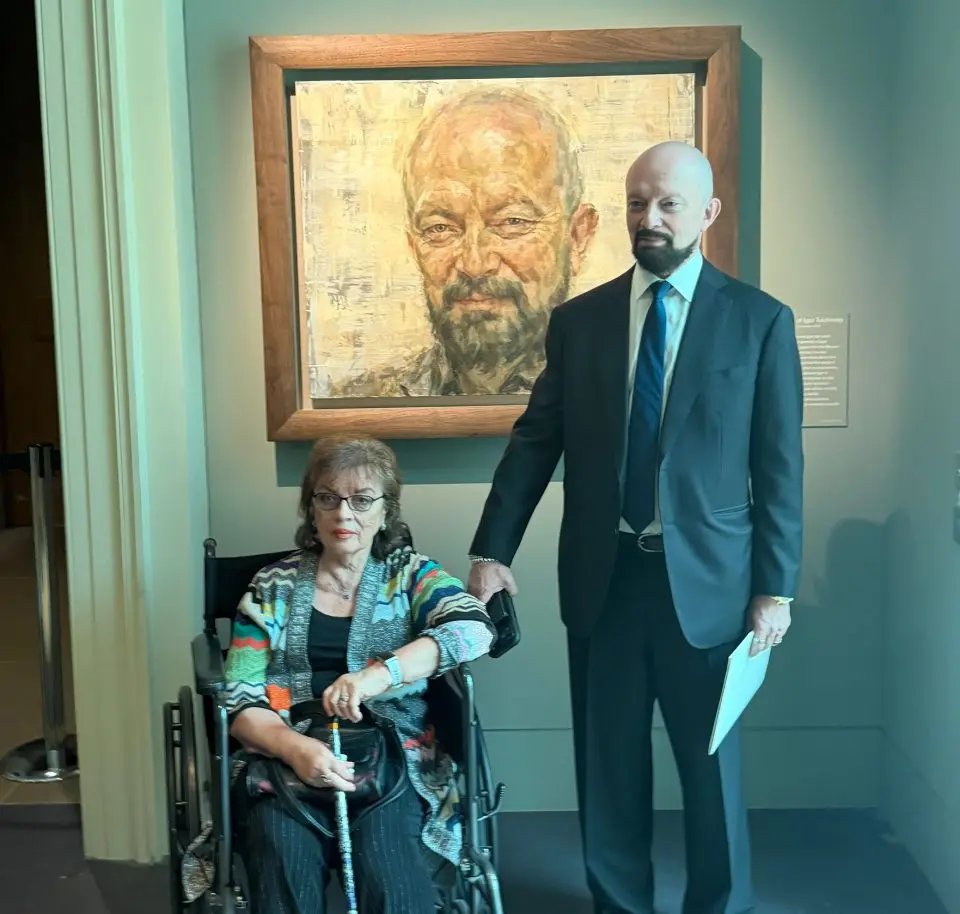
Igor Tulchinsky, a quantitative hedge fund founder with an estimated net worth of $1.7 billion, supported the historic display with a £5 million ($6.8 million) donation. Tulchinsky founded the quantitative hedge fund WorldQuant, which originated within billionaire Israel Englander’s alternative investment firm, Millennium Management, before becoming a standalone entity. WorldQuant specializes in mathematical modeling, automated trading algorithms, and parsing unstructured financial datasets.
Crafted in the late 11th century, the Bayeux Tapestry depicts the Norman Conquest of Anglo-Saxon England in 1066, culminating in the Battle of Hastings—the last successful foreign invasion of Britain. The cross-Channel loan has also served as a focal point for international cultural diplomacy. King Charles III, French President Emmanuel Macron, and British Prime Minister Andy Burnham were recently hosted for a private viewing of the artifact. Macron praised the piece as a “masterpiece,” while King Charles described it as a “remarkable artwork.”


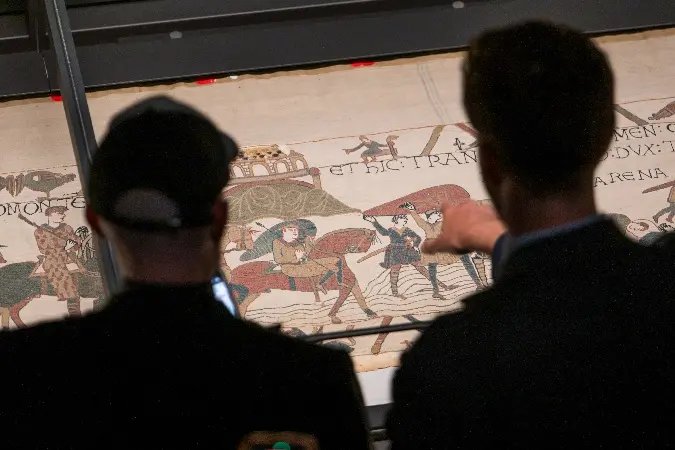
Tulchinsky noted that the tapestry represents an early precursor to modern systems thinking by condensing complex military campaigns, succession crises, and geopolitical transformations into a single, cohesive visual register. “They compressed a big tale into 70 meters of art—that’s mathematical,” Tulchinsky said. “It requires broad understanding. It requires compression. It requires putting things in the right places and doing that without losing the meaning of the story. So definitely, there is an art to math connection.”
His worldview has been shaped by his early life. Born in the Soviet republic of Belarus, he departed the USSR at age 11 during the height of the Cold War. His parents, both professional musicians, faced the precarious Soviet emigration system of the 1970s, in which applicants risked being denied, fired from their jobs, and branded as traitors. Upon securing exit visas, the family was permitted to leave the country with only 1 Soviet ruble. While the official state exchange rate stood at $1.30 per ruble, the real black market value ranged between 20 and 50 cents. Upon crossing the border into Poland, Tulchinsky’s father spent the single coin on a pack of local chewing gum. The family relocated to Italy to formally apply for refugee status, which was granted by the United States four months later.
Historical scholars believe the embroidery was commissioned by Bishop Odo of Bayeux, the half-brother of Duke William of Normandy, later known as William the Conqueror. The elaborate visual narrative was stitched onto fine linen using dyed woolen yarns by skilled English craftswomen before being transported to Normandy, where it was traditionally displayed in Bayeux Cathedral.
Tulchinsky stated that the growing reliance on algorithms and social media platforms makes exposure to tangible historical works essential for cognitive development. “Social media doesn’t require attention span. Everything is served to you to build up your dopamine,” Tulchinsky said. “But here you have to examine something very big, and you have to think. And we cannot lose these things because if we do, there’ll be nobody around who can manage the AI. Somebody has to manage it, and the person who manages it has to be a broad thinker and has to have a deep understanding of not only AI but different subjects, critical thinking.”
The firm is currently deploying advanced artificial intelligence systems that Tulchinsky projects could increase quantitative productivity up to a hundredfold. “It’s a kind of move that changes you,” Tulchinsky said of his family’s emigration. “It puts you in a place where you’re okay taking risks and understanding that sometimes big risks should be taken because even if you don’t try to take them, they can take you.”
He added that engaging with long-term history recalibrates modern perspectives: “Looking into the past is a little bit like flying really high in the sky. You look down, and everything looks small and inconsequential. And when you look into the past, it does the same thing for the present. If you look deeply enough, [it gives you a] kind of respect and humility and understanding that perhaps in some ways those times were much more difficult and demanded strength and character that may not be in such demand today.”
Tulchinsky applies that data-driven philosophy to his philanthropic activities through the WorldQuant Foundation, which operates WorldQuant University. The institution provides tuition-free, accredited online degree programs in financial engineering and applied artificial intelligence to students worldwide. “When you just give money to somebody, they take the money, they spend it, it’s gone,” Tulchinsky said. “When you give somebody a skill, the skill stays with them their whole life, and maybe a part of it gets transferred across generations. It’s like in business. I look for maximum output per dollar spent. In philanthropy, I also look for maximum impact for dollar spent. We really want philanthropy to create permanent skills that compound exponentially over time.”