Stacked Solar Panels With Independent Trackers Yield 27% More Power in Italian Field Tests
Bifacial TOPCon modules separated by 25 centimeters flattened midday peaks and outperformed monofacial baselines by 42% during outdoor testing in Reggio Calabria.
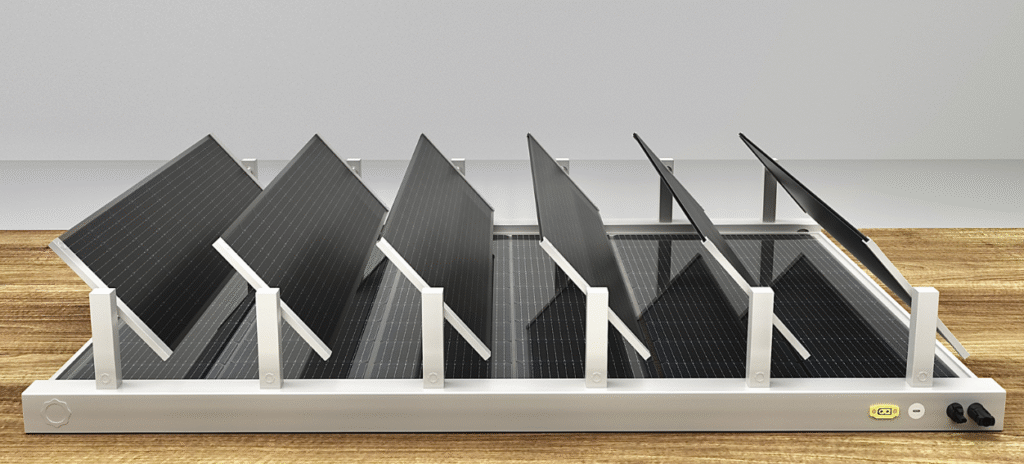
A vertically stacked photovoltaic architecture using two independently tracking layers of solar modules has demonstrated significantly higher energy capture per square meter than conventional ground-mounted arrays, according to field data from southern Italy. The system, developed by AMPS Srl and researchers at Mediterranea University of Reggio Calabria, addresses a persistent bottleneck in utility-scale solar deployment: the physical land area required to generate meaningful power.
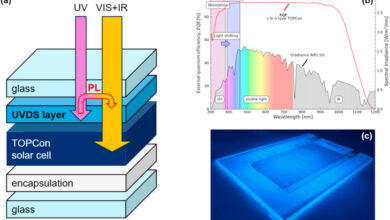
As competition for arable land intensifies between agriculture, housing, and renewable energy infrastructure, maximizing output within a fixed footprint has become a primary engineering challenge. Standard single-axis trackers, which rotate panels along one axis to follow the sun’s east-to-west arc, currently represent the dominant approach for large-scale installations seeking to boost yield over fixed-tilt systems. The newly tested double-layer configuration pushes this concept further by placing a second active surface directly beneath the first, separated by just 25 centimeters.
Field tests conducted under clear-sky conditions in Reggio Calabria revealed that when the top layer actively tracked the sun while the bottom layer remained stationary—a configuration designated as Mode 1—the dual-layer setup generated approximately 27% more short-circuit current than a single-layer bifacial reference array occupying the exact same ground space. Compared against a standard monofacial panel arrangement, the gain reached 42%. Short-circuit current serves as a direct proxy for total solar irradiance captured by the cells before inverter conversion losses are factored in.
The prototype utilized 12 custom-built bifacial TOPCon mini-modules, split evenly with six on each tier. TOPCon (Tunnel Oxide Passivated Contact) technology has rapidly displaced older PERC cells as the industry standard due to higher conversion efficiencies and better performance in low-light conditions. Bifacial modules were essential to the design because the bottom layer relies heavily on light reflecting off the ground and bouncing off the underside of the upper panels. By isolating each module electrically, the team prevented the severe mismatch losses that typically plague shaded strings in conventional commercial architectures.
Critically, the 25-centimeter vertical gap was intentionally chosen to create worst-case mutual shading. In a commercial deployment, wider spacing or optimized geometries would likely reduce these shading penalties. Each module rotated through a 180-degree arc, starting facing east at zero degrees, moving flat at 90 degrees, and finishing facing west.
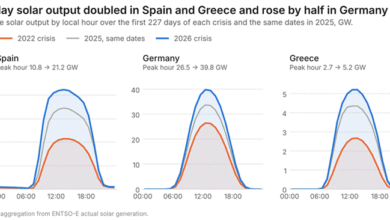
Beyond raw energy volume, the dual-layer mechanics offer a distinct advantage for electrical grid stability. Traditional solar arrays produce a sharp, narrow generation peak around midday, forcing grid operators to manage rapid ramp-ups and ramp-downs—a phenomenon widely known as the duck curve. By coordinating the angles of the two layers, operators can deliberately stagger absorption. One layer can be angled to prioritize morning or late-afternoon capture while the other handles midday flux, flattening the production profile and reducing the need for expensive battery storage to smooth out delivery.
Alternative operating modes yielded different trade-offs. When only the bottom layer tracked while the top remained fixed (Mode 2), the system still produced a 21% gain over the bifacial baseline. A fully static orthogonal arrangement (Mode 3), where both layers were locked at perpendicular angles, delivered a 14% improvement over the bifacial reference and 28% over the monofacial setup. This static mode could prove valuable for sites where mechanical tracker maintenance costs outweigh the benefits of dynamic movement.
While agrivoltaics—co-locating crops and solar panels—has gained regulatory traction globally, most existing designs elevate panels high above the ground on stilts to allow tractor access, which increases wind loading and structural steel costs. A tightly stacked, dynamically managed dual-layer system presents an alternative spatial model, though its impact on specific crop light requirements remains untested outside the laboratory environment.
The research team noted that the mechanical tracking strategy is agnostic to the underlying semiconductor material. As perovskite-silicon tandem cells move closer to commercial manufacturing, their superior efficiency in diffuse light could amplify the gains of a stacked configuration, particularly for the lower layer that operates primarily on scattered and reflected photons rather than direct sunlight.
AMPS plans to transition from the scaled prototype to a full pilot plant utilizing standard commercial modules. Future development targets include artificial intelligence-driven tracking algorithms capable of predicting cloud cover and adjusting layer angles in real time to minimize shading losses. The findings were published in the journal Renewable Energy.