
The towering 1.43:1 aspect ratio of traditional 15/70mm IMAX film has represented the absolute pinnacle of cinematic exhibition for decades. Yet the images seen by audiences come from a process built around an incredibly heavy, expensive, and notoriously loud machine: the traditional IMAX film camera.
Most of the global film industry has transitioned to silent, lightweight digital sensors, but a select group of elite filmmakers continues to champion analog large-format film. Their productions must engineer elaborate physical and acoustic workarounds because the camera produces a constant, high-pitched mechanical roar that threatens production audio on every take.
The format was originally developed in the late 1960s by Canadian inventors Graeme Ferguson, Roman Kroitor, Robert Kerr, and William C. Shaw. Unlike standard 35mm cameras, in which film runs vertically and each frame is four perforations high, IMAX 15/70 technology sends a 65mm-wide camera negative horizontally through the camera. Each frame spans 15 perforations along the edge of the film.


Conventional large-format 70mm systems such as Todd-AO, popularized in the 1950s for widescreen epics, also run vertically and use five perforations per frame. The IMAX arrangement creates an active image area approximately three times larger than a standard 65mm frame and roughly ten times larger than standard 35mm.
At the standard cinematic rate of 24 frames per second, the internal transport system advances 360 sprocket holes every second. The film moves at 5.6 feet per second, or 336 feet per minute. A standard 1,000-foot film magazine adds significant weight and bulk to the camera rig but provides only about three minutes of recording time before a complete reload is required.
The powerful motor needed to pull that physical load, along with the rapid movement of the internal movement and shutter mechanisms, creates a loud metallic rattling noise that easily overpowers on-set microphones. The mechanical rattle is only part of the camera’s acoustic footprint, however.
Because 15/70mm film is physically large, keeping the negative perfectly flat behind the lens during the exact millisecond of exposure is an engineering challenge. Film retains a slight physical curl from being tightly wound inside the feed magazine, and large-format lenses naturally produce an exceptionally shallow depth of field. Even a microscopic bend or warp as the film passes the lens gate can throw the image entirely out of focus and ruin the shot.
IMAX cameras address the problem with a specialized vacuum plate positioned directly behind the lens gate. When a frame reaches the exposure position, a built-in suction system instantly pulls the film flat against the metal plate. The continuous air-suction pump introduces a distinct, high-pitched mechanical whine, and its vacuum hiss combines with the clatter of the motor and internal gears.
Clean, usable live dialogue is therefore nearly impossible to record during filming. Historically, directors reserved IMAX film cameras for grand, sweeping landscape shots, action sequences, or stunt work where live dialogue was absent or could be masked by sound design and musical scores. Cary Joji Fukunaga’s James Bond film *No Time to Die* and Jordan Peele’s sci-fi thriller *Nope* used IMAX cameras primarily for high-energy exterior sequences.
When dialogue is required during an IMAX shot, productions rely heavily on Automated Dialogue Replacement, or ADR, often called “looping.” Actors watch the edited footage in a soundproof studio and re-record their lines to replace the noisy, camera-polluted production audio.
Crews also try to muffle the camera physically. A “barney” is a soft, insulated fabric cover zipped around the camera body to dampen high-frequency noise. For more severe sound isolation, productions use a “blimp,” a rigid, soundproof fiberglass or metal housing that completely encloses the camera.
The insulation adds a major physical penalty. A traditional 15/70mm IMAX camera inside a heavy sound blimp can weigh up to 275 pounds, requiring heavy-duty cranes, dollies, and specialized rigging. Handheld or spontaneous camera movement becomes virtually impossible for a single operator.
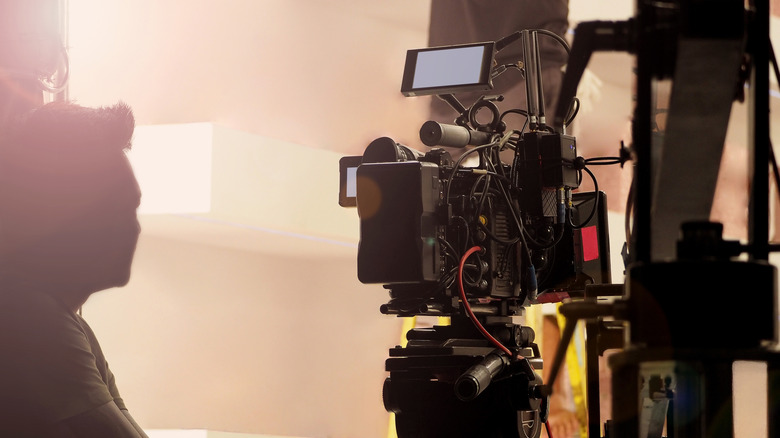
The immense cost, physical weight, and noise of analog film have led the vast majority of modern blockbusters using the IMAX brand toward digital alternatives. Under the “Filmed for IMAX” program, productions use certified large-format digital cameras from systems such as ARRI, RED, or Sony, which operate in absolute silence.
Recent productions, including *Mission: Impossible – The Final Reckoning*, use these digital systems to capture expanded 1.90:1 aspect ratio sequences. Digital capture removes the noise and weight issues, although purists argue that it lacks the organic grain, texture, and towering 1.43:1 verticality of true 15/70mm projection.
IMAX Corporation has also been working on a fleet of next-generation 65mm film cameras to preserve the future of analog film. The cameras are being developed with elite cinematographers and directors, most notably Christopher Nolan, who pioneered the modern use of the format beginning with *The Dark Knight* in 2008.
One quieter system, known colloquially as the “Keighley,” was used during production of Nolan’s project *The Odyssey*. It has a re-engineered, highly integrated blimp enclosure designed to permit synchronized production dialogue on set. The engineering successfully muffles the vacuum and mechanical noise to usable levels, but the entire integrated system reportedly weighs in excess of 300 pounds.
For the small fraternity of filmmakers dedicated to the medium, the physical and acoustic struggle remains a price worth paying. A 15/70mm projection offers unparalleled detail, color depth, and immersive scale, while the roar of the IMAX camera will echo on Hollywood sets for years to come.