
GPT-6 Astra Rolls Out With Enterprise Priority and Fast-Burning Quotas
Enterprise access leads OpenAI’s controlled GPT-6 Astra deployment
SAN FRANCISCO — OpenAI began the commercial deployment of its next-generation artificial intelligence model, GPT-6 Astra, on September 3. The rollout uses a tiered distribution framework that prioritizes high-tier enterprise accounts while applying dynamic compute rationing to consumer subscriptions and developer workloads.
Access also depends on task complexity and regional server availability. Instead of releasing Astra broadly across all subscription classes, OpenAI is controlling access as it manages infrastructure costs for its frontier models.
Corporate customers on ChatGPT Business and Enterprise accounts receive access, as do accounts enrolled in the $100-per-month and $200-per-month Pro plans. Free plans and lower-cost Go tiers are completely excluded from this deployment cycle.


The standard $20-per-month ChatGPT Plus subscription, established by OpenAI in early 2023, does not provide Astra through standard conversational Chat. Plus subscribers are instead being routed through ChatGPT Work and the developer-focused Codex environment as server capacity expands.
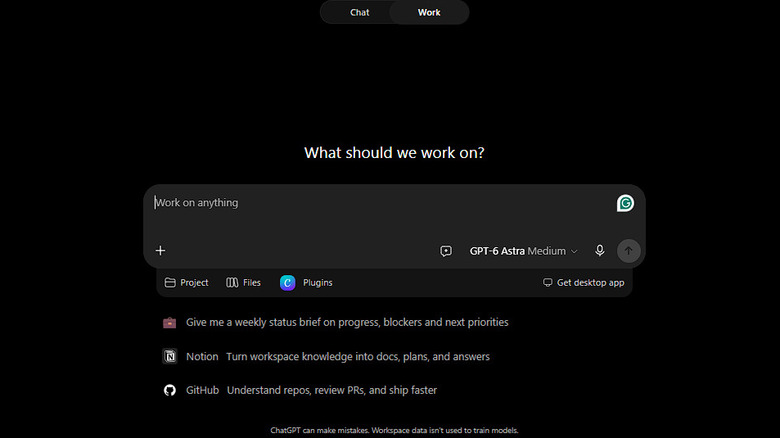
Within standard Chat, OpenAI has placed the model under the label “GPT-6 Pro” in the top model selector. Enterprise access remains dependent on organization-level permissions configured by workspace administrators.
Plus users on desktop, web, and mobile must manually switch the workspace toggle from Chat to Work before the Astra selection menu appears. Desktop software users may need to force a client update through the application menu when the new model does not display immediately.
Codex requires the Codex Command Line Interface (CLI) to be running version 0.153.0 or higher for software development workflows.
ChatGPT Work also carries specific data-handling protocols. OpenAI confirmed that local desktop files and software applications processed through ChatGPT Work continue to transmit message context and task data to remote cloud servers, where the data is stored under standard enterprise data retention policies.
GPT-6 Astra has higher reasoning capabilities and substantially higher computational overhead per query than preceding architectures such as GPT-5.6 Sol. OpenAI therefore established dynamic usage quotas based on operational complexity rather than fixed message counts alone.
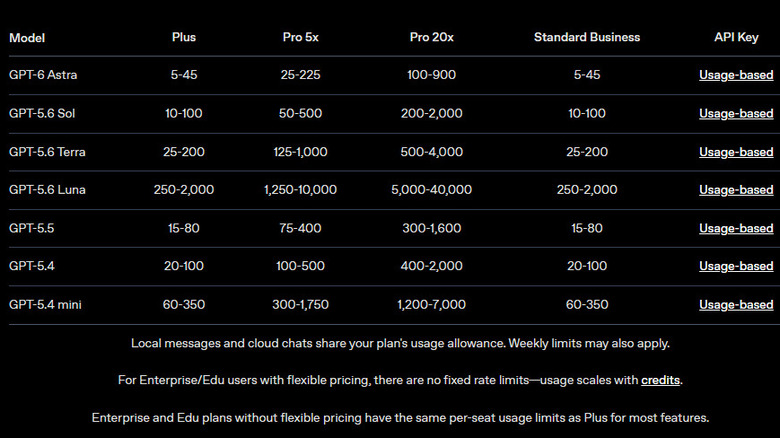
Extended reasoning, multi-step problem solving, and large context processing consume user allowances at an accelerated rate. OpenAI’s prompt engineering guidelines advise users to maintain focused prompts, limit attached file volumes, explicitly define output lengths, and establish baseline assumptions to reduce conversational iterations.
Estimated ChatGPT Plus usage ranges from 5 to 45 local Astra messages per five-hour window within ChatGPT Work. The $100 Pro Plan provides an estimated 25 to 225 local messages per five-hour window in Work. In standard Chat, $100 Pro subscribers share a total cap of 50 messages per week split between GPT-6 Pro and GPT-5.6 Sol Pro.
The $200 Pro Plan is estimated at 100 to 900 local messages per five-hour window in Work. It also includes a dedicated weekly allowance of 200 GPT-6 Pro messages in standard Chat.
User account settings display real-time message allowance tracking and quota reset schedules directly within the usage dashboard.
OpenAI has released GPT-6 Astra to third-party developers through its Application Programming Interface (API). Standard pricing is $10 per 1 million input tokens and $50 per 1 million output tokens.
API calls exceeding 272,000 total input tokens trigger an automatic surcharge because of the server infrastructure demands of large context windows. The surcharge doubles the rate for input and prompt caching while increasing output token charges by 50 percent.