What the Ground Beneath Solar Panels Could Mean for India’s Power Output
Simulations across five Indian climate zones found gains from reflective surfaces beneath bifacial panels
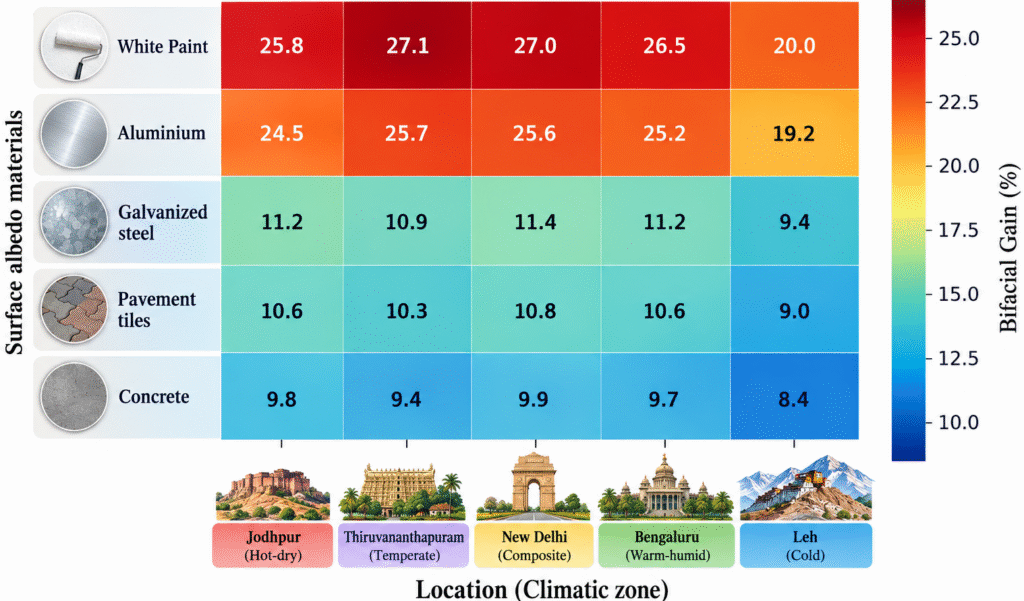
Changing the ground surface beneath bifacial solar panels could raise their electricity output by up to 27.1% compared with conventional monofacial systems, according to a study published in *Next Energy*. The researchers found a predictable, linear relationship: every 0.10 increase in ground reflectivity, or albedo, produced an approximate 2.6 percentage point increase in bifacial energy gain.
The findings come as India works toward its national climate target of installing 500 gigawatts of non-fossil fuel energy capacity by 2030. Its cumulative installed solar capacity has already surpassed 70 gigawatts, and developers seeking greater energy yields and returns on investment from limited land must adapt PV technology to conditions ranging from tropical coastlines to high-altitude cold deserts.
Leh, the high-altitude desert region in Ladakh, delivered the strongest results in the simulations. With intense solar radiation, low ambient temperatures and a highly reflective ground surface, its bifacial installation generated approximately 14.3 megawatt-hours annually and recorded the shortest carbon payback period, at 0.99 years.
Bifacial PV modules collect direct solar radiation on the front and light reflected from the ground on the rear; traditional monofacial panels collect sunlight only on their front-facing side. The collaborative team, drawn from several Indian institutions, tested that difference using simulated 6-kilowatt grid-connected PV installations in five cities representing major climate zones. Jodhpur, in western Rajasthan, represented hot-dry conditions with high solar irradiance and extreme ambient temperatures. Coastal Thiruvananthapuram, in Kerala, represented warm-humid conditions, with high humidity and significant seasonal cloud cover.
Each simulated installation used 400-watt modules paired with a 3-kilowatt inverter configuration. New Delhi represented the National Capital Region’s composite climate, with highly variable seasonal weather and air pollution; Bengaluru, on the Deccan Plateau, represented a temperate climate with moderate temperatures and stable weather patterns. To isolate weather and ground-surface effects, every array faced south, stood 1.5 meters above the ground and had 5 meters between rows. The simulations included a 2% module mismatch loss and a 1.5% direct current (DC) wiring loss.
Tilt was optimized for each site’s latitude, from 11 degrees in Thiruvananthapuram to 34 degrees in Leh, where the steeper angle captures the lower winter sun at higher latitudes. The five modeled surfaces were concrete, with an albedo of 0.30; pavement tiles, 0.33; galvanized steel, 0.35; aluminum, 0.85; and white paint, 0.90. Compared with standard concrete, high-reflectance covers such as aluminum and white paint increased annual generation by 13% to 16%. Under optimal high-albedo conditions, the levelized cost of electricity (LCOE) fell by 4% to 7%, making the technology highly competitive with traditional energy sources.
Higher albedo also reduced the systems’ lifetime greenhouse gas intensity by 10% to 14% when ground reflectivity rose from 0.30 to 0.90. Across all modeled sites, the carbon payback period fell by 13% to 21%. That period measures how long a clean energy system takes to generate enough zero-carbon electricity to offset emissions from its manufacturing and installation.
Leh’s cold-dry conditions helped limit a separate source of lost output. High operating temperatures reduce the open-circuit voltage of silicon solar cells, causing thermal degradation of power output. Lower ambient temperatures allow modules to operate closer to peak efficiency while benefiting from the region’s intense high-altitude irradiance and elevated ground reflectivity.
Corresponding author Mobi Mathew said the ground around a bifacial array should be treated not as a passive site feature but as an active, controllable engineering parameter, optimized alongside module tilt and spacing. The team plans first to establish concrete empirical equations linking albedo to key bifacial performance metrics under diverse Indian weather conditions. A second phase will combine technical energy output, exergy — the useful work potential of the energy produced — economic feasibility and lifecycle environmental impacts across different surfaces and climates.
Researchers in the collaborative study came from the Nehru College of Engineering & Research Center, the Hariterde International Council of Circular Economy Research (HICCER), SR University, Indira Gandhi National Open University, and Saintgits College of Engineering.