U.S. EV Supply Crunch Leaves Drivers Trapped by $100 Oil
Production cuts following the 2025 tax credit repeal left dealerships unable to meet demand when the Iran conflict spiked fuel costs.
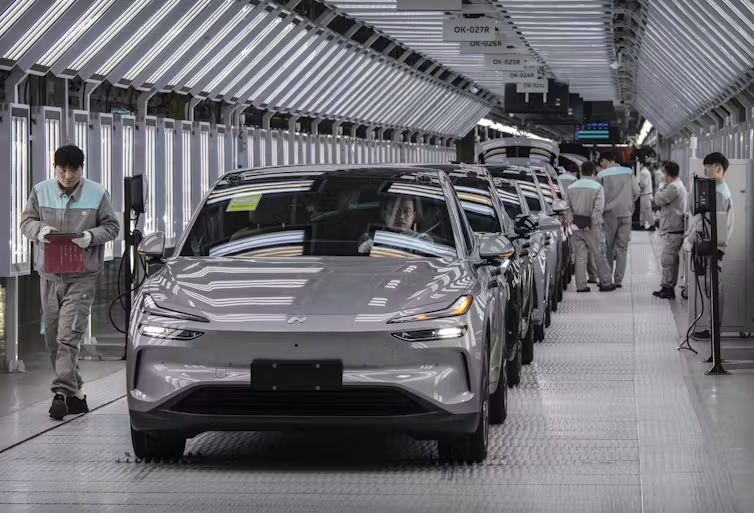
American drivers are paying a steep price for an auto industry that dismantled its electric vehicle manufacturing base just months before the Persian Gulf war sent oil above $100 a barrel.
The supply deficit is no longer theoretical. New EV inventories collapsed from roughly 130 days of supply in early 2026 to 78 days by August, according to industry data. That leaves U.S. consumers entirely exposed to global energy markets with almost no affordable battery-powered alternatives on dealer lots.
This shortage traces directly to corporate retreats triggered by the tax and spending law President Donald Trump signed in July 2025. The legislation eliminated federal EV tax credits — previously up to $7,500 for new vehicles and $4,000 for used ones — after Sept. 30, 2025. Automakers immediately slashed production. General Motors laid off more than 3,400 workers at its EV and battery plants, redirecting its Tennessee facility toward energy storage batteries rather than cars. Ford wrote off $19.5 billion from its EV division, killed the all-electric F-150 Lightning, and converted a Tennessee plant back to gas-powered trucks.


When U.S. and Israeli strikes hit Iran on Feb. 28, 2026, gasoline jumped from $2.94 to $4.35 a gallon within three months. Buyers rushed dealerships looking for electric options, only to find empty lots. Diesel hit a record $6.52 a gallon on Sept. 22.
Toyota, which sells about half of all hybrids in the United States, had spent years expanding hybrid production. Hybrid inventories sat 19% higher in March 2026 compared with a year earlier. Consumers bought what was physically available. Hybrid sales climbed 18% from March through May 2026 compared with the same period in 2025. Fully electric vehicle sales fell 16% over those same months — not because buyers rejected them, but because automakers stopped building them.
Used EV prices surged 13% through late June 2026, adding roughly $3,500 to the cost of a typical model, according to market data. Battery and used EV tracker Recurrent reported the price of a used 2023 Chevrolet Bolt rose almost 20% between January and June. Used EV inventory dropped to 31 days of supply in May, down 23% year-over-year.
Dealer discounting vanished as leverage shifted entirely to sellers. An analysis of online listings from marketcheck.com showed the median new EV was listed 9.8% below sticker price in February. By April, that discount narrowed to 6.6%, and by June it was 4.7%.
The average new car now sells for about $50,000, while the average new EV costs roughly $55,000, according to Kelley Blue Book.
Washington continues to tighten the supply constraints. A fuel economy rule released Sept. 28, 2026, loosens efficiency requirements for gas-powered vehicles and eliminates a credit-trading system in 2028 that previously allowed EV makers to sell compliance credits to lagging automakers. Regulators claim the rollback will save buyers $1,289 on a new gas-powered vehicle’s purchase price. Their own analysis estimates drivers will spend about $1,600 more on fuel over the vehicle’s lifespan, using projections well below current pump prices.
Imports cannot fill the gap. Tariffs exceeding 100% block Chinese EVs, and a Commerce Department rule prohibits cars from Chinese-linked automakers starting with model year 2027, even if assembled domestically. Pending legislation would ban Chinese investment in U.S. auto factories outright. In 2024, Chinese buyers chose from over 130 EV models priced under $40,000. American buyers had four.

Argonne National Laboratory data shows 86,000 EVs sold in August, down from 101,000 in May. Hybrid sales remained above 216,000 a month throughout the summer.