Houthi Strikes Cancel Saudi Summit as Abu Dhabi Courts Tech Cash
Riyadh airport closures trigger mass cancellations while Abu Dhabi signs Databricks and Viasat expansion deals.

Wall Street executives refused to board planes to Riyadh this week. Their decision forced the postponement of Saudi Arabia’s Future Investment Initiative, the kingdom’s premier annual gathering for global capital, according to reporting by Semafor.
The cancellation followed a wave of Houthi attacks that closed Riyadh’s main airport and wiped out an estimated 5,500 departing flights across all Saudi airports. Charter operators immediately capitalized on the panic. The Financial Times reported that private jet prices out of the kingdom surged more than 50%. A single flight from al-Qassim airport north of Riyadh to Geneva sold last week for €94,000 ($105,000), up from roughly €60,000 ($67,000) before the airport closure.
Saudi sovereign fund PIF governor Yasir Al-Rumayyan was among the organizers who received the safety warnings from financiers. The fallout extended well beyond the investment conference. The European Union and Gulf states postponed a joint summit scheduled for this week, and the Six Kings Slam tennis tournament featuring Carlos Alcaraz, Novak Djokovic, and Alexander Zverev was also shelved. The Asian Tour stated it is “closely monitoring the situation in Saudi Arabia” ahead of the PIF Saudi International golf tournament planned for Nov. 18-21 at Riyadh Golf Club.

A Reuters investigation detailed the scope of the campaign threatening these assets, finding that Iran and its allied militias carried out at least 135 missile and drone attacks on 84 infrastructure sites across seven Gulf countries. The strikes deliberately targeted oil terminals, refineries, gas plants, airports, data centers, and water facilities. Reuters cited unnamed sources stating that Iran may have received intelligence from Russia and China, relying on networks of informants with access to sensitive sites. Gulf governments frequently downplayed the damage or attributed it to intercepted missile debris, according to the investigation.
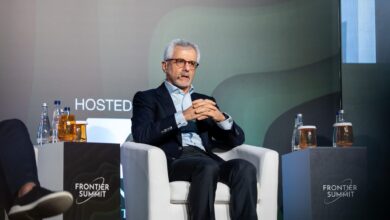
While Riyadh manages cancellations and evacuation logistics, Abu Dhabi spent the week signing deals. Roughly 200 founders, investors, and sovereign wealth representatives gathered at the Frontier Summit hosted by U.S. investment firm Goanna Capital. Representatives from Mubadala, Majid Al Futtaim Group, ADNOC Group, Databricks, Snowflake, and Space42 attended.
Goanna Capital used the event to announce its first international office in Abu Dhabi Global Market (ADGM). U.S. cloud computing and data company Databricks followed with plans to open an Abu Dhabi office in February next year, according to regional vice president for the Middle East and Africa Richard Wylie. The formal announcement is expected in December.
Databricks will relocate a team of over 60 people currently covering the MEA region from Europe and intends to more than double that headcount over the next 12 months. Wylie said the company serves “hundreds” of customers across the region, including Qatar and Saudi Arabia, spanning retail, financial services, telecoms, energy, aviation, automotive, and government sectors. Clients include Al-Futtaim Group, Etihad Airways, and MBC Shahid. Seventy percent of Databricks’ clients globally are Fortune 500 companies, and it maintains offices in 19 countries.
The expansion builds on a $5 billion funding round Databricks closed in August at a $190 billion valuation. UAE-based technology investor MGX jointly led the round alongside Coatue, Blackstone, T Rowe Price, and new investor Sixth Street Growth.
Physical infrastructure requirements for that digital growth are reshaping how Abu Dhabi manages basic resources. Dr Abdulla Saif Al Jarwan, chairman of the Abu Dhabi Department of Energy, wrote in an op-ed for Fortune that power, water, and grids must be coordinated as a single system. “A data center needs electricity, but it also needs water for cooling. A desalination plant provides water while also creating energy demand,” Al Jarwan noted.
The IEA estimates that data center electricity demand rose 17% in 2025, with AI-focused facilities seeing demand increase by around 50%. The UAE and Senegal are set to co-host the United Nations Water Conference in Abu Dhabi this December.
Space42 Managing Director Karim Sabbagh told attendees at the Frontier Summit that his company is pursuing commercial partnerships to reduce its reliance on state contracts. Government clients currently account for approximately 80% of Space42’s revenue, with commercial customers contributing the remaining 20%. The company, backed by the Abu Dhabi sovereign wealth fund Mubadala and International Holding Company, announced last month a partnership with U.S. communications company Viasat to establish Equatys.
Viasat and Space42 committed $1 billion to Equatys, which is scheduled to start operations in 2029. The venture aims to provide global satellite-to-device connectivity for standard smartphones and IoT devices using shared infrastructure, contrasting with SpaceX’s Starlink model. Sabbagh added that Space42 remains open to acquisitions in complementary areas such as geospatial intelligence.
Dubai is simultaneously pouring $1.4 billion into a new financial district named the Water Gardens. Construction has begun on the project, which includes two hotels alongside residential and office towers, targeting completion before the end of 2028.