The Rural AI Data Center Boom Could Leave a Silicon Belt Behind
AI infrastructure investment is moving into rural markets as technology changes faster than the buildings can adapt
NEW YORK — Demand for digital infrastructure has pushed North American data center vacancy rates to a historic low of 1%, according to a market report by Chicago-headquartered commercial real estate services firm Jones Lang LaSalle (JLL). Data center operators contracted for a record 25 gigawatts of electric generating capacity during the first six months of 2026, approximately 5% of the total annual electricity generated across the United States.
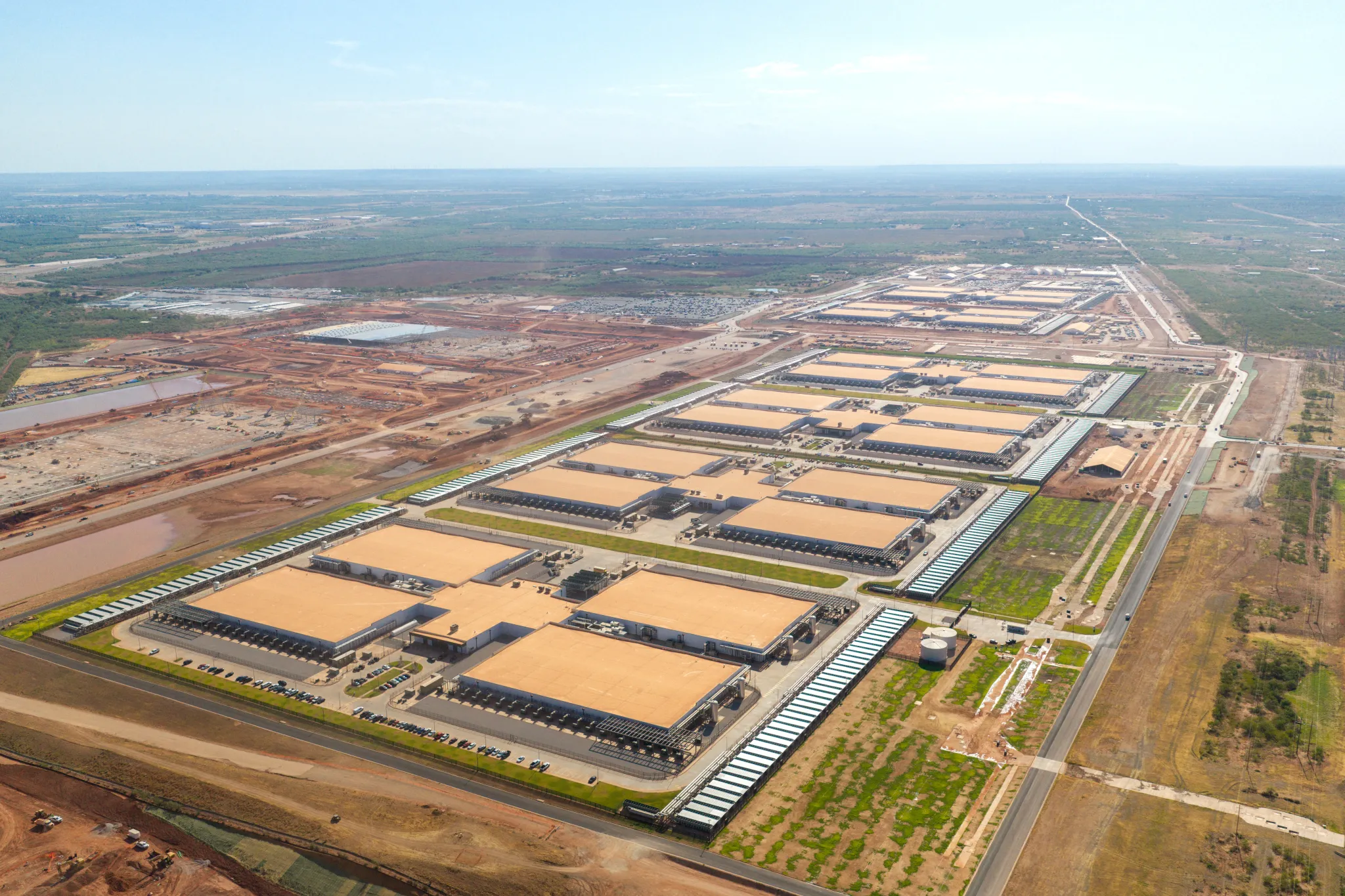
The expansion is moving beyond established technology hubs. Northern Virginia’s “Data Center Alley” faces acute power shortages and grid constraints, while 77% of the data center construction pipeline has shifted toward “frontier” markets, JLL reports. Those locations include rural West Texas, northeast Louisiana, and rural areas east of Columbus, Ohio. The movement is backed by an estimated $7 trillion in global financing and investment earmarked for digital infrastructure and energy generation.
A trillions-of-dollars financing boom aimed at building massive artificial intelligence data centers in rural America is raising concerns among municipal finance experts and real estate analysts. Technology giants are racing to secure land and electricity, but the structured financial models funding the projects, combined with rapid technological obsolescence, risk shifting the long-term economic liabilities of vacant real estate onto public pension funds and local taxpayers.


The physical shell of a concrete data center is built to last 30 to 60 years. Its internal components degrade or become obsolete much sooner: servers and networking hardware typically last 3 to 6 years, cooling systems and electrical architecture last 7 to 15 years, and functional facility design lasts 10 to 15 years.
Technology companies are increasingly using off-balance-sheet joint ventures and short-term leases to avoid carrying depreciating real estate on their books. Meta Platforms Inc.’s $27 billion Hyperion data center project in Richland Parish, located in northeast Louisiana, is a prominent example.
Meta funded the development through a joint venture with Blue Owl Capital, a New York-based alternative asset manager with more than $165 billion in assets under management. Blue Owl holds an 80% equity stake in the venture, which issued bonds to finance construction and thereby kept the massive debt off Meta’s corporate balance sheet.
The financing arrangement does not eliminate the exposure created by the facility. Meta will occupy it under a four-year lease, with options to extend the lease up to 16 years, supported by a residual value guarantee. If the facility’s design becomes obsolete before the lease term concludes, or if the joint venture defaults, the financial exposure falls heavily on bondholders, which often include public pension funds seeking stable yield, and on local municipalities that provided tax abatements, utility infrastructure, and zoning concessions.
The speed of change in artificial intelligence adds to the uncertainty. Epoch AI, a research organization that tracks progress in artificial intelligence, reports that the computational power used to train leading AI supercomputers has been doubling approximately every nine months. That rate is faster than Moore’s Law, the historical benchmark coined by Intel co-founder Gordon Moore in 1965, which projected that the number of transistors on a microchip would double roughly every two years.
Power requirements have changed with the computational leap. Five years ago, a conventional data center server rack drew between 5 and 10 kilowatts of power. Today, high-density AI clusters require 100 to 250 kilowatts per rack, and JLL has tracked project proposals requesting up to 600 kilowatts per rack.
The resulting heat requires a move from traditional air-cooling units to complex liquid-cooling systems, including direct-to-chip piping or immersion cooling. Buildings engineered for the air-cooled systems of 2020 often cannot be retrofitted for high-density liquid cooling without cost-prohibitive structural reconstruction.
The financial concerns recall the industrial expansion that built the American Rust Belt in the early and mid-20th century. Manufacturing companies constructed specialized factories in towns across the Midwest and Appalachia, creating short-term economic booms. Globalization and automation later rendered those facilities obsolete.
Youngstown, Ohio, continues to struggle with the fiscal fallout of the “Black Monday” steel mill closures of 1977, which caused devastating job losses. Gary, Indiana, also remains affected by vacant, highly specialized industrial ruins.
A comparable infrastructure overbuild occurred during the dot-com boom of the late 1990s. Telecommunications firms such as Global Crossing and WorldCom raised billions of dollars to lay millions of miles of fiber-optic cables across the globe. Rapid advances in optical transmission technology then allowed existing cables to carry far more data than previously possible.
The increase in efficiency produced a massive oversupply of communications capacity. Billions of dollars of “dark fiber” remained buried underground, and major telecom operators were forced into bankruptcy. A decommissioned 54,000-square-foot underground communications center in Nebraska, originally built by AT&T and equipped with its own cell tower, was recently listed for sale at $7.95 million—a small fraction of its historical inflation-adjusted construction and equipment costs.
The underlying economic driver is known as the Jevons Paradox. English economist William Stanley Jevons formulated the paradox in his 1865 book *The Coal Question*. It states that technological progress increasing the efficiency of a resource tends to increase, rather than decrease, overall consumption of that resource because cheaper production drives up demand.
Research from OpenAI indicates that between 2012 and 2019, the amount of compute required to train a neural network to a fixed ImageNet benchmark fell by a factor of 44. Under the Jevons Paradox, cheaper computing produced by greater software and hardware efficiency is accompanied by projected exponential growth in global demand for computing capacity and continuous infrastructure expansion.
Intense competition to build the most capable AI models compels companies to keep constructing facilities for next-generation silicon, even when existing structures are rendered obsolete. Unlike standard commercial real estate, such as logistics warehouses that require high ceilings, multiple loading docks, and wide truck courts, decommissioned data centers are highly customized.
These facilities contain reinforced concrete walls, heavy electrical switchgear, and dedicated power substations in remote rural areas. They cannot easily be converted for retail, housing, or general logistics use. A sudden tenant departure can leave local governments with large, empty concrete shells that generate little economic activity or tax revenue, creating the potential for a “Silicon Belt” of abandoned tech infrastructure across the American landscape.