

The Math Behind a Self-Sufficient Solar RV
How battery storage, energy calculations, and sunlight conditions determine an RV solar system
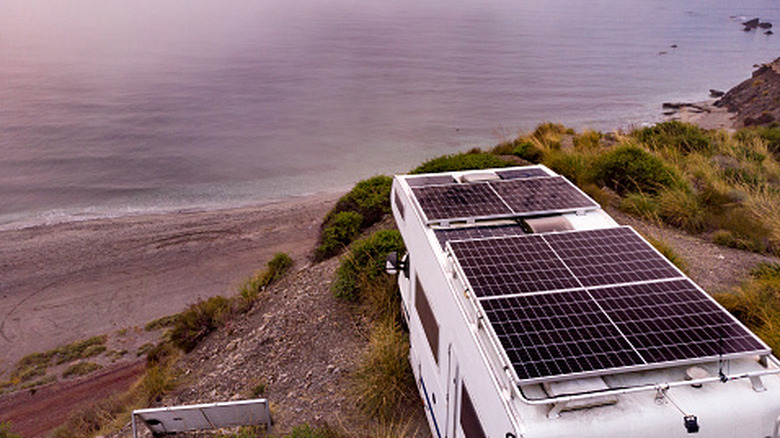
Determining the scale of an RV solar installation begins with a rigorous energy budget. Owners must identify the wattage of every onboard device, including GPS units and charging hubs as well as high-draw appliances such as portable space heaters, induction cooktops, and microwaves. If an appliance label lists only electrical current in amps and voltage, multiplying volts by amps gives the device’s wattage.
That planning is increasingly relevant as the appeal of “boondocking”—camping off the grid on public lands without municipal water or electrical hookups—continues to grow. Travelers are looking for alternatives to crowded campgrounds and the constant drone of traditional gas-powered generators, pushing solar technology from a niche hobby toward a mainstream RV standard.



Daily energy consumption is measured in watt-hours, calculated by multiplying each appliance’s wattage by its run time. A 1,500-watt appliance operating for 10 minutes, or one-sixth of an hour, consumes approximately 250 watt-hours. Adding those individual demands establishes the baseline daily power requirement that the solar array must generate and the battery bank must store.
The move toward mobile power is part of a broader international expansion of consumer-scale renewables, including the rapid adoption of plug-in balcony solar kits in the United Kingdom and Europe. On the road, the engineering challenge is more complex because an RV solar installation must function as a closed-loop system rather than remain connected to a municipal grid.
Complete energy independence on the road requires a synchronized three-part architecture: a battery bank for storage, a charge controller to manage power flow, and an inverter to translate harvested energy into usable electricity. The battery bank stores the direct current (DC) electricity generated by the panels and acts as the system’s heart.
Traditional deep-cycle lead-acid or Absorbent Glass Mat (AGM) batteries were long the industry norm. Modern installations increasingly use Lithium Iron Phosphate (LiFePO4) batteries because they offer longer lifespans and deeper discharge thresholds. RV appliances, meanwhile, typically run on standard 120-volt alternating current (AC), so an inverter must convert stored 12-volt or 24-volt DC power.
System designers recommend sizing the inverter to handle at least 1.25 times the maximum peak wattage the RV might draw at any single moment. A charge controller regulates the voltage and current moving from the panels to prevent overcharging and damage to the battery bank, using either Pulse Width Modulation (PWM) or more advanced Maximum Power Point Tracking (MPPT) technology.
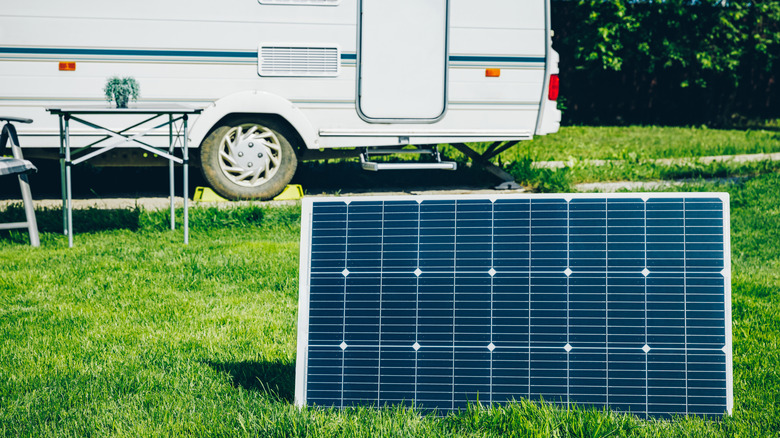
Hardware calculations must also account for the fact that physical and environmental conditions keep solar panels from operating at their theoretical maximum output. Cloud cover and travel through forested areas with dense tree canopies reduce sunlight exposure, while temperature affects photovoltaic efficiency as well.
Solar panels are semiconductor devices, and their voltage drops as they get hotter, reducing overall power output. Bright but cold days therefore produce the highest electrical efficiency, whereas hot summer days can significantly degrade performance.
For that reason, a standard 100-watt solar panel does not generate 100 watts continuously. In the United States, average daily peak sun hours range from three to five hours depending on the region and season. Under typical conditions, after accounting for weather fluctuations and sun angles, one 100-watt panel can be expected to yield about 350 watt-hours of energy per day.
Experienced off-grid system designers use the “20 percent rule” to create a margin of safety against those environmental limits. The engineering safety factor requires a solar array to be sized to generate 20 percent more power than the vehicle’s calculated daily electrical consumption, helping the system sustain vital RV operations during consecutive days of sub-optimal sunlight.
For many moderate travelers, a 400-watt solar array has become the standard entry point. It provides a versatile baseline that balances roof space constraints with the power demands of modern mobile living.